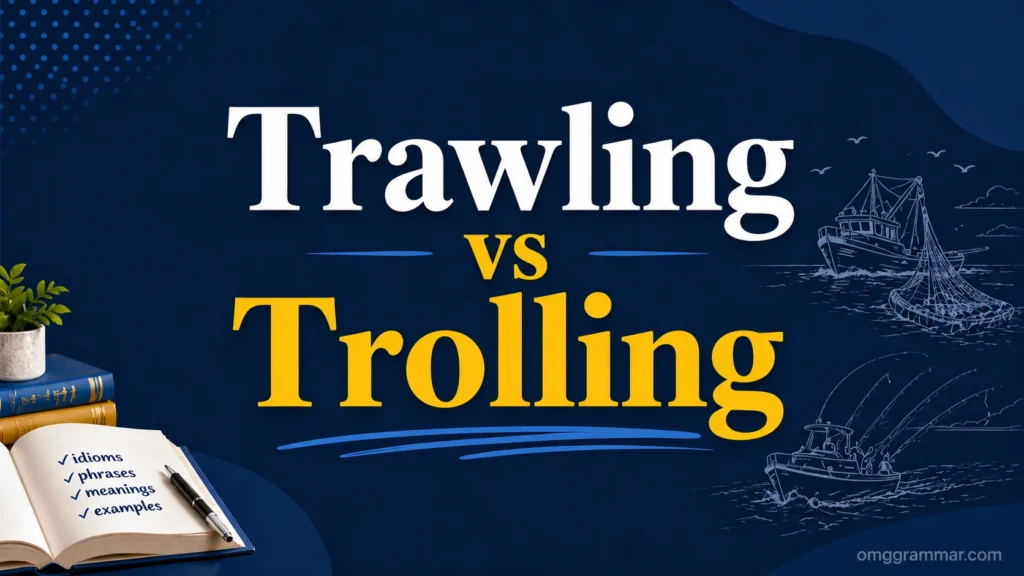
Trawling usually means dragging a fishing net through water or searching carefully through lots of information, while trolling usually means provoking people online or using a baited fishing line that moves through water. The words sound similar, but they belong to different ideas and different contexts, so the choice depends on what the sentence is really about. In modern English, trawling often appears in fishing, research, journalism, and data searches, while trolling appears in social media, gaming, and public arguments.
The key difference is that trawling suggests systematic searching, while trolling suggests baiting, provoking, or fishing with a moving lure. That distinction matters because one word describes careful collection and the other often describes nuisance or deliberate mischief. In editing work, I see this confusion most in headlines and online writing, where writers reach for the word that sounds right instead of the one that matches the action.
What Do Trawling and Trolling Mean?
Trawling means dragging a net through water to catch fish, or moving through a large amount of material in search of something specific. Trolling means fishing with a baited line that is pulled through water, or online behavior meant to provoke, upset, or annoy other people.
TL;DR: Trawling is about sweeping or searching; trolling is about baiting, provoking, or fishing with a moving lure. The overlap in sound causes confusion, but the meanings are not interchangeable.
That split explains most of the confusion. Trawling is broad and methodical. It suggests coverage, search, and collection. Trolling is narrower and more charged: it can describe fishing technique, but in everyday speech it usually points to online provocation. In newsroom copy, business reports, and research notes, trawling often fits better because the writer is describing a careful scan through many items. By contrast, trolling usually belongs to internet culture, comment threads, or the fishing sense with the lure moving behind a boat.
How Do Trawling and Trolling Differ in Practice?
Trawling and trolling differ in both movement and purpose. Trawling covers an area in a sweeping way, while trolling relies on a baited line or a provocative act that tries to trigger a reaction.
Correct Usage Examples
- The crew was trawling the bay at dawn.
This works because trawling names a fishing method that uses a net. - I spent an hour trawling through old emails.
Here, trawling means searching carefully through a large set of material. - The journalist was trawling public records for clues.
This is a strong metaphor because it suggests a wide, methodical search. - He was trolling for tuna near the coast.
This fits the fishing sense of trolling, where a line or lure moves through the water. - She accused him of trolling in the comments.
That use is modern and clear because trolling means deliberate online provocation.
When I edit online headlines, this is where writers most often blur the line: they describe a search, but write trolling instead of trawling. The problem usually comes from sound, not meaning.
Incorrect Usage Examples
- Incorrect: He was trolling the archives for answers.
Correct: He was trawling the archives for answers.
Why: Searching through records is trawling, not trolling. - Incorrect: The boat was trolling a heavy net.
Correct: The boat was trawling a heavy net.
Why: A net dragged through water is trawling. - Incorrect: They were trawling people in the chat.
Correct: They were trolling people in the chat.
Why: Provoking people online is trolling. - Incorrect: She was trolling through the database.
Correct: She was trawling through the database.
Why: Careful searching fits trawling better. - Incorrect: The article described internet trawling.
Correct: The article described internet trolling.
Why: Online harassment or baiting is trolling.
Context Variations
In fishing, both words can appear, but they describe different methods. Trawling usually means a net is involved, while trolling usually means a baited line is moving behind a boat. In online writing, though, trolling has taken on the dominant meaning of provocation, and trawling is the word for searching through material.
In formal writing, trawling often feels neutral and descriptive. Trolling, by contrast, can sound negative because it often points to disruptive behavior. That contrast is useful in editorial work, where precision matters more than clever phrasing.
Where Does the Confusion Between Trawling and Trolling Come From?
The confusion comes from sound, shape, and a shared fishing history. Both words are close in pronunciation, both have fishing roots, and both can involve movement through water.
TL;DR: The confusion survives because the words look and sound alike, but modern usage split them apart. Trawling became the word for searching or dragging a net, while trolling became the word for baiting or provoking.
That overlap makes the mistake easy to understand. Writers often remember only the fishing image and then pick the wrong word for search, comment threads, or headlines. In my editing work, this mistake appears most in social posts, casual news copy, and student writing, where speed matters more than precision. The pattern is simple: if the action is searching broadly, use trawling; if the action is baiting or provoking, use trolling.
A Simple Memory Trick for Trawling vs Trolling
A practical way to remember the difference is to link trawling with a trail through water or text. Both suggest moving across a wide area in a sweeping way. Then link trolling with a troll online, because a troll tries to provoke a reaction.
A technique I often give junior editors is to ask whether the sentence sounds like search or bait. If it sounds like search, trawling is usually the better choice. If it sounds like a deliberate attempt to annoy, trolling is the word you want.
What Do the Words Mean in Different Contexts?
The meaning changes slightly by setting, but the core contrast stays the same. In fishing, trawling is net-based and trolling is lure-based. In digital writing, trawling often means searching across many items, while trolling usually means provoking people on purpose.
Context decides which word fits. Fishing, research, and online behavior all use the same pair, but each field gives the words a different job.
That is why a sentence like “He spent the afternoon trawling forums” sounds natural, while “He spent the afternoon trolling forums” sounds like he was baiting people instead of searching. The same pattern appears in workplace writing, where someone might trawl through documents, data, or emails. Meanwhile, trolling usually belongs to comments, posts, and conflict-heavy spaces.
Common Trawling and Trolling Mistakes
| Error Pattern | Incorrect | Correct |
| Search meaning swapped | trolling through documents | trawling through documents |
| Online provocation swapped | trawling in the comments | trolling in the comments |
| Fishing net confusion | trolling a fishing net | trawling a fishing net |
| Lure-based fishing confusion | trawling for tuna | trolling for tuna |
| General browsing error | trolling the web for sources | trawling the web for sources |
These mistakes happen because the words are close in sound and both have older fishing links, so the brain reaches for the familiar shape instead of the right action. The errors cluster most in fast drafting, headlines, captions, and informal notes, where writers do not pause to ask whether the sentence means searching, fishing, or provoking. Across the table, the pattern is consistent: trawling is about sweeping search or net drag, while trolling is about bait, provocation, or lure-based movement.
Why Does Trawling and Trolling Sound So Similar?
The words sound similar because they share a fishing background and a close rhythm in speech. That similarity makes them easy to mix up, especially in quick reading or typing.
Still, the best cue is the action. If someone is gathering information, scanning records, or sweeping through a lot of material, trawling fits. If someone is provoking, baiting, or using a lure that moves through water, trolling fits. Once the action is clear, the spelling usually follows.
Conclusion
Trawling or trolling becomes easy once you attach each word to its core action. Trawling is for sweeping search or net fishing, while trolling is for baiting, provoking, or lure fishing. That single split solves most confusion, especially in writing where the meanings can drift together. In practice, the safer choice is the word that matches the motion: search for trawling, bait for trolling. Editors notice this difference quickly because it changes tone, not just spelling.
Frequently Asked Questions
Trawling means sweeping through water or information; trolling means baiting, provoking, or using a moving fishing lure.
Trawling is usually correct. It suggests a careful search through many items, pages, or records.
Not always. In fishing, trolling is a neutral technique. In online use, it usually means provoking people.
Yes. Trawling uses a net, while trolling uses a baited line or lure pulled through the water.
They sound similar, and both have fishing roots. That makes the wrong word easy to choose in a hurry.
Think of trawling as a sweeping trail and trolling as a troll trying to provoke a reaction.