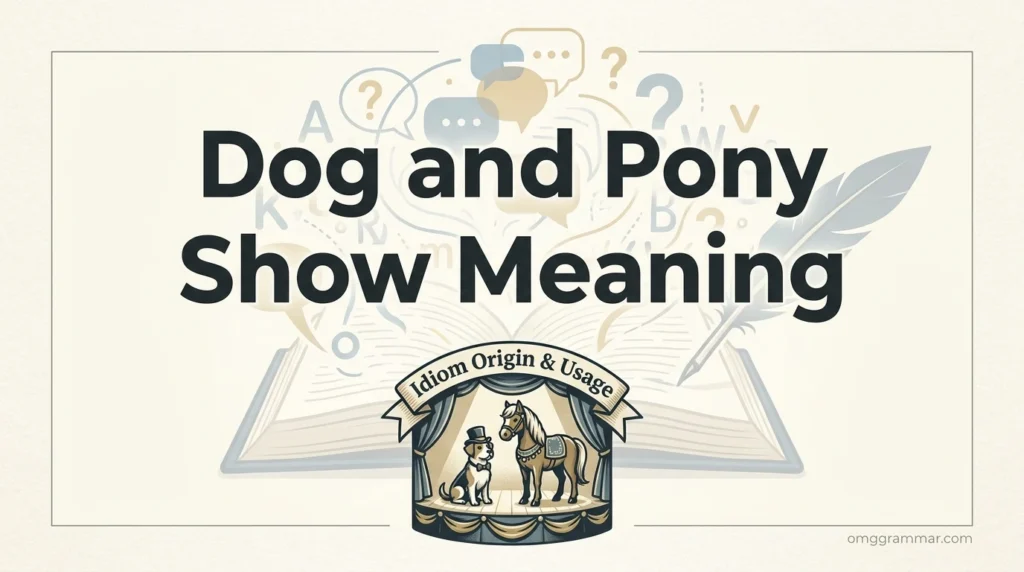
“Dog and pony show” means an event, presentation, or display designed to impress people, often with more style than real substance. It suggests something staged, polished, and sometimes exaggerated to win approval rather than to show true value. The phrase can be neutral in light contexts, but it often carries a slightly critical tone. In modern English, it is commonly used for business presentations, marketing events, or political appearances that feel overly performative. The meaning is simple, but the tone matters a lot when you use it.
What does “dog and pony show” mean?
A dog and pony show is a performance or presentation meant to impress an audience, sometimes more for appearance than for real content.
The phrase usually implies that something looks better than it truly is. It suggests effort has gone into making the event appealing, even if the substance is limited.
In business writing, I often see this used in internal emails after a flashy presentation that did not deliver clear results. The word choice signals quiet skepticism without a long explanation.
TL;DR: A dog and pony show is a showy presentation that may focus more on impressing than on real value.
Is it always negative?
Not always, but it is often slightly critical. The phrase usually hints that the event is more about display than substance.
In casual use, it can be neutral or even playful. Someone might use it to describe a fun but over-the-top presentation without strong criticism.
In professional contexts, however, it often carries doubt. It suggests that the effort went into style rather than meaningful results.
Where does the phrase come from?
The phrase comes from small traveling shows in the past that featured trained dogs and ponies. These shows were designed to entertain and attract attention.
Over time, the meaning shifted from literal performances to figurative ones. Now it refers to any display that is carefully staged to impress.
This origin explains why the phrase feels visual and lively. It carries the idea of tricks, routines, and audience reactions.
When should you use this phrase?
Use dog and pony show when you want to describe something that feels staged, polished, or overly focused on appearance.
It works well in casual conversation, commentary, and some business discussions. In formal writing, it may sound too informal or slightly sarcastic.
In editing reports, I sometimes replace this phrase with “overly staged presentation” when a neutral tone is required. The idiom is clearer, but not always appropriate for every audience.
Examples of “dog and pony show”
Examples help show how tone changes meaning. The phrase often depends on context and attitude.
Correct usage
- “The sales team put on a dog and pony show for the clients.” — suggests a polished but possibly shallow presentation.
- “It felt like a dog and pony show rather than a serious meeting.” — shows mild criticism.
- “The event was a full dog and pony show, with lights, music, and scripted lines.” — emphasizes performance.
- “They gave us a dog and pony show, but we still need real data.” — contrasts style with substance.
- “The launch looked impressive, but some called it a dog and pony show.” — balanced tone.
Incorrect usage
- Incorrect: He dog and pony show the report.
Correct: He turned the report into a dog and pony show.
Why: the phrase is a noun, not a verb. - Incorrect: The dog and pony show are effective data.
Correct: The dog and pony show was effective as a presentation.
Why: it refers to a presentation, not data itself. - Incorrect: She is dog and pony show.
Correct: She organized a dog and pony show.
Why: the structure must match a noun phrase.
Context variations
In casual speech, the phrase can sound humorous. It may describe something flashy without strong judgment.
In business contexts, it often signals doubt. The speaker may feel the presentation lacked depth or honesty.
In media commentary, it can be sharper. Writers may use it to criticize political events or corporate displays.
Common mistakes with “dog and pony show”
The main mistake is using the phrase without understanding its tone. It is not just about presentation; it also suggests a lack of substance.
Another mistake is forcing it into verb form. The phrase works as a noun, so the sentence structure must reflect that.
TL;DR: Use dog and pony show as a noun for a showy presentation, often with a slightly critical tone.
| Error Pattern | Incorrect | Correct |
| Wrong part of speech | he dog and pony show the plan | he made it a dog and pony show |
| Neutral meaning misuse | it was a dog and pony show of accurate data | it was a flashy presentation of data |
| Missing tone awareness | used in formal report without context | replaced with neutral wording |
| Structure error | she is dog and pony show | she ran a dog and pony show |
These mistakes often appear when writers focus on the words but miss the tone behind them.
How do you remember this phrase?
Picture a small show with trained animals performing tricks. The focus is on entertainment and audience reaction.
That image helps you remember the meaning. The phrase is about performance first, and substance second.
In teaching notes, I often ask students to imagine a meeting that looks exciting but leaves them with no clear answers. That feeling matches the phrase well.
Conclusion
A dog and pony show is a presentation designed to impress, often with more style than real substance. The phrase is vivid and useful, but it carries a tone of doubt or criticism.
Use it when you want to highlight performance over value. In more formal contexts, consider a neutral alternative if tone matters.
Frequently Asked Questions
It means a showy presentation meant to impress, often with less real substance behind it.
Often yes. It usually suggests something is more about appearance than real value.
It is better to avoid it in formal writing. The phrase can sound informal or slightly critical.
It is common in business talk, media commentary, and casual conversation.
Yes. Its meaning is figurative and not based on the literal words.