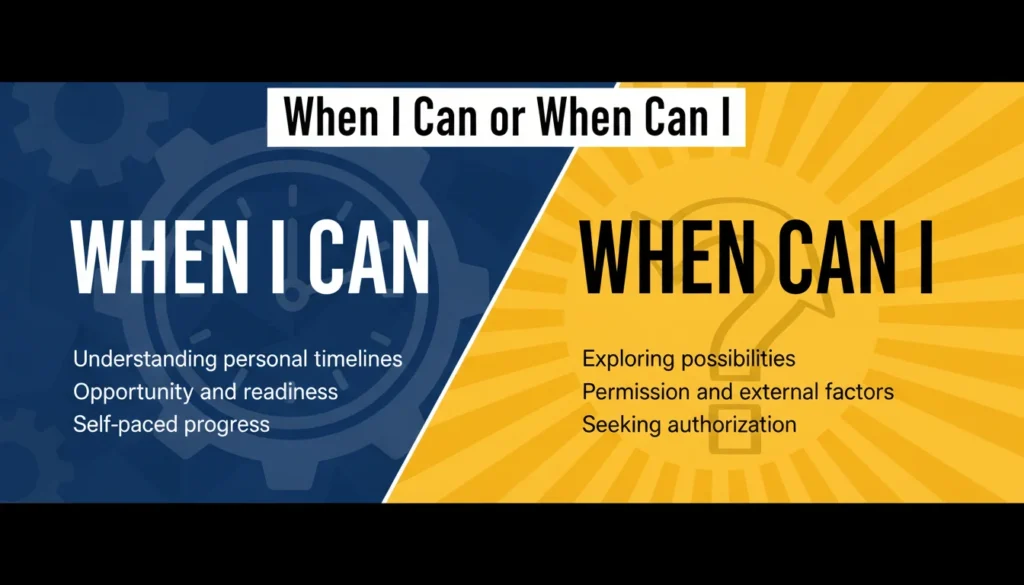
Knowing whether to say when I can or when can I matters for clarity, tone, and meaning. I will show the difference, label the parts of speech (nouns, verbs, adjectives, adverbs, prepositions, conjunctions, pronouns), and check verb tense and subject–verb agreement so you can use each form correctly.
When I can is a dependent clause that usually acts as a time adverbial (conjunction when + pronoun I + modal or verb), while when can I is an interrogative word order used to ask a direct question (question word when + auxiliary/modal + pronoun I). Example: I will call you when I can. Parts of speech: I (pronoun), will (auxiliary verb), call (verb), you (pronoun), when (subordinating conjunction), I (pronoun), can (modal verb). Compare the question: When can I call you? Parts of speech: When (question adverb), can (modal verb), I (pronoun), call (verb), you (pronoun).
In the following sections I will give contextual examples, point out common mistakes, compare American vs British English tendencies, list idiomatic expressions, and share practical tips for speaking and writing. I will check verbs for correct tense and agreement, place modifiers next to what they modify, and revise sentences to remove fragments and run-ons.
Contextual Examples
Time Clause With When I Can
Example: I will help with the move when I can.
Analysis: I (pronoun) will (auxiliary verb, future marker) help (verb) with (preposition) the (article) move (noun) when (subordinating conjunction) I (pronoun) can (modal verb). The clause when I can modifies the verb help and answers the question when. The structure is subordinate and cannot stand alone as a full question; it depends on the main clause.
Grammar check: Subject–verb agreement is fine. The verb phrase will help uses future tense correctly. Modal can is present-tense modal indicating ability; it does not change for subject person/number.
Direct Question With When Can I
Example: When can I start the presentation?
Analysis: When (interrogative adverb), can (modal verb), I (pronoun), start (verb), the (article) presentation (noun). This is a direct question; modal inversion (can + I) signals interrogation. The expected answer will provide a time slot or permission.
Tense and modality: Can expresses ability or permission depending on context. If the speaker is asking for permission, they might use may I in formal contexts: When may I start the presentation?
Embedded Question
Example: Please tell me when I can start.
Analysis: Please (polite adverb), tell (verb, imperative), me (pronoun), when (subordinating conjunction), I (pronoun), can (modal verb), start (verb). Here a question is embedded within a statement. Note word order: the embedded question uses subject–verb order (I can), not inversion (can I). This is a common source of errors.
Grammar rule: Embedded questions keep normal declarative order: tell me where she lives, not tell me where does she live.
Permission Versus Ability
Example (permission): When can I leave the meeting? (Asking for permission.)
Example (ability): I will tell you when I can if I finish early. (Stating I will tell you at the time I am able.)
Parts of speech and nuance: In both examples can is a modal verb, but context determines whether it conveys permission or ability. Check tone: When can I is more likely to be used for permission in a direct question.
Polite Alternatives
Example: When may I speak to the manager? (More formal, asking permission.)
Example: Let me know when I can call you. (Polite embedded clause.)
Grammar note: May is traditionally used for permission in formal registers, while can is common in spoken, informal English.
Common Mistakes
Mistake: Using Inverted Question Order In Embedded Clauses
Faulty: Tell me when can I start.
Why it’s wrong: Embedded questions keep normal word order; do not invert subject and modal.
Fix: Tell me when I can start.
Analysis: Tell (verb), me (pronoun), when (subordinating conjunction), I (pronoun), can (modal), start (verb). Subject–verb order is correct.
Mistake: Confusing Direct Questions And Time Clauses
Faulty: I will arrive when can I.
Why it’s wrong: When can I is a question form and cannot function as a subordinate time clause.
Fix: I will arrive when I can.
Alternate if asking: When can I arrive?
Mistake: Missing Main Clause With When I Can
Faulty fragment: When I can.
Why it’s wrong: When I can is a subordinate clause; left alone it forms a fragment.
Fix: Add a main clause: I will help when I can.
Or embed it properly: Tell me when I can help.
Mistake: Wrong Modal Choice For Permission
Faulty: When can I leave your office? (In a very formal context.)
Why it’s not always wrong: In informal contexts can is fine. In formal contexts prefer when may I to ask permission politely.
Fix (formal): When may I leave your office?
Explanation: May is traditionally the modal for permission in formal registers, although many speakers use can conversationally.
Mistake: Double Modals In Some Dialects
Faulty (nonstandard/dialect): When could I can do that?
Why it’s wrong: English generally does not stack modals. Use one modal: When can I or When could I, depending on politeness/timeframe.
Fix: When can I do that? (present possibility)
Or: When could I do that? (politer or conditional)
Mistake: Punctuation Errors With Embedded Questions
Faulty: Please tell me, when can I come?
Why it’s wrong: The comma is often unnecessary and the word order is wrong for an embedded clause. Use either direct question punctuation or correct embedded form.
Fix (embedded): Please tell me when I can come.
Fix (direct): When can I come?
American vs British English Differences
Modal Preference And Formality
Both American and British English use when I can for embedded clauses and when can I for direct questions. The main differences lie in formality: British English may favor may I slightly more in formal contexts, while American English often uses can I in both formal and informal speech. However, these differences are subtle and context-dependent.
- Example (American): When can I start the job?
- Example (British, formal): When may I start the job?
- Example (British, informal): When can I start the job?
Grammar check: Both dialects follow the rule that embedded questions use subject–verb order.
Tag Questions And Politeness
British speakers sometimes add tag questions more frequently for politeness: When can I start, then? or When can I start, if that’s all right? American speakers may use so or okay tags less often in certain registers. These differences affect cadence rather than strict grammar.
Conditional Forms
Both dialects use conditional forms with when differently. For planned future events, Americans might say: I will come when I can. For hypothetical or less certain events, speakers may use conditional language: I would come when I could, but this pattern is less common.
Example: I would help when I could, but I am busy now.
Analysis: could is the past form of can used in conditional mood.
Idiomatic Expressions
When I Can As Casual Promise
Example: I’ll visit, when I can.
Analysis: This is a short, idiomatic promise. It implies the speaker will visit at the next convenient time. The subordinate clause when I can is brief and often used in speech without specifying exact time.
Parts of speech: I (pronoun), will (modal contracted to ‘ll), visit (verb), when (conjunction), I (pronoun), can (modal).
When Can I In Polite Requests
Example: When can I pick up the package? When can I schedule an appointment?
Analysis: Such questions are routine in service contexts. Use a polite tone and add please if needed: When can I pick up the package, please?
Embedded Questions With Whether/If Contrast
Compare: Tell me when I can start and tell me if I can start. When asks for time; if asks for condition or permission. Parts of speech: when (conjunction/time), if (conjunction/condition).
Example: Tell me if I can start early. (Asking permission or confirmation.)
Tell me when I can start. (Asking for the time.)
Time Clauses With Other Tenses
Example: Call me when you have time. (Present perfect used to indicate time that is relevant now or immediately.)
Compare: Call me when you had time — wrong. Use proper tense.
Grammar note: For future events, English often uses simple present in time clauses: I will call you when I arrive, not when I will arrive. For ability or permission, modals appear: I will call when I can.
When Can I Versus Can I When
When can I is standard question order. Can I when is not a grammatical alternative. Avoid scrambling word order.
Faulty: Can I when go to the store?
Fix: When can I go to the store?
Or: Can I go to the store?
Practical Tips
Tip 1: Identify Whether You Are Asking Or Stating
Ask yourself: am I asking a question or stating a time? If you are asking, use inversion (When can I…). If you are stating a time or embedding a question, use normal word order (when I can).
Tip 2: Use Correct Word Order In Embedded Questions
Embedded question rule: keep subject + verb order. Correct: I wonder when I can leave. Incorrect: I wonder when can I leave.
Tip 3: Choose Modals Carefully For Tone
Use can for informal ability/permission, may for formal permission, and could for polite or conditional requests.
Examples: When can I start? (informal)
When may I start? (formal)
When could I start? (polite or conditional)
Tip 4: Use Present Simple In Time Clauses For Future
When you refer to future time in a subordinate clause, use present simple not future will: I will tell you when I arrive, not I will tell you when I will arrive. For ability/permission use modal: I will go when I can.
Grammar rationale: English uses present tense in time clauses referring to the future.
Tip 5: Avoid Fragments
Never leave when I can alone. Add a main clause. Wrong: When I can. Right: I will call you when I can.
Tip 6: Be Polite In Professional Contexts
If you need permission in formal settings, prefer may I. Example: When may I present my proposal?
Tip 7: Use Punctuation Correctly
Use question mark for direct questions: When can I start? Embedded clauses within statements do not use a question mark: Tell me when I can start.
Tip 8: Teach This Rule With Simple Examples
Show learners: Direct → When can I go? Embedded → Tell me when I can go. Practice with different verbs and modals.
Tip 9: Add Time Markers For Clarity
If the time is vague, add markers: I will stop by when I can this afternoon. Or: Let me know when I can call tomorrow.
Tip 10: Read Aloud To Check Naturalness
Reading your sentence aloud helps you hear whether word order is correct and whether the modal matches intended meaning.
Conclusion
The difference between when I can and when can I is straightforward but important. Use when can I to form direct questions that ask about time or permission, and use when I can as a subordinate clause that tells when you will do something. Keep embedded questions in normal word order, pick modals (can, may, could) to match tone and politeness, and avoid fragments by pairing subordinate clauses with main clauses. Check verb tense in time clauses (use present simple for future time clauses) and maintain subject–verb agreement. These small checks improve clarity, tone, and grammatical accuracy.
FAQs
- Q: When do I use “when can I” versus “when I can”?
A: Use when can I for direct questions (interrogative inversion) and when I can for subordinate time clauses or embedded questions. Embedded clauses keep normal subject–verb order. - Q: Is “when can I” rude?
A: Not necessarily. Tone matters. In formal contexts, you may prefer when may I for politeness. Add please or soften with a phrase: When can I join, please? - Q: Can I say “Tell me when can I come”?
A: No. For embedded questions use normal order: Tell me when I can come. The embedded question does not invert. - Q: Which modal should I use for permission, can or may?
A: May is traditionally more formal for permission. Can is widely used in speech and informal writing. Choose based on register. - Q: Do I use present tense in time clauses about the future?
A: Yes. In clauses beginning with when, use present simple for future meaning: I will call you when I arrive. - Q: How do I avoid fragments with “when I can”?
A: Always attach when I can to a main clause: I will help when I can, not just when I can. - Q: Is “when could I” acceptable?
A: Yes. Could is a polite or conditional modal. Use it for politeness or less certain situations: When could I meet you if that works? - Q: Are there dialect differences in using these forms?
A: No major grammar differences; both American and British English follow the same rules for embedded questions and inversion. Modal preference (may vs can) can vary by formality.