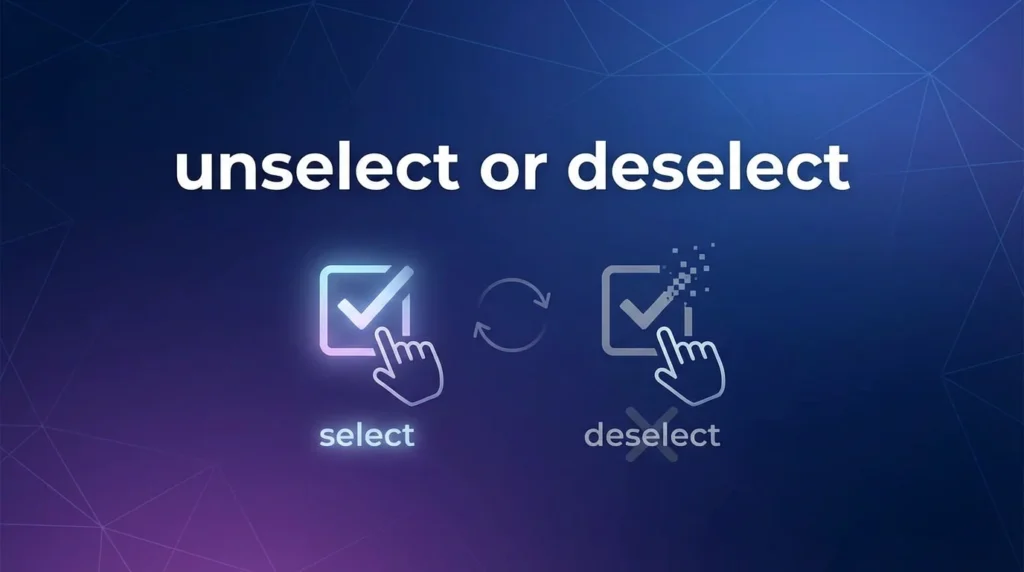
Choosing between unselect and deselect may seem trivial, but the difference touches user interface design, technical terminology, and everyday speech.
Unselect (verb) is often built from the verb select with a prefix un- (prefix), while deselect (verb) is formed by the prefix de- plus select (verb). Both verbs typically mean “to remove selection,” but they appear in different registers and technical contexts. In the sentences below, I will label parts of speech, check verb tense and subject–verb agreement, and ensure modifiers sit next to the words they modify.
Example sentence: The user (noun) deselected (verb, past simple) the file (noun) to avoid accidental upload (verb phrase). That sentence is active and clear; the subject (the user) agrees with the verb (deselected). Another example: The option was unselected (past participle functioning in passive voice) by default (prepositional phrase). Here the auxiliary was (verb, past simple) agrees with singular subject option (noun).
Contextual Examples
Desktop File Manager
Example: Select the files you want, then deselect any you no longer need.
Parts of Speech: Select (verb, imperative), the (article), files (noun, plural), you (pronoun), want (verb, present simple), then (adverb), deselect (verb, imperative), any (determiner), you (pronoun), no (adverb modifying need), longer? (needs correction) — correction: any you no longer need. Need (verb) agrees with you (pronoun). This instruction uses deselect as the preferred UI verb because it pairs well with select (select/deselect) as opposites.
Why This Works: The active imperative voice (“Select”, “deselect”) is direct and standard in UI copy. The verbs are consistent in form and meaning, and the instruction flows with parallel structure.
Web Form Checkbox
Original: To remove a choice, click the checkbox again to unselect it.
Parts of Speech: To (preposition), remove (verb, base), a (article), choice (noun), click (verb, imperative), the (article) checkbox (noun), again (adverb), to (preposition) unselect (verb, base) it (pronoun).
Stylistic Note: Unselect appears naturally in some UI texts and in informal instruction. It is understandable and often used by writers who favor the straightforward un- prefix.
Command-Line Tool
Example: Use –deselect to remove previously selected patterns.
Parts of Speech: Use (verb, imperative), –deselect (command flag noun), to (preposition), remove (verb), previously (adverb), selected (adjective or past participle), patterns (noun).
Why This Works: Command-line conventions tend to prefer deselect because many CLI tools use the Latin-derived prefix de- for reversal actions (for example, decompile, debug, decompress). Deselect fits this morphological pattern and reads like a technical command.
Design Documentation
Original: Items may be unselected by default to reduce clutter.
Parts of Speech: Items (noun, plural), may (modal verb), be (auxiliary), unselected (past participle/adjective), by (preposition), default (noun).
Grammar Check: Modal verb + base passive form (may be unselected) is correct. The subject items (plural) pairs with the plural idea and the passive form is appropriate in documentation where the actor is unimportant.
Mobile App Toggle
Example: Tap again to deselect the highlighted option.
Parts of Speech: Tap (verb, imperative), again (adverb), to (preposition), deselect (verb, base), the (article), highlighted (adjective/past participle), option (noun).
Clarity Check: This short imperative uses deselect as a clear opposite of select. It is concise and consistent with user expectations.
Common Mistakes
Mistake: Mixing Forms In The Same Interface
Faulty: Click to unselect or press Ctrl+D to deselect.
Problem: The interface uses two different verbs for the same action, creating confusion. Users may wonder whether the two actions differ.
Fix: Pick one verb and use it consistently. For technical audiences, deselect often feels more formal and fits established command names. For casual interfaces, unselect is acceptable, but avoid mixing them.
Grammar Note: Click (verb, imperative) to (preposition) unselect (verb, base) is parallel with press (verb), Ctrl+D (noun phrase), to (preposition) deselect (verb). Parallelism requires identical grammatical forms; here they match but the verbs differ semantically for the user.
Mistake: Using Unselect As A Noun
Faulty: Click the unselect to remove the highlight.
Why It’s Wrong: Unselect is a verb; the noun form should be deselection or selection removal.
Fix: Click the deselect option to remove the highlight.
Or: Click the deselection control to remove the highlight.
Parts of Speech Check: Click (verb), the (article), deselect (verb used verbally? better use “deselect” as verb or “deselection” noun), option (noun). Use correct word class for the intended function.
Mistake: Verb Tense Confusion
Faulty: The item was deselect and removed.
Problem: “Was deselect” is ungrammatical because deselect is base form; passive requires a past participle.
Fix: The item was deselected and removed.
Grammar Fix: was (auxiliary, past simple) + deselected (past participle) is correct. Subject the item (singular) matches auxiliary.
Mistake: Dangling Modifier With Evidential Phrases
Faulty: Unselected automatically, the files were moved to trash.
Problem: The placement suggests files did the unselecting, which is illogical.
Fix: The files were unselected automatically, and then moved to trash.
Or: Automatically, the system unselected the files and moved them to trash.
Sentence Structure: Use active or passive but place modifiers clearly. “Automatically” placed at clause start or next to the verb clarifies who or what did the action.
Mistake: Casual Language In Formal Documentation
Faulty: Users can unselect any option they don’t like.
Problem: “Don’t like” is too informal for policy or legal documentation.
Fix: Users may deselect any option they consider inapplicable.
Tone Check: Replace casual verbs and colloquialisms with neutral, precise phrasing in formal contexts.
American vs British English Differences
Terminology Preferences
In general usage, deselect is widely accepted in both American and British English for technical contexts. Unselect appears more often in informal documentation, tutorials, or UI text written by non-native speakers or by teams favoring transparent morphology (un- + select). Neither dialect strictly forbids either form, but registers differ.
Example (American Technical): Select the files you want, and then deselect the ones you don’t intend to share.
Example (British User Guide): Select your choices; to change them, deselect or click again.
Analysis: Both dialects commonly use deselect because it echoes other de- prefixed verbs (deactivate, decode, detach). The prefix de- is Latin-based and common in formal technical language.
Spelling And Usage
Spelling: Both variants follow the same spelling; there is no regional spelling difference like color/colour. The question is more about preference and perceived formality.
Usage Note: In internationalized software, translation teams often standardize on deselect for string IDs (e.g., “button_deselect”) because of its prevalence in programming and localization tools.
Interface Copy And Localization
Localization teams should treat deselect as a canonical verb when mapping to other languages; translators expect a technical, one-word verb that maps cleanly to equivalents like Spanish “deseleccionar” or French “désélectionner”. Unselect may map differently or create inconsistencies across languages.
Practical Advice: Use deselect in string IDs and UI code for consistency across regions and for easier machine-aided translation.
Idiomatic Expressions
Collocations And Pairs
• Select/Deselect — The standard antonym pair used in computing and UI text.
• Select/Unselect — Common in informal how-to guides.
• Add/Remove Selection — A more descriptive pair that avoids morphological preferences.
• Toggle Selection — Implies switching state; common in UI patterns.
Parts of Speech: Select (verb), Deselect (verb), Toggle (verb or noun), Selection (noun), Remove (verb).
When To Use Toggle Versus Deselect
Use toggle when the interface provides a single control that alternates state — for example, a button that selects when off and deselects when on. Use deselect when you want to describe the explicit act of removing selection, especially when multiple items are involved.
Example: Click the toggle to switch the filter on or off. Use deselect when you need to remove a chosen option without toggling others.
Grammar Check: Click (verb, imperative) the (article) toggle (noun) to (infinitive marker) switch (verb, base) the (article) filter (noun) on or off (adverbial phrase).
Technical Terms With De-Prefix
The prefix de- appears in many action verbs: deactivate, decode, deallocate, decompress. In technical writing, deselect fits naturally in the family of de- verbs that reverse or remove a prior action.
Example in Code: button.toggleSelected() might be part of an API; developers may provide button.deselect() as an explicit method. When naming methods, prefer consistency: select() / deselect().
Parts of Speech and Code: In API documentation, select() and deselect() are verb phrases (function names) and treated as imperative instructions when invoked.
Practical Tips
Tip 1: Choose One Term and Use It Consistently
Pick deselect or unselect for your product and apply it across UI labels, documentation, and code. Consistent terminology reduces user confusion and simplifies translation.
Example: If your product uses deselect in the dropdown menu, avoid writing “unselect” in the help center.
Grammar Reminder: Maintain verb form consistency; don’t mix imperative and passive instruction styles unpredictably. If the UI uses imperative copy (“Select file”), keep documentation in the same tone for parallelism.
Tip 2: Use The Most Appropriate Register
• Use deselect in formal documentation, APIs, and technical guides.
• Use unselect in casual tutorials or conversational help text if your audience prefers plain morphological cues.
• Use descriptive phrases like remove selection when clarity matters more than brevity.
Parts of Speech Check: remove (verb), selection (noun) is a nominalized phrase that can be clearer for non-technical users.
Tip 3: Prefer Clear Commands In UI Copy
Good: Click Deselect to remove items from your selection.
Better for brevity: Click Deselect.
Check Parallelism: If you have a list of actions, use the same verb form for each bullet point.
Tip 4: Avoid Dangling Or Ambiguous Modifiers
Faulty: Unselected by clicking, the option disappeared.
Corrected: When a user deselects an option by clicking, the option disappears.
Grammar Fix: Subject-first active structure clarifies who performs the action. The verb tense (present simple) matches user-interface behavior described as habitual or general.
Tip 5: API And Command Naming
Use deselect for method names (deselectAll), deselect Item(index)) because the de- prefix is conventional in APIs. It also reads better for developers maintaining code.
Naming Example With Parts Of Speech: deselectAll() — deselect (verb), All (determiner functioning as argument meaning “all items”).
Tip 6: Keyboard Shortcuts And Accessibility
When assigning shortcuts, document both the key and the verb consistently. Example: Press Ctrl+D to deselect the current selection. For screen readers, use consistent aria-labels like aria-label=”Deselect current item”.
Accessibility Check: Use present tense verbs in labels for screen readers — this matches how assistive technology announces controls.
Tip 7: Help Text And Error Messages
In help text, prefer descriptive phrases: Use Remove Selection when you want to be explicit. Error message: “Cannot deselect the last remaining item” is direct and correct.
Parts of Speech: Cannot (modal + negation), deselect (verb), the (article), last (adjective), remaining (adjective/present participle), item (noun).
Tip 8: Internationalization And Localization
Standardize on deselect in your string keys for easier translation. Example string key: button.deselect = “Deselect” — translators will find equivalent verbs in target languages without ambiguity.
Grammar Note: Keep string grammar simple — avoid context-dependent pronouns which make translation harder.
Tip 9: Documentation Style Guides
Add a glossary entry: deselect (verb) — to remove selection from an item or set of items. Provide example sentences and UI contexts to guide writers and translators.
Example Gloss Example: deselect (verb): To remove the selection state; e.g., “Click the checkbox to deselect the item.”
Tip 10: User Testing For Terminology
Run simple A/B tests. Use one group with deselect and another with unselect in instructions. Measure time to complete tasks and error rates. User preference will tell you which term fits your audience.
Data Reporting: When reporting, state results in clear grammatical sentences: Group A (n=50) completed the task in an average of 12.3 seconds; Group B (n=52) averaged 13.9 seconds. Check verb tense (past simple) and agreement with subjects (Group A averaged — singular noun phrase treated as unit).
Conclusion
Both unselect and deselect mean “remove selection,” but they differ in register, morphology, and typical contexts. Deselect is the more standard choice for technical documentation, APIs, and localization workflows; unselect appears as a more transparent morphological variant and is common in informal instructions.
Whichever term you choose, be consistent, place modifiers next to the expressions they modify, check verb forms (use deselected with auxiliaries for passive constructions), and prefer parallel structures in lists and commands. For clarity in user interfaces, favor short imperative verbs, match your tone to your audience, and standardize string keys for translators. These practices improve user comprehension and reduce ambiguity. By paying attention to parts of speech, verb tense, and modifier placement, you make your text easier to read and your software easier to use.
FAQs
- Q: Which is more formal, “unselect” or “deselect”?
A: Deselect is generally more formal and common in technical documentation, APIs, and localization. Unselect is more informal but understandable. - Q: Can I use “unselect” in UI labels?
A: Yes, but choose one term for consistency; many localization teams prefer deselect. - Q: How do I fix “was deselect” in a sentence?
A: Replace the base form with the past participle: “was deselected” so the auxiliary verb agrees with the subject. - Q: Should I use “toggle” instead of “deselect”?
A: Use toggle only when a single control alternates the state; use deselect to describe explicitly removing selection. - Q: What noun should I use instead of “unselect”?
A: Use deselection or removal of selection as the noun form; avoid using unselect as a noun. - Q: Are there localization concerns with these terms?
A: Yes; standardizing on deselect helps translators find direct equivalents in other languages. - Q: Which should be used in API method names?
A: Prefer deselect (for example, deselectAll()), as it matches developer expectations and de-prefix conventions. - Q: How should I write help text for screen readers?
A: Use present-tense, imperative labels like “Deselect current item” and maintain consistent aria-labels for accessibility.