
Unregister vs. deregister both mean “to remove something from a registry,” but unregister dominates technical and computing contexts (APIs, devices, event listeners), while deregister appears in legal, regulatory, and administrative language (securities, companies, professional licenses). The split isn’t arbitrary—it reflects a 1,000-year linguistic turf war between Germanic and Latin roots.
Why Does Your Brain Short-Circuit on These Two Words?
Your confusion isn’t incompetence. It’s Lexical Competition, a neurological phenomenon where two words fight for the same mental slot. When you write code, your brain has been primed by thousands of API calls using “unregister.” When you file corporate paperwork, regulatory documents have drilled “deregister” into your procedural memory.
Here’s what happens inside your head: the prefrontal cortex tries to retrieve the “correct” word, but both prefixes signal reversal. Your brain scans for contextual anchors. If you’ve just typed “API.unregister()” five times, switching to “deregister” mid-document feels wrong—even if the dictionary says both work. This is Domain-Specific Priming, where professional jargon creates neural shortcuts. Software engineers don’t “deregister” webhooks. Lawyers don’t “unregister” securities. Cross those wires, and readers sense something’s off.
Core Concepts and Historical Evolution
Both words emerged when English needed verbs to reverse “register,” but they split along class lines centuries ago. The Germanic prefix “un-” attached to everyday Anglo-Saxon words, while Latin “de-” marked formal, learned vocabulary imported by Norman nobility and church scholars. That social divide hardened into semantic territories we still patrol today.
Etymology and the Germanic-Latin Divide
“Register” itself traveled from Medieval Latin registrum (a list, roll) through Old French registre into Middle English around 1350. When English speakers needed to say “remove from a register,” two construction paths opened.
The un- prefix descends from Proto-Germanic unda- meaning “against” or “back.” Old English used it freely: unbindan (unbind), unlūcan (unlock). It felt native, direct, physical. When technical writing boomed in the 19th century, engineers reached for “un-” because it matched the concrete, mechanical language of their trade. You unscrew a bolt. You unregister a device.
The de- prefix arrived via Latin de- (“down from, away”). Norman scribes imported it wholesale: depose, detract, denounce. It carried institutional weight. When 17th-century legal clerks needed language for removing names from official rolls, “deregister” sounded appropriately formal. Courts deregister companies. Agencies deregister securities.
This wasn’t conscious design. Linguistic drift sorted words by social context, and 400 years later, we inherit the battle lines.
Grammatical Mechanics and Reversative Verbs
Both function as reversative denominal verbs—verbs formed by adding a reversing prefix to a noun. They take the same grammatical slots:
Golden Rule: Subject + unregister/deregister + Direct Object. “The admin unregistered the device.” “The court deregistered the company.” Both require transitive use; you can’t “unregister” without stating what you’re removing.
The difference isn’t syntax. It’s pragmatic register—the formality level and professional domain that dictates word choice. Think of it like measuring tools: a ruler and a caliper both measure length, but mechanics grab calipers, seamstresses grab rulers. Same function, different workshops.
When Should You Use Unregister vs. Deregister?
The context determines everything. Software documentation overwhelmingly prefers “unregister” (95%+ of API references). Legal and regulatory texts default to “deregister” (80%+ of securities filings). But the boundaries blur in hybrid fields.
Technical and Computing Contexts
Unregister reigns in code. When you write JavaScript, Python, or Java, you unregister event listeners, unregister components, unregister devices from IoT hubs. Cloud platforms like AWS, Azure, and Google Cloud all document “unregister” commands for removing nodes, deregistering only appears in regulatory compliance sections discussing business licenses.
Example breakdown:
Subject: System Administrator | Verb: unregistered | Object: the deprecated API endpoint | Prepositional Phrase: from the service mesh
Active voice keeps the agent visible. The admin performs the action. If you wrote “The endpoint was deregistered,” you’d sound like a lawyer discussing liability, not a developer documenting a task.
Legal and Regulatory Contexts
Deregister dominates official processes. Corporate registrars deregister dissolved companies. Securities commissions deregister delisted stocks. Professional boards deregister revoked licenses. The formality signals institutional authority.
When a government agency writes, “The SEC deregistered the offering,” the verb choice matters. “Unregister” would sound flippant, almost careless. “Deregister” communicates that this is an official act with legal consequences—audits, filings, public records.
The Nuance Trap
Both words are technically correct in neutral contexts, but native speakers sense a mismatch. If you write “The technician deregistered the faulty sensor,” English speakers pause. It’s grammatical but feels wrong—like wearing a tuxedo to a hardware store. Conversely, “The regulator unregistered the non-compliant broker” sounds too casual for a legal action.
The brain rejects these not because they violate grammar rules, but because they violate genre expectations. Professional writing has invisible dress codes, and word choice is the uniform.
How Writers Actually Use Unregister vs. Deregister in Print
Technical manuals from the early 20th century show “unregister” emerging alongside electrical engineering. Patent filings from 1910-1920 describe machines that “unregister” counters or “unregister” mechanical locks. The prefix matched the physicality of the work.
Historical Usage in Technical Documentation
Early computing documents (1960s-1970s) adopted “unregister” for memory management and device drivers. IBM manuals, DEC operating system guides, and Bell Labs technical memos all standardized “unregister” for programmatic operations. That consistency created a linguistic monoculture in software development.
Modern Style in Professional Writing
Today’s technical documentation reinforces this split. The Microsoft Style Guide, Google Developer Documentation Style Guide, and Apple Developer Documentation all specify “unregister” for API operations. Meanwhile, the SEC Edgar Filing Manual and UK Companies House guidance consistently use “deregister” for administrative removals.
Legal thriller novels simulate this distinction carefully. When depicting corporate espionage or financial crime, skilled novelists write “deregister” for formal actions and “unregister” for hacking or technical sabotage. The verb choice signals whether we’re in the boardroom or the server room.
Synonyms and Variations of Unregister vs. Deregister
Both words share semantic neighbors, but their synonyms also split by domain. “Unregister” pairs with remove, disconnect, detach, unmount—mechanical verbs. “Deregister” pairs with revoke, cancel, dissolve, strike off—administrative verbs.
Semantic Neighbors and Illocutionary Force
When you say “unregister,” you perform a declarative speech act: “I am removing this item from the active list.” The illocutionary force (the social action the words perform) is technical and procedural.
When you say “deregister,” you perform an institutional speech act: “I am officially terminating this entity’s registered status.” The force is authoritative, often carrying legal weight. This explains why banks “deregister” funds but apps “unregister” users.
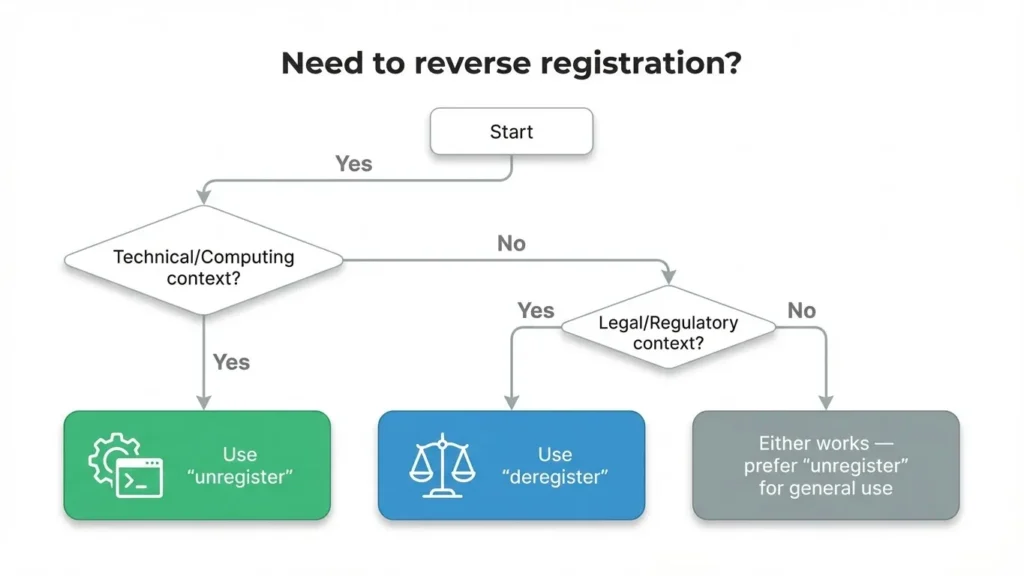
The visual shows how context narrows your choice. Start with domain, end with prefix.
Regional Variations
US and UK English handle these identically—the technical/legal split transcends dialect. However, British regulatory documents occasionally use “strike off” or “remove from the register” as alternatives to “deregister,” especially in older Companies House forms. American legal writing tends to use “deregister” more consistently. Australian English follows UK patterns for corporate law but adopts US conventions in software documentation.
Common Mistakes When Choosing Unregister vs. Deregister
People mix these up in predictable ways, usually by importing the wrong domain’s vocabulary. Here are the five most frequent errors:
| Incorrect | Correct | The Fix |
| The API deregistered the callback | The API unregistered the callback | Use “unregister” for programmatic operations |
| The state unregistered the LLC | The state deregistered the LLC | Use “deregister” for official administrative acts |
| Users can deregister their accounts | Users can unregister their accounts | User-initiated technical actions take “unregister” |
| The compliance officer unregistered the investment advisor | The compliance officer deregistered the investment advisor | Regulatory enforcement uses “deregister” |
| Deregister the event handler before unmounting | Unregister the event handler before unmounting | Code comments and documentation need “unregister” |
The psychological trigger here is hypercorrection. People assume “deregister” sounds more professional, so they overuse it in technical contexts. They’re applying a formality rule where it doesn’t belong. Think of it like saying “whom” when “who” is correct—you’re reaching for prestige that backfires.
Another trap: code-switching anxiety. When engineers write end-user documentation, they sometimes switch to “deregister” thinking it sounds less technical. Bad move. Users already struggle with tech jargon. Changing the term creates confusion. Stick with “unregister” across all technical communication.
Practical Tips and How I Learned This the Hard Way
When Consistency Matters More Than Correctness
Back in 2014, I edited a software-as-a-service contract for a startup selling to government agencies. The engineers had written the technical specs using “unregister” throughout—completely standard for API documentation. But the legal team, preparing for federal procurement review, changed every instance to “deregister” in the contract language, thinking it sounded more official.
The result? Chaos during user acceptance testing. Government IT staff read the contract, saw “deregister,” then opened the API documentation and found “unregister.” They filed a discrepancy report, questioning whether these were different operations. The procurement officer flagged it as a documentation defect. We had to halt the rollout, rewrite the contract to match the technical docs, and resubmit.
The lesson hit me hard: internal consistency beats theoretical correctness. If your codebase uses “unregister,” your contracts, training materials, and help docs must match. Don’t let lawyers “fix” technical terms they don’t understand. I learned to create a term glossary at project kickoff, establishing which prefix we’d use and enforcing it across all deliverables.
That three-week delay cost the startup a quarter’s revenue target. All because someone thought “deregister” sounded more professional. Now, whenever I see this swap in a document, I flag it immediately. The stakes are higher than people realize.
Memory Aids That Actually Work
Here’s the trick I teach junior editors: “Un” is for “Unter”—German for “under the hood.” If you’re talking about what’s under the hood (technical systems), use “un-.” If you’re talking about De-escalating official status (regulatory action), use “de-.”
Another angle: “Un” undoes. “De” demotes. Undoing is mechanical. Demotion is institutional. Pick the verb that matches the power structure.
Conclusion
The unregister vs. deregister distinction isn’t pedantic—it’s a signal of professional fluency. Software developers, systems administrators, and UX designers should default to “unregister” for all technical operations. Lawyers, compliance officers, and corporate secretaries should use “deregister” for legal and administrative actions. When writing for mixed audiences (white papers, executive summaries), choose the prefix that matches your primary domain, then maintain consistency.
This split didn’t happen by accident. It encodes centuries of English class structure and professional specialization. Respect the boundary, and you’ll sound like you belong in your field. Cross it carelessly, and readers will sense you’re an outsider—even if they can’t articulate why.
FAQs
Unregister is more common. It appears roughly 3x more frequently in published text because technical documentation (software, engineering, IT) vastly outweighs regulatory publishing. If you’re unsure which to use, “unregister” is the safer default for general audiences.
No, not in professional contexts. While both are grammatically correct, domain conventions matter. Mixing them in technical documentation or legal filings signals carelessness. Choose one prefix per document and stick with it.
Deregister for official actions. Federal agencies (SEC, FCC, FDA) use “deregister” when removing entities from official registries. However, their IT departments use “unregister” for system operations.
Check your industry’s style guides. If you’re writing code or technical docs, use unregister. If you’re drafting legal documents or regulatory filings, use deregister. When in doubt, search your company’s existing documents for precedent.
No. Both are standard dictionary entries. Spell checkers can’t catch domain mismatches, which is why human editors remain essential for professional documents.
Yes, identically to American usage. The technical/legal split applies across all English dialects. British software developers use “unregister”; UK Companies House uses “deregister.”
Yes, both exist. “Unregistration” appears in technical contexts (“the unregistration process failed”). “Deregistration” appears in administrative contexts (“file for company deregistration”). Same domain rules apply.
Use “re-register” exclusively. Once something is removed from a registry (by either verb), you always “register it again” or “re-register it.” “Re-deregister” doesn’t exist in standard usage.