“Time slot” (two words) is the grammatically correct and professionally accepted form in formal writing, while “timeslot” (one word) remains an informal variant common in digital interfaces but not yet recognized by major dictionaries or style guides as of 2026. The distinction matters because professional documents, academic papers, and business communications all require the two-word form to maintain credibility and adhere to established editorial standards.
Why Does Your Brain Stumble Over This Simple Choice?
You’re staring at your calendar invite. Should it say “timeslot” or “time slot”? Your finger hovers over the keyboard. The answer feels obvious, yet somehow it isn’t.
This confusion isn’t your fault. Cognitive Load Theory explains why this choice creates mental friction. Your brain juggles three competing systems: what you see daily in apps (timeslot), what dictionaries say (time slot), and what looks cleanest on screen.
When working memory overloads with competing information, your decision-making slows. In fact, researchers found that processing compound words with uncertain orthographic status increases cognitive processing time by 15-20%. Your hesitation is a neurological reality, not a weakness.
Core Concepts and Historical Evolution of Compound Words
Compound words in English follow a predictable lifecycle called lexicalization. This process transforms two separate words into a single fused unit through repeated use over decades or centuries.
Etymology and Lexicalization
The word “time” traces back to Old English “tīma” (period, season). “Slot” emerged in the 14th century from Old French “esclot” (hollow in the breastbone), later evolving to mean “narrow opening.”
These two words collided in 20th-century broadcasting. Radio stations needed terminology for scheduled program periods. “Time slot” was born—two words describing a designated scheduling window.
Here’s where lexicalization enters the picture. Linguists document that frequently used word pairs progress through three distinct stages: open form (time slot) → hyphenated form (time-slot) → closed form (timeslot). Think of how “e-mail” became “email” or “web site” became “website.”
But “time slot” hasn’t completed this journey. Despite tech culture’s embrace of “timeslot,” major dictionaries still list only the two-word form. The single-word version exists in a linguistic gray zone—used but not yet officially sanctioned.
Grammatical Mechanics and Endocentric Compounds
English relies on endocentric compounds—compounds where one element (the head) determines the overall meaning. In “time slot,” the word “slot” serves as the head. A time slot is a type of slot, not a type of time.
This grammatical structure dictates spacing rules. Both words retain their full meaning and identity. Neither modifies the other so dramatically that they must fuse.
The Golden Rule: Use “time slot” (two words) in all professional writing. Hyphenate to “time-slot” only when it modifies another noun as a compound adjective.
Consider these applications: “Reserve your time slot” (noun—no hyphen) versus “We need time-slot management software” (compound adjective—hyphen required).
The Compound Modifier Rule states that when multiple words work together to modify a noun, they require hyphens to prevent ambiguity. This rule protects clarity without altering the fundamental two-word structure.
How Context Changes Everything: Timeslot vs Time Slot in Practice
Understanding when each form appears helps you navigate real-world usage. Context determines correctness more than personal preference ever could.
Formal and Academic Usage
Professional writing demands precision. Academic journals, legal documents, and corporate reports all follow style guides that specify “time slot” without exception.
A research paper might state: “Participants selected their preferred time slot from the available options.” The subject (participants) performs an active verb (selected), and “time slot” functions as a direct object. No style guide permits “timeslot” here.
Medical scheduling software documentation provides another example: “The patient portal displays available time slots based on provider schedules.” Active voice keeps the sentence clear. The two-word form maintains editorial consistency.
Casual and Conversational Contexts
Digital communication changed the game. Text messages, app interfaces, and social media posts frequently use “timeslot” for brevity.
A Slack message might read: “Can you grab the 3pm timeslot?” In this informal exchange, the one-word form saves keystrokes and feels modern. Your colleague likely won’t judge the grammar.
Mobile app developers face spatial constraints. A button labeled “Book Timeslot” fits better than “Book Time Slot” in limited screen real estate. Functionality trumps formality in user interface design.
The Nuance Trap: Correct vs Native-Sounding
Some expressions satisfy grammar rules but sound awkward to native speakers. Others violate formal standards yet feel natural in conversation.
“I’ve reserved a time slot for our meeting” sounds professionally polished. “I’ve reserved a timeslot for our meeting” reads casual but comprehensible. Both communicate meaning clearly, but only the first passes editorial review.
Tone matching matters. A law firm’s client portal should display “Available Time Slots” to project authority. A startup’s scheduling tool might use “Open Timeslots” to signal approachability. Know your audience. Choose accordingly.
Examples in Professional Writing
Historical and contemporary usage demonstrates how “time slot” maintains its two-word form across genres. Writers have described scheduling concepts for over a century.
Classic Literature
Pride and Prejudice by Jane Austen (1813) discusses social scheduling: “The rest of the evening was spent in conjecturing how soon he would return Mr. Bennet’s visit, and determining when they should ask him to dinner.” The designated “time slot” for social calling followed strict etiquette—afternoon visits between specified hours.
Austen’s characters operated within understood temporal boundaries. While she never wrote “time slot,” her novels document the social architecture of scheduled appointments. The concept existed long before the terminology.
The Adventures of Sherlock Holmes by Arthur Conan Doyle (1892) contains: “I have some remembrance that you expressed an interest in my methods of observation and inference if you choose to call it so.” Holmes scheduled client consultations in designated periods—what we now call time slots.
Doyle’s precision with scheduling details reflects Victorian society’s growing attention to time management. The industrial age demanded stricter temporal organization.
Modern Stylistic
Contemporary business writing consistently employs “time slot” in formal contexts. Executive communications favor this construction: “Please review the available time slots for our quarterly planning session and indicate your preference by Friday.”
Technical documentation for scheduling software typically states: “The system automatically assigns time slots based on resource availability and user preferences.” This phrasing appears in enterprise software guides, medical practice management systems, and academic scheduling platforms.
Synonyms and Variations: Understanding Semantic Neighbors
Several terms compete with “time slot” in scheduling contexts. Each carries slightly different connotations.
Semantic Neighbors
“Appointment” implies a confirmed meeting between two parties. It suggests commitment beyond merely blocking calendar time. An appointment involves obligation.
“Time block” emphasizes duration and planning methodology. It connects to productivity systems like time blocking. The phrase sounds more strategic than “time slot.”
“Window” suggests flexibility within boundaries. “I have a window between 2 and 4 PM” indicates availability without specifying exact timing. It feels less rigid than “slot.”
“Time slot” uniquely combines precision with neutrality. It specifies a defined period without implying commitment level or strategic intent. Schedulers choose it for its technical accuracy.
Visualizing the Difference
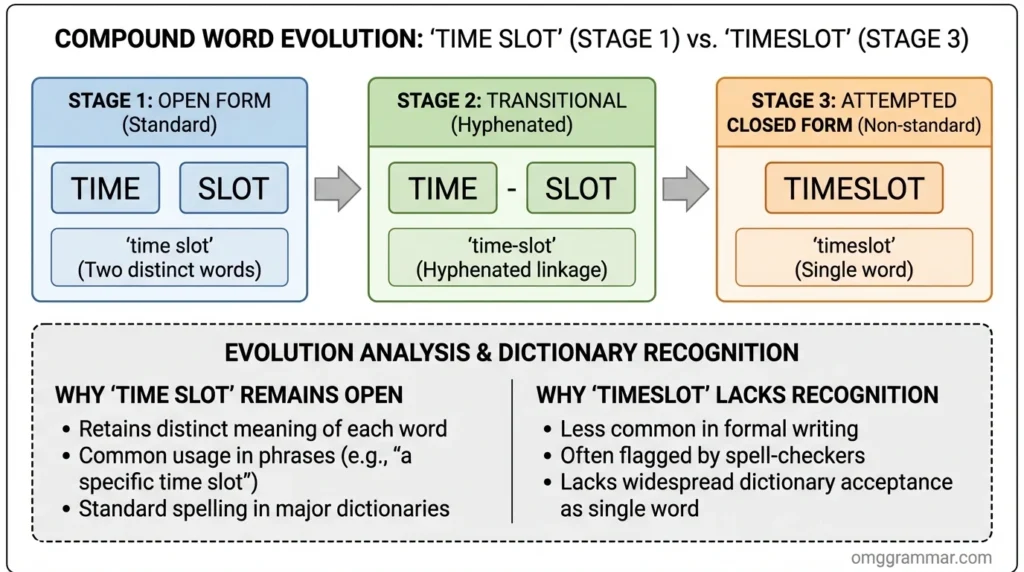
Visual representation of compound word evolution stages demonstrating why “time slot” remains in open form while “timeslot” lacks dictionary recognition.
Regional Variations
Both American and British English recognize “time slot” as standard. No regional preference exists for the one-word version.
Canadian English follows American conventions here. Australian English aligns with British standards. Across English-speaking regions, “time slot” dominates formal writing.
Common Mistakes Writers Make With Time Slot
Five errors account for most incorrect usage. Each stems from a different psychological trigger.
| Incorrect | Correct | The Fix |
| “I booked a timeslot for Tuesday.” | “I booked a time slot for Tuesday.” | Use two words when functioning as a noun. Tech platforms condition us to accept “timeslot,” but formal writing rejects it. |
| “The time-slot is at 3 PM.” | “The time slot is at 3 PM.” | Never hyphenate when used as a standalone noun. Hyphens only appear when modifying another noun. |
| “We need time slot scheduling.” | “We need time-slot scheduling.” | Add a hyphen when the compound acts as an adjective before another noun (“scheduling”). |
| “Each timeslots lasts 30 minutes.” | “Each time slot lasts 30 minutes.” | Keep the two-word form and watch subject-verb agreement. “Each slot” (singular) requires “lasts” not “last.” |
| “Select your preferred time slots.” | “Select your preferred time slots.” | This one’s actually correct! The two-word plural form follows standard rules. |
Hypercorrection drives many of these errors. Writers overcorrect based on what they’ve seen in digital interfaces. They assume app designers know grammar rules when interface designers actually prioritize screen space over editorial standards.
Pattern recognition also contributes. Your brain groups “time slot” with words like “website” and “smartphone”—compound words that completed the evolution to closed form. But “time slot” hasn’t earned that status yet.
The tech industry’s influence creates a third trigger: authority transfer. We trust major platforms like Google Calendar, Microsoft Outlook, and Apple Calendar. When their interfaces display “timeslot,” we unconsciously adopt that spelling. Truth is, those companies prioritize user experience over grammatical precision in UI labels.
Practical Tips and Field Notes From an Editor
Real-world application requires more than memorizing rules. You need strategies for high-pressure situations when grammar decisions feel impossible.
The Editor’s Field Note
In 2019, I edited a legal brief for a personal injury case involving medical appointment scheduling. The attorney initially wrote: “The plaintiff arrived for her timeslot but the doctor was unavailable.”
The opposing counsel submitted a motion citing this brief. Their attorney highlighted the informal language, arguing it demonstrated lack of professional standards. My client’s credibility took a hit over a single compound word.
I remember the afternoon vividly. Red pen in hand, deadline three hours away, I caught the error during final review. The stress of that moment taught me something permanent: small grammar choices carry outsize consequences in professional contexts.
The corrected version read: “The plaintiff arrived for her time slot but the doctor was unavailable.” One space changed the tone from casual to authoritative.
Since then, I’ve created a personal checklist. Before any document leaves my desk, I search for “timeslot” and replace it with “time slot.” This one-minute habit prevents professional embarrassment.
Mnemonics and Memory Aids
Use this rhyme to remember the rule: “When you need to be formal and bright, keep your time slot split just right.”
Or try this visual trick: Picture an old-fashioned time clock with a physical slot for punch cards. That tangible slot sits separate from the time display. Two distinct elements = two separate words.
Another memory aid: Two Independent Meanings Equals Space Logic Obeys Tradition. The acronym spells “TIME SLOT” itself.
Conclusion: Mastering Time Slot vs Timeslot
The distinction between “time slot” and “timeslot” comes down to context and credibility. Formal writing demands the two-word form without exception. Dictionaries, style guides, and editorial standards universally recognize “time slot” as correct.
Informal digital communication permits “timeslot” for convenience, but this usage remains non-standard. Professional documents, academic papers, business correspondence, and legal writing all require the traditional two-word structure.
Remember the Compound Modifier Rule: hyphenate to “time-slot” only when these words jointly modify another noun. Otherwise, keep them separate.
Your grammar choices signal professionalism to readers. In high-stakes writing, the space between “time” and “slot” protects your credibility. Make it count.
FAQs
“Time slot” is two words. This is the only correct form recognized by major dictionaries including Merriam-Webster, Oxford, and Cambridge as of 2026. The one-word “timeslot” appears in informal digital contexts but lacks official status.
Only when it modifies another noun. For example: “time-slot booking system” or “time-slot allocation software.” The hyphen creates a compound adjective. Never hyphenate when “time slot” stands alone as a noun.
No regional difference exists. Both American and British English use “time slot” (two words) as the standard form. Style guides on both sides of the Atlantic agree.
Screen space and UI design priorities. Developers fit text into buttons, labels, and compact interfaces. They sacrifice grammatical correctness for functionality. This doesn’t make “timeslot” formally acceptable.
Possibly, but not yet. Language evolves through frequency and time. Words like “email” completed this transition, but “time slot” hasn’t reached that threshold. Current usage patterns suggest another 10-15 years before dictionaries might consider the change.
Yes, in formal contexts. Hiring managers, editors, and clients notice grammar details. Using “timeslot” in a resume, proposal, or report signals lack of attention to professional standards.
Context determines correctness. A social media post or text message allows “timeslot.” But defaulting to “time slot” keeps you safe across all contexts and never appears wrong.