
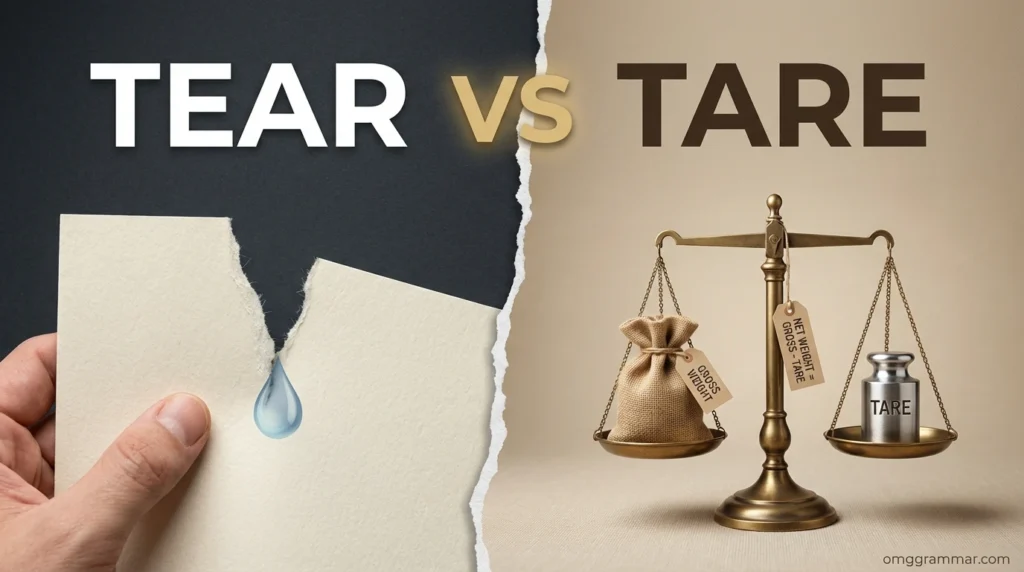
“Tear” means to rip something apart or refers to the result of ripping, while “tare” means the weight of an empty container that gets subtracted when weighing goods. Tear vs tare are homophones that sound identical but mean completely different things.
Why Do These Identical-Sounding Words Confuse People?
Your brain hits a wall with “tear vs tare” because these words offer no meaning clues to help you choose. Homophone confusion happens when your brain must pick between words that sound exactly alike but activate totally different mental concepts. Truth is, most homophones share some connection—”there” and “their” both involve location or possession relationships. But tear and tare? Zero overlap.
Here’s what happens: you’re writing about shipping containers and you pause. Should it be “tear weight” or “tare weight”? Your brain searches for meaning connections and finds nothing. One word involves ripping fabric. The other involves container measurement. They sound identical by pure accident of linguistic history, not because they share any actual relationship.
The confusion gets worse because “tear” itself has multiple meanings. It can mean ripping something, a hole from ripping, or the water that comes from your eyes when you cry. So your brain juggles three definitions for “tear” while trying to remember if “tare” even exists as a real word.
Where Did Tear and Tare Come From?
Tear and tare arrived in English through completely different routes separated by thousands of miles and different language families. Their identical pronunciation happened by coincidence, not design. Understanding their separate histories makes the distinction clearer.
The Germanic Path: How Tear Evolved
“Tear” traces back to Proto-Indo-European *der-, meaning “to split” or “to flay.” This ancient root spawned words across many languages. Old English used teran to mean “pull apart by force” or “lacerate.” The word stayed remarkably stable through centuries.
Middle English kept the form teren with the same meaning. By the 1300s, English speakers used “tear” exactly as we do today—both as a verb (to tear paper) and as a noun (a tear in cloth). The past tense “tare” existed briefly in very old English but got replaced by “tore” around the 1600s.
The word appears in related Germanic languages too. German has zehren (“to consume”), Dutch has teren (“to eliminate”), and Gothic had ga-tairan (“to destroy”). All these cousins share that core idea of breaking something apart through force.
This Germanic word had nothing to do with containers or weights. It lived entirely in the world of physical actions—ripping, tearing, splitting things. That meaning stayed consistent for thousands of years.
The Arabic Journey: How Tare Arrived
“Tare” took a completely different path. It started in Arabic as taraha, meaning “to throw away.” Medieval Arabic traders used tarah to mean “thing deducted or rejected”—specifically, the waste weight you subtract when buying goods.
Italian merchants picked up this word as tara around the 1400s during Mediterranean trade. French traders borrowed it as tare. The concept spread because it solved a real business problem: how do you fairly price goods when the container adds weight?
English adopted “tare” in the late 1400s, probably from Anglo-French. Early records show British naval inventories using “tare” to account for barrel weight when measuring gunpowder. The word entered English already carrying its technical meaning about container weight.
Unlike “tear,” which everyone uses daily, “tare” stayed in specialized contexts. Merchants, shippers, and traders needed it. Regular people didn’t. That specialization continues today—you’ll see “tare” on commercial scales and shipping documents but rarely in casual writing.
The Rule: Use “tear” for ripping or eye fluid. Use “tare” for container weight in technical or commercial contexts.
These two words sound identical only because of how English pronunciation evolved. They have zero historical or meaning connection. Tear came from Germanic roots about splitting things. Tare came from Arabic trade language about subtracting weight. Pure coincidence made them homophones.
How Do You Use Tear vs Tare in Different Contexts?
Context determines which word you need. “Tear” appears in everyday writing about physical actions and emotions. “Tare” shows up in technical, commercial, and scientific contexts where precise weighing matters.
Everyday Writing with Tear
Most writing uses “tear” because it describes common actions and experiences. You can tear paper when opening mail. You might tear your jeans climbing a fence. Tears fall from eyes during sad movies.
The verb “tear” works in countless situations: “She tore the letter in half.” “Don’t tear the wrapping paper.” “The fabric tears easily.” These sentences describe physical ripping that everyone understands immediately.
The noun “tear” (meaning a rip or hole) appears in descriptions: “There’s a tear in the curtain.” “He patched the tear with duct tape.” Again, everyday situations that need no special knowledge.
Note that “tear” pronounced like “tier” (rhyming with “beer”) means eye fluid—that’s a different word entirely. This article focuses on “tear” that rhymes with “tare.”
Technical Writing with Tare
“Tare” belongs to specialized fields: shipping, logistics, commercial weighing, and scientific measurement. The term appears on commercial scales in grocery stores. Shipping containers display their tare weight on the side. Chemistry labs use tare weights when measuring precise quantities.
Business writing uses “tare” in specific contexts: “The tare weight of the shipping container is 4,800 pounds.” “Please tare the scale before weighing produce.” These sentences wouldn’t make sense with “tear.”
E-commerce and warehouse systems track tare weights automatically. Software calculates net weight by subtracting tare from gross weight. This happens millions of times daily in global commerce, but most people never notice unless they work in these fields.
Scientific papers mention tare when describing experimental methods: “We tared the beaker before adding the chemical sample.” Chemistry, physics, and biology all use this term in lab procedures.
When Context Makes It Obvious
Usually, the sentence itself tells you which word belongs. If you’re writing about ripping something, breaking something, or crying, you need “tear.” If you’re writing about weighing goods, shipping containers, or scientific measurements, you need “tare.”
Problems arise when writers second-guess themselves or autocorrect changes the word. Someone writing about shipping containers might type “tear weight” accidentally. The spell-checker won’t catch it because “tear” is a real word. But the meaning becomes nonsense.
Examples of Tear in Classic Literature
Writers have used “tear” for centuries to describe physical and emotional moments. Classic literature shows how the word functions across different meanings and contexts.
Famous Uses in Old Books
Mark Twain used “tear” frequently in dialogue and narration. In “The Adventures of Tom Sawyer” (1876), he wrote about torn clothing and tears from sadness. The word appeared naturally because Twain captured real speech patterns.
Charles Dickens employed “tear” in “A Tale of Two Cities” (1859) during dramatic scenes. Characters tear clothing in grief. Fabric tears from age and wear. The word conveyed both violence and decay in Dickens’s depictions of Revolutionary France.
These classic authors used “tear” the same way modern writers do—as a versatile word for breaking things apart. The meaning hasn’t changed over centuries. What tears today tore in Dickens’s time and will tear in the future.
Modern Business and Technical Writing
Contemporary shipping documents routinely mention tare weight. Invoices list “gross weight,” “tare,” and “net weight” as separate line items. This specialized language helps businesses track costs accurately.
Modern chemistry textbooks instruct students: “Always tare your balance before measuring reagents.” This standard lab procedure prevents measurement errors. Scientific precision demands knowing exactly what you’re measuring, excluding the container.
E-commerce platforms calculate tare automatically. When you order 10 pounds of coffee beans, the system subtracts the bag weight to ensure you get 10 pounds of actual product. Users never see this calculation, but it happens constantly behind the scenes.
What Words Mean the Same as Tear vs Tare?
Understanding synonyms and related terms helps clarify when to use tear versus tare. Each word has its own family of similar terms.
Words Related to Tear
“Rip” works almost identically to “tear” in most contexts. “She ripped the paper” means the same as “She tore the paper.” Both describe forceful separation. “Rip” sounds slightly more violent or sudden.
“Rend” appears in formal or literary writing. “The explosion rent the building” uses old-fashioned language for dramatic effect. Modern casual writing prefers “tear” or “rip.”
“Split” works when something separates along a line. “The wood split” describes tearing along the grain. “Shred” means tearing into many small pieces. All these words orbit the same basic concept of forceful separation.
Words Related to Tare
“Tare weight” sometimes appears as “unladen weight” or “empty weight,” especially for vehicles. All three terms mean the same thing—weight without cargo or contents.
“Net weight” is the opposite of tare. If tare is the container, net is the contents. “Gross weight” means everything together—container plus contents.
In scientific contexts, “tare” sometimes becomes “counterbalance” or “zero point.” Lab technicians “tare” or “zero” the scale, both meaning the same action. Commercial contexts stick with “tare” more consistently.
Visualizing the Differences
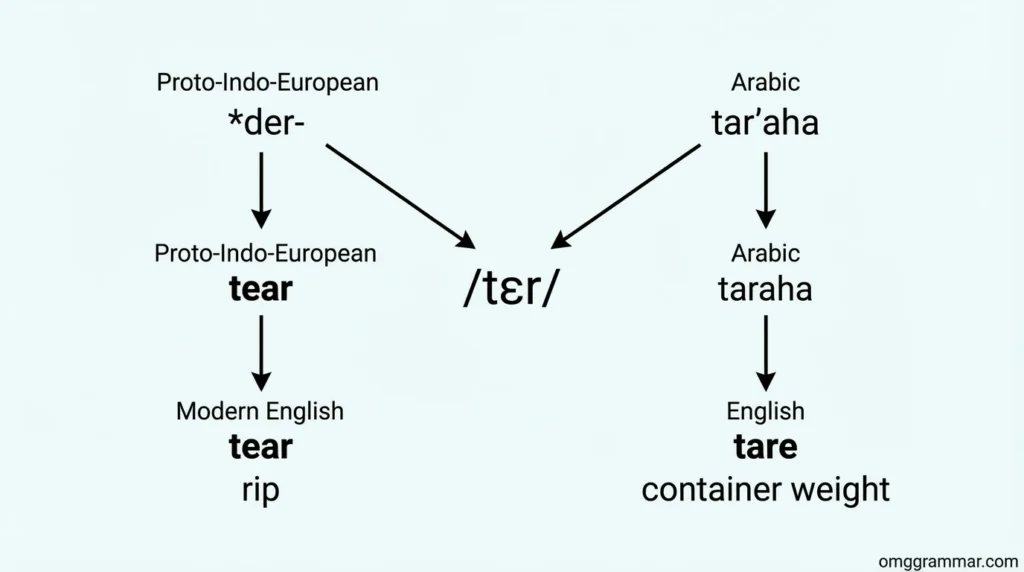
This chart shows why tear and tare confuse people. They started in different language families thousands of miles apart. They carried unrelated meanings through separate cultures. Then English pronunciation changes made them sound exactly alike, creating a homophone pair that shares nothing except sound.
American and British English
Both American and British English use “tear” and “tare” identically. Regional differences don’t affect these words. Pronunciation stays consistent—both rhyme with “air” in all English-speaking countries.
Common Mistakes When Using Tear vs Tare
People make predictable errors with these homophones, usually in technical writing where “tare” belongs but “tear” appears instead. Understanding these patterns helps avoid mistakes.
| Incorrect | Correct | The Fix |
| The shipping container’s tear weight is 3,000 pounds. | The shipping container’s tare weight is 3,000 pounds. | Use “tare” for container weight in shipping and commerce. “Tear” makes no sense in this context. |
| Please tare the paper carefully along the edge. | Please tear the paper carefully along the edge. | Use “tear” for ripping actions. “Tare” only works with scales and weights. |
| The tear of the empty box must be subtracted. | The tare of the empty box must be subtracted. | Use “tare” when discussing weight deductions. “Tear” would mean a rip in the box, not its weight. |
| I need to tear the scale before weighing ingredients. | I need to tare the scale before weighing ingredients. | Use “tare” as the verb for zeroing a scale. “Tear” would mean breaking the scale. |
| The tare in his jacket needs repair. | The tear in his jacket needs repair. | Use “tear” for holes or rips in fabric. “Tare” has no meaning for clothing damage. |
The psychological trigger behind these errors is context blindness. Writers focus so hard on technical accuracy that they overlook word choice. Someone writing a shipping document thinks about weights and containers but doesn’t catch that they typed “tear” instead of “tare.”
Autocorrect causes problems too. Modern spell-checkers recognize both words as correct. They won’t flag “tear weight” as an error even though it’s nonsense. Writers must catch these mistakes manually.
Speed creates errors. Typing quickly, your fingers produce “tear” because it’s the more common word. Your brain knows you mean “tare” but your hands default to the familiar spelling. Proofreading becomes essential.
Practical Tips for Using Tear vs Tare Correctly
Mastering these homophones requires both knowing the rule and developing habits that catch errors before they reach readers. Here’s how to get it right consistently.
Real-World Editing Experience
In 2020, while editing technical documentation for a shipping company, I found “tear weight” scattered throughout a 50-page manual. The deadline was tight—we needed to submit the manual for ISO certification within three days. Every instance of “tear weight” made the company look unprofessional and raised questions about measurement accuracy.
I searched the entire document and found 47 instances. The writer, an engineer who understood shipping perfectly, had consistently typed “tear” instead of “tare.” His fingers defaulted to the common word while his brain focused on technical content.
We fixed every instance, but it taught me an important lesson: subject matter experts often make homophone errors precisely because they’re thinking about concepts rather than spelling. The engineer knew container weights perfectly. He just didn’t register that he was typing the wrong homophone.
That experience showed me that expertise doesn’t prevent spelling errors. If anything, deep focus on technical content makes you more vulnerable to homophone confusion. You need systematic checking, not just knowledge.
Memory Tricks That Work
The simplest trick: think “tare = rare.” Both have the “are” ending, and tare is the rarer word. You’ll use “tear” 99% of the time in normal writing. When you need the rare word about weights, you need “tare.”
Another method: “tare” rhymes with “air,” and air weighs something. Containers have air weight—that’s their tare. This connection links sound to meaning.
For “tear,” picture tearing paper. The action is “tear.” The result is a “tear.” Both spellings are “tear” because they’re the same word in different forms.
A practical shortcut: If you’re writing about anything except commercial weighing, scientific scales, or shipping weights, use “tear.” The specialized term “tare” appears only in narrow contexts.
Conclusion
Use “tear” for everyday writing about ripping, breaking, or separating things by force. Use “tare” exclusively in technical contexts involving commercial weighing, shipping documentation, or scientific measurement. The context almost always makes the correct choice obvious.
Tear vs tare demonstrates how English creates confusion through pure linguistic coincidence. These words evolved in completely different language families—Germanic versus Arabic—and carried unrelated meanings for centuries. Sound changes made them homophones in modern English, but no meaning connection exists between ripping something and weighing containers.
Understanding that these words share no historical or semantic connection helps prevent confusion. They’re not two meanings of one word—they’re two entirely different words that happen to sound alike. Treat them as separate vocabulary items that accidentally collided in pronunciation.
Master this distinction by checking context carefully. If you’re discussing weights and measurements in commercial or scientific writing, “tare” is probably correct. For everything else, “tear” fits. That simple decision rule covers nearly all cases you’ll encounter.
FAQs
“Tear” means to rip something or a hole from ripping, while “tare” means the weight of an empty container.
Both words pronounced like this rhyme with “air” and sound exactly alike. That’s what makes them homophones—identical sound, different meanings.
Use “tare” only for container weight in commercial, shipping, or scientific contexts. If you’re writing about weighing goods, shipping containers, or lab procedures, “tare” is correct.
No, you tear paper, not tare it. “Tare” only works as a verb meaning to zero a scale or to calculate container weight.
Tare weight is the weight of an empty container, box, or vehicle. Subtract tare from gross weight to get net weight (just the goods inside).
Yes. Tare entered English in the 1400s from Arabic through Italian trade language and remains standard in commercial and scientific contexts.
They sound exactly alike but mean completely different things. The brain struggles with homophones that have zero meaning overlap.
No, that’s incorrect. “Tear weight” is meaningless. The correct term is “tare weight” for container or packaging weight in commercial contexts.
“To tare” means to zero a scale or to calculate container weight. Lab technicians tare their balances before measuring chemicals. Shipping clerks tare scales before weighing packages.
No, both varieties use “tear” and “tare” identically. Pronunciation and meaning stay consistent across all English-speaking regions.