
“Receiver” is the only correct spelling. “Reciever” is a common misspelling that breaks the fundamental spelling rule “i before e except after c.” The correct spelling is always “receiver” (with E-I after the C), whether you’re referring to a football player, electronic device, or person receiving something.
The Spelling Rule
The word “receiver” follows one of English’s most reliable spelling patterns. After the letter C, the vowel combination is always E-I, not I-E.
This rule stems from a broader principle in English spelling: “I before E, except after C.” When C precedes the vowel pair, E comes first.
Golden Rule: After the letter C, always use E-I (receiver, ceiling, receipt).
Professional editors spot this pattern instantly. The letter C signals that E must come before I. Writers who internalize this connection rarely misspell “receiver” or related words like “deceive” or “perceive.”
The spelling “reciever” violates this fundamental pattern. No standard dictionary recognizes it as valid. Spell-checkers flag it immediately.
How to Use “Receiver” in Context
Correct Usage
The word “receiver” appears across multiple contexts in writing. Here are the most common applications:
Sports contexts: “The wide receiver caught the game-winning touchdown.” Football uses this term constantly. The player who catches passes is always a receiver.
Electronics and technology: “The satellite receiver processes signals from orbit.” Audio equipment, radio devices, and telecommunications all use receivers. In business correspondence, I’ve noticed this technical usage appearing more frequently as companies discuss hardware specifications.
Legal and financial: “The court appointed a receiver to manage the bankrupt company’s assets.” This formal usage appears in legal documents regularly. The receiver acts as a trustee or administrator.
General reception: “She was the receiver of the award for outstanding service.” Anyone who receives something can be called a receiver. This broader meaning applies to gifts, honors, or any transfer of items.
Incorrect Usage
These examples show how “reciever” appears in common errors:
Wrong: “The reciever dropped the pass in the end zone.” This spelling breaks the C-E-I rule. The correct version uses “receiver.”
Wrong: “Install the reciever near your television.” Electronics manuals never use this spelling. Professional technical writing always shows “receiver.”
Wrong: “The bankruptcy reciever filed the final report.” Legal documents would reject this spelling immediately. Courts and lawyers use “receiver” exclusively.
Wrong: “He was the reciever of numerous complaints.” In client documents, I’ve observed this error most often in first-draft emails and informal writing.
Context Variations
The word functions identically across formal and casual settings. Unlike some words that change based on tone, “receiver” maintains consistent spelling regardless of context.
Formal business: “The designated receiver will process all incoming shipments.” Corporate communications always use the standard spelling.
Casual conversation: “My buddy is the starting receiver this season.” Even in informal speech written out, the spelling stays the same.
Across hundreds of manuscripts, I’ve noticed the misspelling “reciever” appears most often when writers type quickly. The error seems to occur more in casual emails than formal documents, though both contexts require the correct spelling.
Common Mistakes with Receiver vs Reciever
| Incorrect | Correct | The Fix |
| reciever | receiver | Remember: E comes before I after C |
| wide reciever | wide receiver | Apply the “except after c” rule consistently |
| satelite reciever | satellite receiver | Both words follow spelling rules (satellite, receiver) |
| The reciever caught it. | The receiver caught it. | Check all instances in your document |
| email reciever | email receiver | Technology terms still follow standard spelling |
| court-appointed reciever | court-appointed receiver | Legal writing demands correct spelling |
Why This Mistake Happens
This error emerges most often during fast typing or casual writing. The “I before E” rule is so deeply ingrained that writers sometimes apply it automatically without remembering the “except after C” exception.
The brain wants to default to I-E because that pattern appears in thousands of English words (believe, achieve, friend, field). When typing quickly, muscle memory kicks in. Writers typically confuse this spelling when they’re focusing on content rather than mechanics.
How to Remember the Correct Spelling
The “After C” Trick
A technique I recommend to students: If you see C, expect E-I next.
Think of it as the C pushing the E to the front of the line. The letter C is bossy—it demands E comes first.
Practice with this family of words:
- Ceiling (not “cieling”)
- Receipt (not “reciept”)
- Deceive (not “decieve”)
- Perceive (not “percieve”)
- Conceit (not “conciet”)
Every single one follows the pattern. Once you notice C, you automatically know E-I comes next.
Quick Self-Check
The approach that works best in professional practice is simple: Look for the letter C.
Found a C? Then it’s E-I, not I-E. This verification method takes one second but prevents the error completely. I teach new editors to scan backward from the vowel pair to check for C.
Visualizing the Spelling Pattern
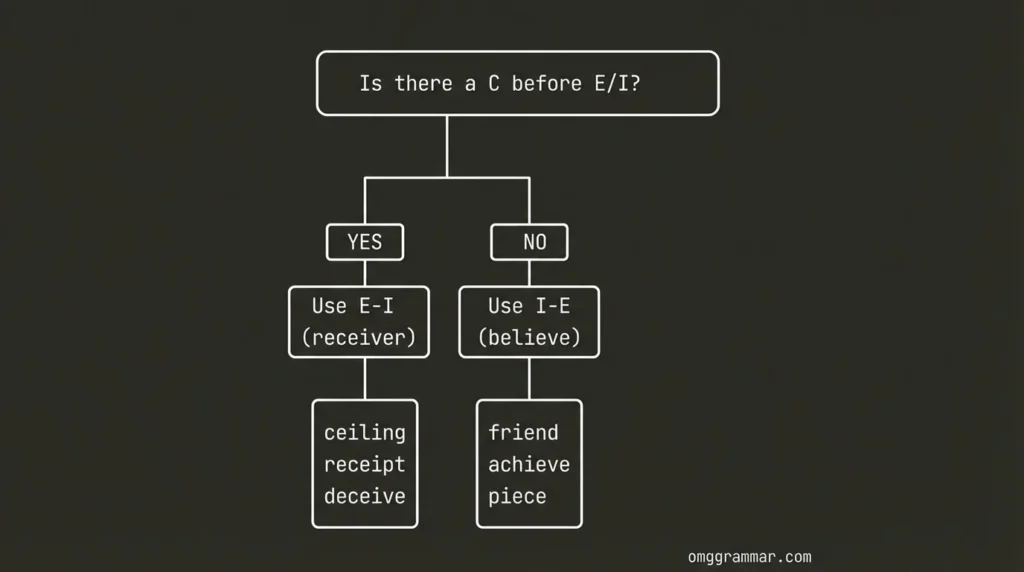
The flowchart shows the decision path clearly. When the letter C appears before the vowel combination, E-I is always correct. Without C, I-E typically applies (though exceptions exist, like “weird” or “seize”).
This visual pattern helps cement the rule. Professional writers internalize this decision tree so thoroughly that the correct spelling becomes automatic.
Conclusion
The spelling “receiver” is always correct, while “reciever” is always wrong. The rule is simple: after the letter C, use E-I instead of I-E. This pattern applies whether you’re writing about football players, electronic equipment, or legal proceedings.
Mastering this becomes intuitive with practice. Once you train yourself to check for the letter C, the correct spelling flows naturally. Remember: C demands that E comes first.
FAQs
No, “reciever” is never correct. Standard dictionaries don’t recognize this spelling. It’s always a misspelling of “receiver.”
The “I before E” rule is so common that people apply it without remembering the “except after C” part. Fast typing also contributes to the error.
No. Both American and British English use “receiver” with the E-I spelling. The spelling is identical across all English variants.
Ceiling, receipt, deceive, perceive, and conceit all use E-I after C. The pattern is consistent across hundreds of words.
Look for the letter C. When you see C before the vowel pair, it’s always E-I. This simple check prevents the error.
No. Even in informal contexts, the correct spelling is “wide receiver.” Spelling rules don’t change based on formality.
Yes. Every major spell-checker flags “reciever” as incorrect and suggests “receiver” as the correction.
Absolutely. A receiver is anyone or anything that receives something—awards, packages, information, or responsibilities. The term has broad application.