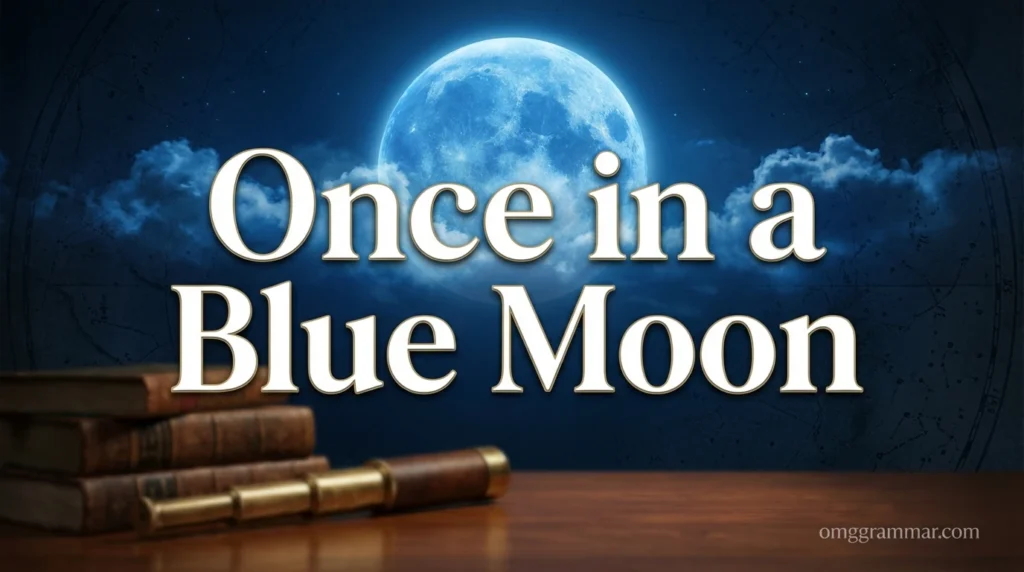
“Once in a blue moon” means something happens very rarely or almost never. When someone uses this phrase, they’re describing an event that occurs so infrequently you might wait years between occurrences. The idiom has nothing to do with the moon’s actual color—it’s purely figurative language that speakers use to emphasize extreme rarity. People say “once in a blue moon” in casual conversation, informal writing, and everyday speech when “rarely” or “seldom” feels too plain.
What Does “Once in a Blue Moon” Mean?
“Once in a blue moon” is a fixed idiomatic expression meaning “very rarely” or “almost never.”
The phrase functions as an adverbial expression that modifies how often something happens. When speakers use this idiom, they’re emphasizing that the event in question occurs so infrequently that it’s remarkable or unexpected.
Key characteristics:
- It’s a fixed phrase—you can’t change the wording to “twice in a blue moon” or “during a blue moon”
- It always means extreme rarity, never frequency
- It’s informal and conversational (not suited for formal academic writing)
- The phrase is metaphorical—no actual blue moon is required
Golden Rule: Use “once in a blue moon” when you want to emphasize that something happens so rarely it’s almost never.
Writers employ this idiom because it’s more vivid and memorable than simply saying “rarely.” The moon imagery creates a stronger impression than plain adverbs. In my editing work, this phrase appears most often in narrative writing, casual blog posts, and conversational dialogue.
Professional writers understand that idioms like this one add personality to writing. The phrase carries a slightly whimsical tone that makes prose feel more human and less robotic.
How to Use in Context
Correct Usage in Everyday Situations
The idiom works naturally in countless contexts where you’re describing rare occurrences:
Personal Habits:
- “I eat fast food once in a blue moon—maybe three times a year.”
- “She calls her sister once in a blue moon, which creates tension.”
- “Once in a blue moon, he actually cleans his apartment.”
- “We go to the movies once in a blue moon since streaming became popular.”
Social Activities:
- “They throw parties once in a blue moon, so everyone shows up.”
- “Once in a blue moon, the whole family gets together for dinner.”
- “He cooks once in a blue moon, and it’s always an adventure.”
Work and Professional Settings:
- “Our boss compliments people once in a blue moon.”
- “The system crashes once in a blue moon, but it’s always at the worst time.”
- “We get snow days once in a blue moon in this city.”
People use this phrase when the rarity itself is noteworthy. Students learning English often ask whether they can use it in formal writing—generally, the answer is no. Save it for casual contexts.
Correct Grammatical Placement
The phrase typically appears at the beginning or end of sentences:
Beginning Position:
- “Once in a blue moon, I’ll have a glass of wine.”
- “Once in a blue moon, something unexpected happens.”
End Position:
- “I see my childhood friends once in a blue moon.”
- “That kind of opportunity comes around once in a blue moon.”
Mid-Sentence (Less Common):
- “He would, once in a blue moon, surprise everyone with his kindness.”
You should avoid splitting the phrase apart. You wouldn’t say “once in a moon that’s blue” or “in a blue moon, once”—the expression is fixed.
Tone and Context Variations
The idiom carries different subtle meanings depending on context:
Neutral Observation:
- “It rains once in a blue moon here.” (Simple fact)
Regret or Disappointment:
- “We spend time together once in a blue moon.” (Wish it were more)
Positive Rarity:
- “Once in a blue moon, everything goes perfectly.” (Appreciating rare good fortune)
Humorous Exaggeration:
- “He’s on time once in a blue moon.” (Playful criticism)
You can master this nuance naturally through repetition. The surrounding context signals whether you mean disappointment or simple observation.
Common Mistakes with “Once in a Blue Moon”
| Incorrect | Correct | The Fix |
| “I see him twice in a blue moon.” | “I see him once in a blue moon.” | The phrase is fixed—always “once” |
| “Once in the blue moon, we visit.” | “Once in a blue moon, we visit.” | Use “a” not “the” |
| “It happens once in blue moon.” | “It happens once in a blue moon.” | Include the article “a” |
| “Once in a blue moon times.” | “Once in a blue moon.” | Don’t add “times”—it’s redundant |
| “He comes once or twice in a blue moon.” | “He comes once in a blue moon.” | Can’t modify “once”—it’s fixed |
Why These Mistakes Happen
This error pattern emerges when learners treat the idiom like a regular phrase instead of a fixed expression. Students sometimes try to make the phrase more specific by adding “twice” or “three times,” but idioms don’t work that way.
The mistake increases among non-native speakers who haven’t internalized that certain English phrases are frozen in form. You can’t change idioms the way you’d modify regular phrases.
I’ve observed this confusion across beginner-level writing. People think logically: “If once is rare, twice must be rarer!” But idioms follow their own rules. “Once in a blue moon” is the only correct form—you can’t adjust it to match your exact frequency.
Another common error is dropping the article “a.” Speakers sometimes say “once in blue moon,” which sounds incomplete to native ears.
How to Remember
The Rarity Connection
Think about blue moons in reality. A blue moon (the second full moon in a calendar month) happens roughly every 2-3 years. That’s genuinely rare—not impossible, but infrequent enough to be special.
Connect the phrase to this actual rarity. If something happens “once in a blue moon,” it’s like waiting for that rare astronomical event. You might experience it a few times in your life, but not regularly.
A technique I recommend to students: Picture yourself waiting for the moon to turn blue. You’d wait a long time, right? That’s the feeling the idiom captures—long waits between occurrences.
The Quick Test
Ask yourself: “Does this happen so rarely I could count the occurrences?”
- YES → “once in a blue moon” fits
- NO → Use “rarely” or “occasionally” instead
If something happens weekly, monthly, or even a few times per year, it’s not “once in a blue moon” territory. Reserve the phrase for truly exceptional rarity.
After using the idiom correctly a few dozen times, you develop an instinct for when it fits.
Other Ways to Say “Once in a Blue Moon”
Similar Idioms and Expressions
English offers many alternatives when “once in a blue moon” doesn’t fit the context:
Equally Informal:
- “Once in a while” (less rare—means occasionally)
- “Every now and then” (moderate frequency)
- “From time to time” (slightly more formal)
- “Hardly ever” (very close in meaning)
- “Once in a lifetime” (even rarer—usually once ever)
More Formal Alternatives:
- “Rarely” (plain adverb)
- “Infrequently” (academic tone)
- “Seldom” (literary quality)
- “On rare occasions” (professional writing)
- “Scarcely ever” (formal)
Regional Variations:
- “Once in a coon’s age” (Southern US, informal)
- “Once in a dog’s age” (dated, informal)
Writers choose among these based on formality level and exact frequency. “Once in a blue moon” sits at the informal, conversational end of the spectrum. Colleagues working on business reports typically opt for “rarely” or “infrequently” instead.
The idiom has more personality than its formal alternatives, which is why people love using it in casual contexts.
When to Use and Avoid
Best Contexts for This Idiom
Use in:
- Casual conversation
- Informal emails to friends or family
- Creative writing and dialogue
- Social media posts
- Personal narratives
Strong Situations:
- Describing personal habits (“I cook once in a blue moon”)
- Talking about rare events (“We see each other once in a blue moon”)
- Adding personality to informal prose
- Creating relatable, human tone
When to Choose Alternatives
Avoid in:
- Academic papers
- Business reports
- Technical documentation
- Legal writing
- Professional presentations
- Formal correspondence
People sometimes ask whether idioms ever work in professional settings. The answer depends on industry and company culture. Creative agencies might embrace “once in a blue moon” in internal communications, while law firms would find it too casual.
Professionals find that matching language to context matters more than following rigid rules. Read the room—if everyone else speaks formally, switch to “rarely.”
Conclusion
“Once in a blue moon” means something happens very rarely or almost never. It’s a fixed idiomatic expression that adds personality to casual writing and conversation. The phrase always takes this exact form—you can’t change “once” to “twice” or drop the article “a.”
Remember the connection to actual blue moons, which occur every 2-3 years. That real-world rarity reflects the idiom’s meaning. If you’re describing something truly infrequent, “once in a blue moon” captures it perfectly.
Save this phrase for informal contexts. In formal writing, switch to “rarely” or “infrequently.” But in everyday speech and casual prose, this idiom adds warmth and relatability that plain adverbs can’t match.
Speakers master idioms through exposure and practice. Once you’ve heard “once in a blue moon” used correctly dozens of times, you’ll develop an intuition for when it fits naturally.
FAQs
It means very rarely or almost never. The phrase describes something that happens so infrequently you might go years between occurrences.
No, “once in a blue moon” is a fixed idiom. You can’t change “once” to “twice” or any other number.
It’s informal and conversational. Use it in casual writing and speech, but avoid it in academic papers, business reports, or formal correspondence.
A blue moon is the second full moon in a calendar month. It happens roughly every 2-3 years, making it genuinely rare (though the moon doesn’t actually look blue).
No, the phrase is metaphorical. “Blue moon” refers to the rare astronomical event, not an actual color change.
Generally no. The phrase is too casual for most professional contexts.
No, “once in a while” means occasionally (moderate frequency), while “once in a blue moon” means very rarely (extreme infrequency).
The phrase connects to the rare astronomical phenomenon of blue moons (two full moons in one month). Writers started using it in the 1800s to describe rare events.