
A leotard is a one-piece garment that covers the torso, while tights are skin-tight legwear that covers from the waist down. The key difference: leotards are tops (like a bodysuit), and tights are bottoms (like fitted pants or hosiery). Many dancers, gymnasts, and athletes wear both together, which creates confusion between these two distinct pieces of clothing.
The Core Difference Between Leotards and Tights
Understanding the leotard vs tights distinction starts with recognizing what each garment covers.
A leotard is a one-piece garment that fits snugly over the torso. It typically covers from the shoulders down to the crotch, similar to a swimsuit. Leotards can have long sleeves, short sleeves, or no sleeves. They leave the legs bare unless paired with separate legwear.
Tights are form-fitting legwear extending from the waist down to the feet or ankles. They’re essentially hosiery or very fitted pants. Tights cover the legs and sometimes feet, but don’t cover the upper body.
Golden Rule: Leotards cover your torso; tights cover your legs. Think bodysuit versus fitted pants.
Professional costume designers distinguish these instantly by asking: “What part of the body does it cover?” In my editing work with dance publications, this pattern appears when writers describe performance attire—the leotard is always the top layer over the torso, while tights go underneath as legwear.
The confusion happens because performers often wear them together. A dancer might wear a leotard over tights, creating a complete outfit. But they’re two separate garments.
How to Use Leotard and Tights in Context
Correct Usage of “Leotard”
Dance and gymnastics: “She wore a black leotard for her ballet class.” The leotard is the standard upper garment for dance training. It allows instructors to see body alignment and movement.
Performance wear: “The gymnast’s competition leotard featured intricate beading.” Competitive leotards are often elaborate and designed for specific routines.
Costume references: “The superhero costume started with a basic leotard as the foundation.” In client documents, I’ve noticed costume designers use leotards as base layers before adding other elements.
Correct Usage of “Tights”
Dance attire: “Ballet dancers wear pink tights to create a clean line.” Tights are essential in classical ballet, providing coverage while maintaining the silhouette.
Athletic wear: “Compression tights help runners maintain muscle support.” Modern athletic tights serve functional purposes beyond appearance.
Everyday fashion: “She paired her dress with black tights for warmth.” Tights work as regular clothing items, not just performance wear.
Using Both Together
Combined outfit: “The dancer wore a purple leotard over pink tights.” This combination is standard in dance studios worldwide. The leotard covers the torso while tights cover the legs.
Layering description: “She pulled on her tights first, then slipped into her leotard.” Across hundreds of dance-related manuscripts, I’ve observed this dressing sequence described consistently—tights first, then leotard over them.
Incorrect Usage
Wrong: “She wore tights on her upper body.” Tights don’t cover the torso. The correct term would be “leotard” or “top.”
Wrong: “His leotard covered his legs completely.” Leotards don’t extend down the legs. If legwear is involved, it’s tights worn with the leotard.
Wrong: “The ballet tights had sleeves.” Tights don’t have sleeves because they’re legwear. This describes a leotard.
Wrong: “She bought new leotards to wear under her skirt.” For legwear under a skirt, use “tights,” not leotards.
Context Variations
The leotard vs tights distinction remains consistent across all contexts. Professional dancewear catalogs, casual gym conversations, and costume design specifications all maintain the same definitions. Regional variations exist—some areas call tights “pantyhose” or “stockings”—but the fundamental difference between torso coverage (leotard) and leg coverage (tights) stays constant.
Common Mistakes with Leotard vs Tights
| Incorrect | Correct | The Fix |
| “tights with sleeves” | “leotard with sleeves” | Tights are legwear only; sleeves indicate a leotard |
| “leotard covering the feet” | “leotard with tights” | Leotards don’t extend to feet; add tights for leg coverage |
| “put tights over your torso” | “put a leotard on” | Tights cover legs; leotards cover the torso |
| “her leotards were torn at the knee” | “her tights were torn at the knee” | Leotards don’t have knees; tights do |
| “wearing just tights” for full coverage | “wearing a leotard and tights” | Specify both garments if both body parts are covered |
Why This Confusion Happens
This mistake emerges most often when people describe dancewear without hands-on experience. The terms seem interchangeable because dancers wear them together so frequently.
People often confuse these when writing about dance or gymnastics for the first time. Someone who’s never worn dance attire might see a performer in “something tight-fitting” and not realize it’s two separate pieces. The visual similarity adds to confusion—both items are form-fitting, stretchy, and come in similar colors.
How to Remember the Difference
The Body Part Trick
A technique I recommend to students: Leotards cover your “Leo” (torso/body). Tights cover your “legs.”
Think of a lion (leo) having a body. The leotard goes on the main body. Think of “tights” sounding like “legs tight”—they fit tightly on your legs.
The Clothing Category Method
The approach that works best in professional practice:
- Leotard = Top/Bodysuit (like a shirt or swimsuit)
- Tights = Legwear (like pants or stockings)
When shopping, leotards appear in “tops” or “bodysuits.” Tights appear with “legwear” or “hosiery.”
Quick Self-Check
Ask yourself: “What body part am I covering?”
- Torso/upper body → Leotard
- Legs/lower body → Tights
- Both → Leotard AND tights (two items)
Visualizing Leotard vs Tights
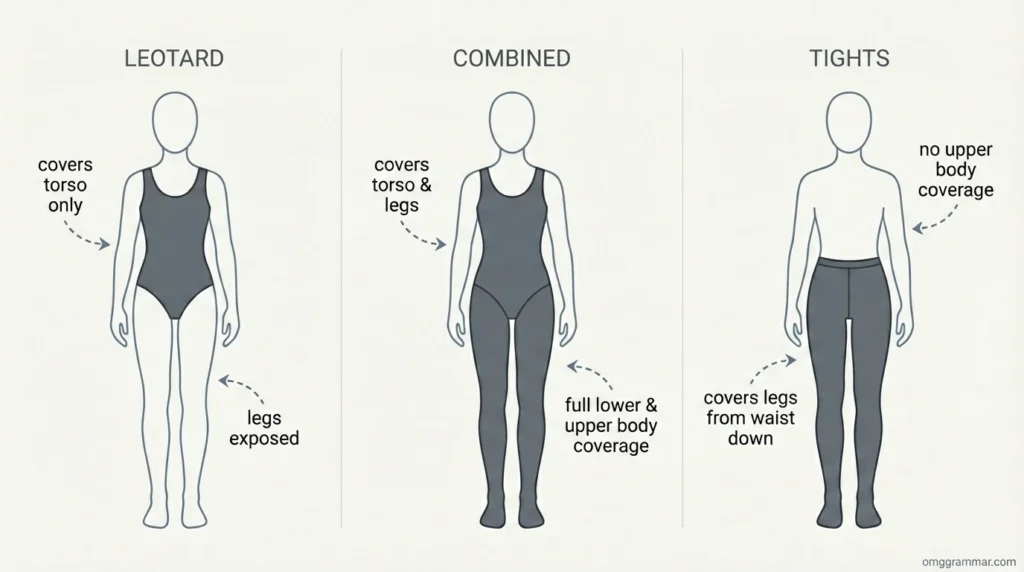
The diagram illustrates the fundamental distinction. The leotard covers the torso but leaves legs bare. Tights cover the legs but provide no upper body coverage. The center shows how dancers combine both pieces for full coverage while maintaining movement freedom.
When to Wear Each
When to Wear a Leotard
Dance and gymnastics training: Leotards allow instructors to see body positioning and muscle engagement clearly.
Performance situations: Competition leotards stay securely in place during complex movements.
Activities requiring torso support: The snug fit provides support during athletic movements while allowing full leg mobility.
When to Wear Tights
Leg coverage in dance: Classical ballet particularly requires tights to create the aesthetic line and keep legs warm.
Cold weather layering: Tights add warmth under skirts or dresses without bulk.
Athletic compression: Modern performance tights offer muscle support and moisture-wicking properties.
When to Wear Both
The combination creates the standard dance uniform. Wear both when you need full-body coverage with maximum flexibility. This pairing dominates ballet studios, gymnastics centers, and figure skating rinks worldwide.
Word Origins
The term “leotard” honors Jules Léotard, a French acrobat who developed the trapeze act in the 1850s. He created the tight-fitting one-piece garment for aerial performances. The outfit became associated with his name, entering English around the 1880s.
“Tights” comes from “tight,” meaning close-fitting. The term emerged in the 18th century for tight-fitting leg coverings in theatrical performances. Both terms reflect their functional origins—the leotard for acrobatic movement, tights for sleek leg lines.
Conclusion
The leotard vs tights distinction is straightforward once you remember what each covers. Leotards cover your torso like a bodysuit, while tights cover your legs like fitted pants. They’re often worn together in dance and athletics, but they’re two completely different garments.
Remember: leotard equals torso coverage, tights equal leg coverage.
FAQs
A leotard covers the torso (like a bodysuit), while tights cover the legs (like fitted pants). They’re two distinct garments often worn together but serving different purposes.
Yes. Leotards can be worn alone, leaving the legs bare. Many gymnasts and dancers wear just leotards, especially in warm environments.
Absolutely. Tights are commonly worn with regular clothing—under skirts, with tunics, or as athletic wear with any top.
Not quite. Leggings are typically thicker and more opaque than tights, and they don’t usually cover the feet. But functionally, both are legwear.
Yes. Male dancers and gymnasts regularly wear both, though men’s versions often have slightly different cuts and styles.
If a one-piece garment covers both torso and legs, it’s called a “unitard” or “catsuit,” not a leotard.