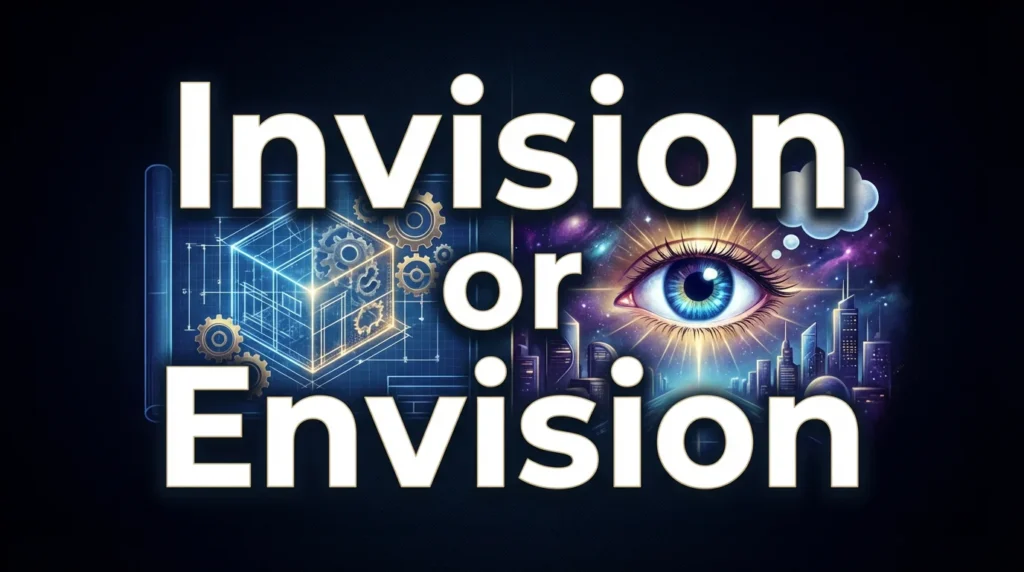
Choosing between invision or envision matters for writers, editors, product teams, and anyone who wants clear, professional prose. In this guide I explain the difference, show how each form functions in sentences, and annotate the parts of speech (nouns, verbs, adjectives, adverbs, prepositions, conjunctions, pronouns) so you can write with confidence.
Envision (verb) is the standard and widely accepted form meaning “to imagine or picture a future possibility”: we envision a cleaner design. Invision is usually a proper noun (brand name) or an error when used as a verb; it is not a substitute for envision in general writing. We will check verb tense and subject–verb agreement, review articles and prepositions for precision, and place modifiers next to the words they modify to avoid ambiguity.
I will give contextual examples, list common mistakes, compare American and British tendencies, explore idiomatic expressions, and share practical tips that editors and writers can apply immediately.
Contextual Examples
General Usage With Envision
Example: We (pronoun) envisioned (verb, past simple) a (article) quieter (adjective) urban (adjective) street (noun).
Analysis: Subject–verb agreement: we (plural) pairs with envisioned (past plural form is identical to singular past; context fits). Envision is a verb meaning to form a mental image. Here the verb takes a direct object (a quieter urban street), which is a noun phrase. Modifiers quieter and urban are adjacent to street, so meaning is precise.
Why this works: Envision correctly expresses a mental projection, and the verb frame (subject + envision + object) is clear and grammatical.
Brand Name Invision (Proper Noun)
Example: We reviewed the InVision (proper noun) prototype (noun) and (conjunction) left (verb, past simple) feedback (noun).
Analysis: InVision (capitalized, proper noun) refers to a specific design collaboration tool. The sentence treats it as a noun: the prototype created in the InVision system. Subject–verb agreement: we reviewed — correct. When using InVision, capitalize and treat it as brand name to avoid confusion.
Usage note: Do not lowercase Invision when you mean the product; use the vendor’s preferred capitalization if known (often InVision).
Incorrect Verb Form With Invision
Faulty: We (pronoun) invisioned (verb) the strategy.
Why it’s wrong: Invision used as a verb is nonstandard; the correct verb is envision. Fix: We envisioned the strategy. Parts of speech: we (pronoun), envisioned (verb), the (article), strategy (noun). Subject–verb agreement remains correct.
Present Participle And Progressive Forms
Example: We (pronoun) are (auxiliary verb, present) envisioning (present participle) a new onboarding flow (noun phrase).
Analysis: Are envisioning forms present progressive; auxiliary are matches plural subject we. Use progressive to emphasize ongoing imagining or planning.
Adjective And Noun Derivatives
Example: Their (possessive pronoun) envisioned (past participle used adjectivally) solution (noun) impressed (verb) the team (noun).
Analysis: Envisioned acts as adjective modifying solution. Subject–verb agreement: solution (singular) impressed (singular past) the team — but here we must check: solution impressed the team needs to be rephrased: Their envisioned solution impressed the team. Correct: Their envisioned solution (subject) impressed (verb) the team (object). Grammar is sound.
Infinitive Uses
Example: We aim (verb, present) to (infinitive marker) envision (verb, base) a future state (noun phrase).
Analysis: To envision here is an infinitive functioning as direct object of aim. Keep infinitive marker to with verb base and maintain tense consistency in the main clause.
Common Mistakes
Mistake: Using “invision” as a Verb Instead of “envision”
Faulty: She (pronoun) invisioned (verb) the final product.
Why it’s wrong: Invision is not a standard English verb. The correct verb is envision.
Fix: She envisioned the final product. Parts of speech: she (pronoun), envisioned (verb), the (article), final (adjective), product (noun). Subject–verb agreement checks out.
Editorial Tip: Search-and-replace tools should not blindly convert invision to envision if the capitalized brand InVision is present; review case and context.
Mistake: Lowercasing Brand Name
Faulty: We used invision for wireframes.
Why it’s wrong: Brand names are proper nouns and usually require capitalization. Lowercasing creates ambiguity.
Fix: We used InVision for wireframes. Parts of speech: we (pronoun), used (verb), InVision (proper noun), for (preposition), wireframes (noun). Subject–verb agreement is correct.
Mistake: Confusing Pronunciation And Spelling
Some writers attempt invision because it mirrors spoken forms, but spelling must match the intended word. If the meaning is “to picture mentally,” use envision. If the writer references the tool, use InVision.
Grammar checklist: Identify whether the target is a verb (action) or a noun (brand/product) before choosing spelling and capitalization.
Mistake: Incorrect Verb Tense After Envision
Faulty: We (pronoun) envision yesterday a new layout.
Why it’s wrong: Tense inconsistency. When placing a time adverb like yesterday, use past tense.
Fix: We envisioned a new layout yesterday. Parts of speech: we (pronoun), envisioned (verb, past), a (article), new (adjective), layout (noun), yesterday (adverb). Subject–verb agreement and tense are correct.
Mistake: Using Envision With Passive Meaning Without Auxiliary
Faulty: The future envisioned by the team.
Why it’s awkward: This fragment lacks an active verb or a full clause; to use passive voice correctly, include auxiliary.
Fix: The future was envisioned by the team. Or more direct: The team envisioned the future. Parts of speech: the (article), future (noun), was (auxiliary), envisioned (past participle as verb), by (preposition), the (article), team (noun).
American vs British English Differences
Spelling And Usage
Both American and British English use envision as the standard verb form meaning “to imagine.” There is no major regional spelling variation for envision; British writers sometimes prefer synonyms like envisage (verb), which is common in British English. Envisage and envision are near synonyms but carry slight stylistic differences.
Example (American): We envision a scalable system.
Example (British): We envisage a scalable system.
Analysis: Both sentences are grammatical in their respective dialects; choose the verb that best fits register and audience. When writing for a global audience, envision is widely understood and safe; envisage reads slightly more British/formal.
Brand Name Recognition
If referring to the design tool (brand), American and British users will likely encounter InVision in similar ways. Maintain brand capitalization and check trademark guidelines in marketing copy.
Tone And Register
British English sometimes favors more hedged phrasing (we envisage rather than we envision), while American English may use envision in confident, forward-facing corporate language. These are stylistic tendencies, not hard rules.
Idiomatic Expressions
Envision As Part Of Fixed Phrases
• Envision a future — common collocation: envision (verb) + a + noun phrase.
• Envision how — envision (verb) + how (conjunction/adverb) + clause.
• Envision the possibility — verb + determiner + noun.
Example: We (pronoun) envision how (conjunction) new features (noun phrase) will (auxiliary) improve (verb) retention (noun).
Envisage Versus Envision
When writing for British audiences or a formal journal, envisage may be preferable.
Example: We envisage several regulatory scenarios. Analysis: envisage functions identically grammatically to envision but can alter tone.
Brand-Based Idioms
When the brand InVision is part of a sentence, treat it as a noun and pair it with appropriate verbs:
• We prototype in InVision. (preposition in + proper noun)
• The InVision mockup shows layout. (proper noun + noun)
Creative Uses And Wordplay
Writers sometimes create puns or brand-driven phrases: We envisioned the feature, then built it in InVision. The juxtaposition can be effective when you mean both the act of imagining and the platform used to prototype.
Grammar tip: Keep capitalization consistent to avoid confusing the verb envision with the brand InVision.
Practical Tips
Tip 1: Decide Meaning From Context First
Before you type, ask: Do we mean “to imagine” or the design tool? If it’s imagining, use envision; if it’s the product, use InVision.
Quick test: Can you replace the word with picture or imagine? If yes, use envision. If no (refers to a brand), use InVision.
Tip 2: Capitalize Brand Names Correctly
If referring to the company or product, capitalize consistently: InVision (or the vendor’s official styling). Proper nouns require capitalization and often appear with trademark formatting in marketing materials.
Tip 3: Use Envision With Correct Verb Forms
Check tense and subject agreement: we envisioned (past), she envisions (present singular), they are envisioning (progressive). Maintain parallelism in lists: we envision, we plan, we execute.
Tip 4: Avoid Mixing Envision And Envisage Without Purpose
If your site targets an international audience, choose one term for consistency, or explicitly note regional variants: “Envision (US) / Envisage (UK).” This helps readers and translators.
Tip 5: Keep Modifiers Close
Avoid dangling modifiers: Faulty: Envisioned by the team, the future looked promising. This structure suggests the future did the envisioning. Fix: Envisioned by the team, the roadmap looked promising. Better: The team envisioned a promising future. Place agents next to actions to maintain clarity.
Tip 6: Watch Passive Voice With Envision
Passive: A new direction was envisioned by leadership. Active is often clearer: Leadership envisioned a new direction. Choose active voice to increase authority and readability unless the actor is unimportant.
Tip 7: Spell-Check Brand Names Separately
Automated spell-checkers may flag InVision as an error. Add brand names to the dictionary to avoid accidental autocorrect to envision or invision. Conversely, watch for auto-capitalization that turns envision into Envision undesirably.
Tip 8: Use Parallel Structures When Listing
Correct: We envision product features, define user flows, and validate designs. Each verb is base form and parallel, improving readability.
Tip 9: Localize Carefully
For localization or translation, provide context: label whether the word is a verb or a brand name. Translators will choose appropriate equivalents (for example, imaginar in Spanish for envision, or leave brand name untranslated).
Tip 10: Edit For Concision
Replace weak phrasing. Faulty: We were envisioning the possibility that the product might become more scalable over time. Better: We envisioned a more scalable product. Shorter, clearer sentences improve reader comprehension and SEO metrics.
Conclusion
In most prose, envision is the correct verb when you mean “to imagine” or “to picture a possibility.” Use InVision (capitalized) for the product or brand, and treat it as a proper noun. Keep modifiers adjacent to the words they modify, verify verb tense and subject–verb agreement around envision, and prefer active voice for clarity. For British readers consider envisage as an alternative in formal contexts, but avoid mixing variants without reason.
FAQs
- Q: Is “invision” ever correct as a verb?
A: No. Use envision as the verb meaning “to imagine.” Invision is typically a brand name and should be capitalized when used as such. - Q: How do I write the design tool name correctly?
A: Use the product’s official styling, often InVision (proper noun); treat it as a brand and capitalize it consistently. - Q: What is the British alternative to “envision”?
A: Envisage is commonly used in British English and carries the same basic meaning; choose one term and remain consistent for clarity. - Q: Can I use “envisioned” in passive voice?
A: Yes — e.g., A new strategy was envisioned by the team — but active voice (The team envisioned a new strategy) is usually clearer and stronger. - Q: Should I change “invision” to “envision” automatically in edits?
A: Not automatically. Check context: if the sentence refers to the brand, keep InVision; if it means “imagine,” correct to envision. - Q: How do I check verb tense and agreement with “envision”?
A: Match the auxiliary and main verb to the subject: we envisioned (past), she envisions (present singular), they are envisioning (progressive plural). - Q: Does “envision” have noun or adjective forms?
A: There is no common noun envision; use vision (noun) or envisioned (past participle used adjectivally) as in an envisioned plan. - Q: How should we handle localization for the brand name?
A: Leave the brand name untranslated and provide context in a string for translators; ensure consistent capitalization in all localized copies.