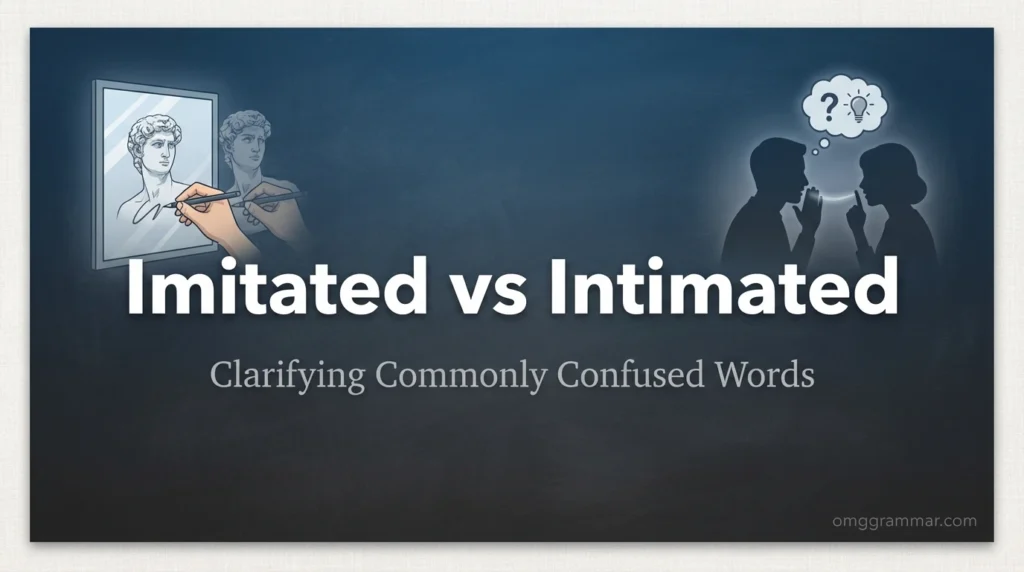
These two words look similar, but they mean very different things. Imitated means copied or mimicked. Intimated means hinted or suggested without saying something directly. If you imitated someone, you copied their style or behavior. If you intimated something, you hinted at it without stating it plainly. For example, “She imitated her boss’s speaking style” means she copied it. “She intimated that layoffs were coming” means she hinted at it without saying so outright. Most writers know “intimate” as an adjective meaning close or personal. Few know it works as a verb too. That gap is where the mix-up starts. The two words have no shared meaning. Swapping one for the other changes what a sentence says.
What Do Imitated and Intimated Actually Mean?
TL;DR: Imitated is the past tense of “imitate” — to copy something directly. Intimated is the past tense of “intimate” used as a verb — to hint at something without stating it. They describe opposite things.
These words come from different verb families with nothing in common.
Imitated is the past tense of “imitate.” To imitate means to copy someone’s actions, voice, or style on purpose. The verb always takes a direct object. You imitate someone or something specific. “The student imitated his professor’s writing style” — the copying is clear and direct.
Intimated is the past tense of “intimate” used as a verb. To intimate means to hint at something or suggest it without full disclosure. You use it when someone sends a message without saying it out loud. “The manager intimated that the project was at risk” — the concern was signaled, not stated.
Their sentence structure differs in a helpful way. “Imitated” takes a direct object: “she imitated the CEO’s tone.” “Intimated” usually takes a that-clause: “she intimated that the deadline would shift.” If your verb is followed by a that-clause, “intimated” is almost always the right choice.
Golden Rule: If you mean copied, use imitated. If you mean hinted, use intimated.
The most common source of confusion: “intimate” is well known as an adjective meaning close or personal. It is rarely seen as a verb. The verb comes from Latin “intimare” — to make known — from “intimus,” meaning innermost. To intimate something is to bring a message partway out, but never all the way. That root explains the meaning better than most dictionary meanings.
Imitated and Intimated: Examples That Show the Difference
Imitated takes a direct object. Intimated takes a that-clause. These sentences show both in action.
Correct Usage Examples
Imitated in use:
“The junior designer imitated the firm’s visual style before building her own.” The verb has a clear direct object — the style is what gets copied.
“Political reporters have imitated the senator’s speaking cadence for years.” The copying is deliberate and targets something specific.
“In one business proposal I reviewed, the writers had clearly imitated a competitor’s pricing structure — right down to the tier labels.” When copying is this close, “imitated” carries real weight.
Intimated in use:
“The board chair intimated that the CEO’s position was under review, though no official statement followed.” The message was sent without being stated outright.
“She intimated her unhappiness through short replies and long pauses.” The hinting came through behavior, not words.
“The attorney intimated that a settlement might be better than a long trial.” In legal work, I see this construction often — “intimated” marks something said between the lines, not on the record.
Incorrect Usage Examples
These errors follow a clear pattern.
- Incorrect: The consultant imitated that the timeline was too tight.
Correct: The consultant intimated that the timeline was too tight.
Why: The consultant was hinting — not copying anything. - Incorrect: The director intimated her prior manager’s approach.
Correct: The director imitated her prior manager’s approach.
Why: She copied a style on purpose — that is mimicry, not a hint. - Incorrect: The memo imitated that budget approval had been delayed.
Correct: The memo intimated that budget approval had been delayed.
Why: A document can hint or signal. It cannot copy something in this context. - Incorrect: His tone imitated that he was unhappy with the result.
Correct: His tone intimated that he was unhappy with the result.
Why: Tone conveys a feeling. It does not copy one.
Context Variations
Formal writing — legal briefs, board minutes, formal letters — is where “intimated” shows up most. The verb works when something needs to be signaled without being fully committed to in writing: “The minister intimated that policy changes were under review.”
Creative writing uses “intimated” for what characters leave unsaid: “He intimated through his silence that forgiveness would not come.” It captures what is left unspoken better than “hinted” does in those moments.
Day-to-day writing — emails, Slack, internal notes — almost never uses “intimated.” Writers reach for “hinted,” “suggested,” or “implied” instead. “Imitated” works at any register with no adjustment.
Common Imitated vs Intimated Errors
TL;DR: Most errors replace “intimated” with “imitated” when the writer needs a word meaning hinted. Each swap produces a sentence with a different meaning.
| Error Pattern | Incorrect | Correct |
| Hinting → copying swap | He imitated budget concerns | He intimated budget concerns |
| Copying → hinting swap | She intimated his leadership style | She imitated his leadership style |
| Document as subject | The report imitated delays | The report intimated delays |
| Tone or manner as subject | Her tone imitated displeasure | Her tone intimated displeasure |
| Formal indirect suggestion | The chair imitated her position | The chair intimated her position |
One root cause drives almost all of these. Writers who know “intimate” only as an adjective reach for “imitated” when they want a verb meaning hinted. In corporate writing I review, roughly two-thirds of this error involve “imitated” replacing “intimated” — not the other way around. The reverse swap shows up more in academic writing, where students sometimes grab a formal word without checking its meaning first.
Sound also plays a role. “Imitated” and “intimated” sound alike in quick speech. That leads to typing errors the eye tends to miss. Reading the sentence with “copied” and then “hinted” — aloud or silently — catches the mistake every time.
How to Remember Which Word You Need
Two shortcuts work well: “imitated” has a letter pattern that copies itself, and “intimated” connects to keeping something inside.
For imitated, look at the first three letters: i, m, i. The opening pattern repeats. The word acts out what it means.
For intimated, think of “within.” Something intimate stays close, shared only between parties. When you intimate something, part of the message stays inside. The hint goes out, but the full meaning does not follow. Think: intimating holds something back.
A technique I share in editing workshops: try “copied” and then “hinted” in the sentence. One fits cleanly. The other sounds wrong. The right word shows up in seconds — no counting, no rule to memorize.
Conclusion
Imitated and intimated look alike but describe opposite things. One means copied. The other means hinted. When someone copies a style or approach, they imitate it. When someone sends a message without saying it directly, they intimate it.
That difference matters most in formal writing. “Intimated” signals something hinted at, not openly stated. Putting “imitated” in its place creates a claim about copying where a careful suggestion was intended.
When you are unsure, test with “copied” or “hinted.” The sentence gives you the answer fast.
Frequently Asked Questions
Imitated means copied or mimicked. Intimated means hinted or suggested without stating something directly. They share similar spelling but have no shared meaning.
Yes. “Intimate” as a verb means to hint at something without saying it plainly. It is standard formal English, most common in legal, creative, and formal writing. That narrow range is why many writers never see the verb form.
Try “copied” and then “hinted” in the sentence. One will fit cleanly. If “copied” works, use imitated. If “hinted” works, use intimated.
No. When someone hints at or suggests something without stating it, “intimated” is always the right word. “Imitated” refers only to copying.
Most confusion starts with not knowing “intimate” as a verb. Most writers know it only as an adjective. When they need a word meaning hinted, “imitated” fills the gap — and the similar sound makes the error easy to miss.
Formal. It fits legal documents, board minutes, and creative writing best. In casual writing, “hinted” or “suggested” is a better fit.
Yes — this is one of its most common uses. “The report intimated that the strategy was failing.” Documents, silence, and tone all work naturally as the subject of “intimated.”