The difference between day off vs off day comes down to presence and performance. A day off means scheduled time away from work—a planned absence where you choose not to work. An off day means you’re physically present but performing below your usual level due to low energy, poor mood, or mental fog. Word order changes everything.
Why Do These Two Phrases Trip Up Your Brain?
Your brain struggles with day off vs off day because of what neuroscientists call Cognitive Load Theory. When you hear or read these phrases, your working memory processes the exact same words in different positions. This creates what researchers term a “split-attention effect.”
Here’s what happens inside your head: Your brain must simultaneously decode word position, grammatical function, and contextual meaning. Since working memory can only hold about four chunks of information at once, this triple processing task pushes your cognitive limits. The result? You might use the wrong phrase without realizing it.
The confusion gets worse in spoken English because both phrases sound nearly identical when said quickly. Your auditory processing system receives the same phonemes but must rely entirely on word order to distinguish meaning.
Historical Evolution and Core Concepts
English inherited its compound noun structures from Germanic languages, where word order determines meaning with surgical precision. In Old English, compounds formed through strict positional rules that modern English still follows.
Etymology and Germanic Compound Formation
The word “off” entered English from Old English “of,” meaning “away from.” This preposition transformed over centuries into both an adverb and an adjective, creating the modern confusion. Germanic Compound Formation rules explain why “day off” stresses the first word while “off day” distributes stress differently.
In historical Germanic languages, postpositive modifiers (coming after the noun) typically indicated separation or removal. That’s why “day off” literally meant “day away from work.” The compound structure followed what linguists call right-headed modification, where the modifier clarifies the type of day.
Conversely, when “off” precedes “day,” it functions as a prepositive attributive adjective. This pattern emerged later in English development, borrowing from Romance language influences where adjectives could precede nouns to emphasize quality over identity.
Grammatical Mechanics and Attributive Adjective Phrases
The core distinction rests on grammatical function. An Attributive Adjective Phrase places the descriptive word before the noun, creating a quality-first emphasis. When you say “off day,” the adjective “off” characterizes the entire day as aberrant or substandard.
The Golden Rule: Word order determines function. “Day off” treats “off” as a postpositive modifier indicating absence; “off day” uses “off” as a prepositive qualifier indicating poor quality.
In “day off,” the phrase functions as a nominal compound where stress falls on “day.” Phonetically, you’d say DAY-off. The stress pattern signals that “day” carries the semantic weight while “off” provides directional information.
For “off day,” stress distributes more evenly: OFF-day. This balanced stress pattern indicates that both words contribute equally to meaning. The adjective-noun structure makes “off” inseparable from “day” in determining the phrase’s reference.
How These Phrases Work in Real Contexts
Both phrases appear frequently in American and British English, but context determines which one fits. The distinction matters because using the wrong phrase in professional settings can confuse your message or even change its meaning entirely.
Formal Academic and Professional Usage
In formal writing, “day off” appears in scheduling contexts, HR documentation, and legal agreements. You’ll find it in employment contracts specifying paid time off or vacation policies. The phrase carries neutral-to-positive connotations because it represents planned, approved absence.
Example: “The employee requested a day off on March 15th to attend a medical appointment.” In this sentence, “day off” functions as the direct object of “requested.” The phrase operates as a countable noun—you can have one day off, two days off, or multiple days off throughout the year.
Active voice dominates professional usage: “I’m taking a day off” rather than “A day off was taken by me.” This active construction emphasizes the worker’s agency in scheduling their own time.
Casual Conversational Contexts
“Off day” thrives in informal speech where people describe subpar performance or low energy. Athletes use it constantly: “LeBron had an off day, shooting just 30% from the field.” The phrase acknowledges temporary struggle without assigning permanent inadequacy.
Text messages frequently feature this phrase: “Having an off day, might skip dinner tonight.” Notice how speakers use it to explain unusual behavior or request understanding. The phrase serves as social shorthand for “I’m not myself today.”
Tone shifts dramatically between the phrases. “Day off” sounds celebratory or matter-of-fact, while “off day” carries apologetic or explanatory weight.
The Nuance Trap: When Both Sound Wrong
Sometimes neither phrase perfectly captures your meaning. You might feel tempted to say “I’m off today” to mean you have no work, but this sounds incomplete to native ears. The fuller “I’m on my day off” or “I’m taking a day off” sounds more natural.
Similarly, “I’m having an off day” works better than “It’s my off day” when describing poor performance. The continuous aspect (“having”) emphasizes the temporary nature of the situation, whereas “It’s my off day” sounds like you’re announcing a scheduled break.
Native speakers often say “I’m off today” in casual speech, relying on context to clarify whether they mean a scheduled break or poor performance. However, this ambiguity makes the phrase risky in professional communication.
Day Off and Off Day in Literature
Classic American literature demonstrates how these phrases evolved in English usage. Writers chose between them based on rhythm, emphasis, and semantic precision.
Classic Literature
In Mark Twain’s “The Adventures of Tom Sawyer” (1876), we find instances of characters discussing time away from obligations, though Twain often used more elaborate constructions than our modern shortened form. The concept of a “day off” existed but hadn’t yet crystallized into the compact phrase we use today.
Twain’s characters spoke of having “a day to themselves” or being “free from duties for the day.” The wordier construction reflected 19th-century speech patterns where speakers valued elaborate phrasing over brevity. As American English evolved toward efficiency, these phrases condensed into “day off.”
Jack London’s “The Call of the Wild” (1903) includes descriptions of dogs having poor performance days without using the exact phrase “off day.” London wrote: “Buck was beaten, but he was not broken.” This demonstrates the concept—a day when performance suffers—without the modern terminology.
These historical examples show that while the concepts existed, the specific two-word phrases represent 20th-century linguistic compression. As workplace culture formalized, so did the vocabulary surrounding work schedules and performance variability.
Modern Stylistic Usage
Contemporary workplace fiction uses “day off” and “off day” to build character and establish power dynamics. In modern corporate thrillers, a character might say: “I need a day off” to signal burnout, while “I’m having an off day” might excuse a crucial mistake that drives the plot forward.
Business communication guides in 2026 emphasize the importance of distinguishing these phrases. A manager who confuses them in an email might accidentally suggest an employee performed poorly when they merely took vacation. Such miscommunication can create HR issues or damage workplace relationships.
Modern style guides recommend using “day off” for any scheduled absence and reserving “off day” exclusively for discussions of performance, mood, or energy levels. This distinction prevents ambiguity in remote work environments where written communication dominates.
Synonyms and Distinguishing the Phrases
Understanding semantic neighbors helps clarify when to use each phrase. Both have alternatives that might better suit specific contexts.
Semantic Neighbors and Alternatives
For “day off,” consider these Attributive Adjective Phrase alternatives:
- Rest day: Emphasizes recuperation over mere absence
- Break day: Highlights interruption in routine
- Leave day: More formal, common in British English
- Free day: Stresses freedom from obligations
Each alternative shifts the semantic frame slightly. “Rest day” implies physical or mental recovery, while “free day” emphasizes liberty. In professional contexts, “leave day” carries more weight because it references official policy.
“Off day” alternatives include:
- Rough day: Emphasizes difficulty over poor performance
- Tough day: Similar to rough, but slightly more sympathetic
- Bad day: More general, less specific about performance
- Struggle day: (Informal) Highlights effortful coping
The illocutionary force differs across these options. Saying “I had a bad day” makes a broader claim about overall experience, while “I had an off day” specifically addresses performance or energy levels.
Visualizing the Difference
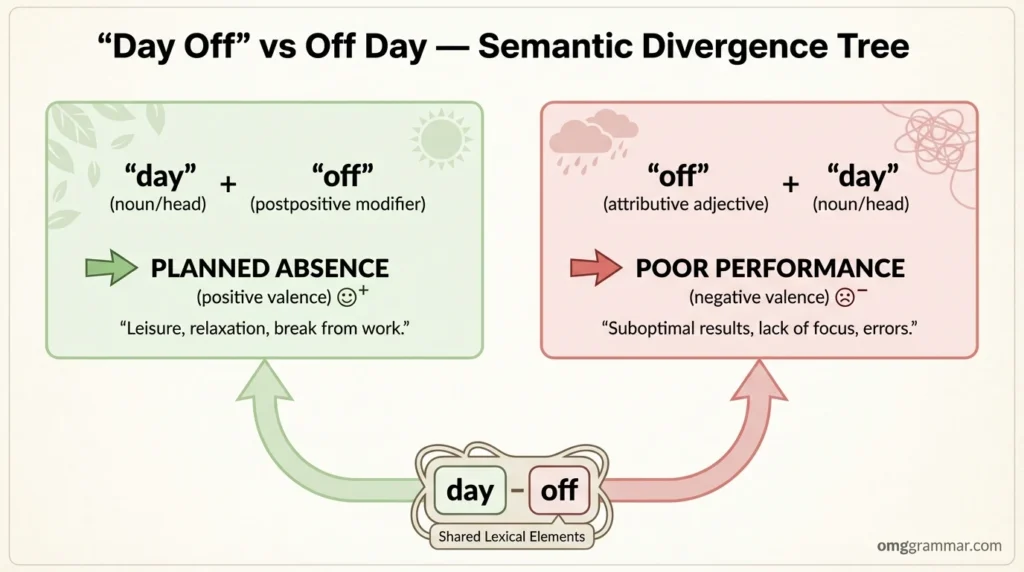
The visual representation clarifies how identical words create opposite connotations through positional change. This grammatical phenomenon appears throughout English but rarely with such clear semantic opposition.
Regional Variations: US vs UK
American English strongly prefers “day off” in workplace contexts. You’ll hear it in every industry from tech to manufacturing. British English accepts “day’s leave” or “day’s holiday” as equally valid alternatives, though “day off” has gained ground since the 1990s.
In sports commentary, both American and British speakers use “off day” identically. Athletes worldwide have off days regardless of which side of the Atlantic they’re on.
Australian English follows British patterns but with American influence increasing in recent decades. Canadians typically use “day off” in line with American usage, though French Canadian speakers might calque from “jour de congé.”
Common Mistakes People Make
Five errors dominate when speakers confuse day off vs off day. Each stems from the cognitive load issues discussed earlier, where working memory fails to properly track word order.
| Incorrect | Correct | The Fix |
| “I’m taking an off day tomorrow.” | “I’m taking a day off tomorrow.” | “Off day” means poor performance, not scheduled absence. Use “day off” for planned breaks. |
| “He had a day off and missed three shots.” | “He had an off day and missed three shots.” | “Day off” implies he didn’t play. “Off day” means he played poorly. |
| “Can I get my off day on Friday?” | “Can I get my day off on Friday?” | When requesting time off, always use “day off.” “Off day” isn’t something you request. |
| “Every athlete needs off days to rest.” | “Every athlete needs days off to rest.” | Pluralize correctly: “days off” for scheduled rest, not “off days.” |
| “I’m feeling a day off today.” | “I’m having an off day today.” | Use “having” with “off day” to describe current poor performance. |
The psychological trigger behind these errors is called hypercorrection. Speakers overgeneralize one pattern to contexts where it doesn’t apply. Someone who learned “day off” first might incorrectly assume “off day” is just a casual variant, when actually the phrases occupy different semantic spaces.
Another trigger involves interference from other languages. Spanish speakers might confuse these because “día libre” (free day) translates better to “day off,” but their conceptual framework doesn’t include a separate phrase for performance dips. This linguistic gap increases error rates in L2 English speakers.
Practical Tips and Field Notes
Mastering day off vs off day requires both understanding the rule and building muscle memory through practice. These field-tested techniques help cement the distinction.
The Editor’s Field Note
In 2019, while editing a union contract for a manufacturing company, I caught a critical error that could have cost the employer thousands. The draft read: “Workers may request off days with two weeks’ notice.” This phrasing implied workers could schedule days when they’d perform poorly—obviously not the intent.
I changed it to: “Workers may request days off with two weeks’ notice.” The stress of that deadline remains vivid—red pen in hand, fluorescent lights humming, knowing that one misplaced word could trigger a labor dispute. After I circulated the correction, the HR director called within an hour: “How did we all miss that?”
That moment taught me something visceral about these phrases: legal documents demand precision because ambiguity creates liability. Since then, I’ve developed a reflex check whenever I see either phrase in professional writing. I ask: “Is this about scheduling or performance?” The answer determines which phrase works.
Mnemonics and Memory Aids
Try this rhyme to remember the difference:
“Day off’s when you rest and recharge your brain, Off day’s when your game just isn’t the same.”
Or use this visual trick: Picture “off” as a door. In “day off,” you’re walking out the door (leaving work). In “off day,” the door is broken (something’s wrong with the day itself).
Another method involves hand gestures. For “day off,” wave goodbye (you’re leaving). For “off day,” put your palm up in a “stop” gesture (something’s not right).
Associate “day off” with other two-word phrases where the second word starts with “off”: “kick off,” “send off,” “time off.” All involve departure or separation. Associate “off day” with other phrases where “off” acts as an adjective: “off color,” “off brand,” “off base.” All indicate deviation from normal.
Conclusion
The distinction between day off vs off day might seem minor, but precise language prevents costly misunderstandings in professional and personal contexts. Remember that “day off” describes scheduled absence with positive or neutral connotations, while “off day” identifies temporary poor performance with sympathetic undertones.
Word order matters in English because it determines grammatical function. When “off” follows “day,” it creates a compound noun meaning planned break. When “off” precedes “day,” it becomes an attributive adjective meaning subpar performance.
Master this distinction not just for correctness, but for clarity. In 2026’s hybrid work environment, where so much communication happens asynchronously through text, the right phrase prevents confusion and preserves professional relationships. Next time you write either phrase, pause for one second to confirm you’re saying what you actually mean.
FAQs
Day off means scheduled time away from work, while off day means a period of poor performance or low energy. Day off is something you plan and request. Off day happens unexpectedly when you’re not at your best despite trying.
No. Always use “day off” when requesting scheduled time away.
Yes, but only when discussing performance issues. You can write “The team had an off day in Q3” to explain below-average results.
Days off. The plural form shifts “day” to “days” while “off” stays the same. Never say “offs day” or “day offs.”
Day off appears more frequently overall because people discuss scheduled time off more than they discuss poor performance days.
Both. Athletes can take a day off from training (scheduled rest) or have an off day during competition (poor performance).
“I’m off today” is more casual and can be ambiguous without context. “I have a day off” clearly indicates scheduled time away from work.
Cognitive Load Theory explains the confusion. Your working memory processes the same words in different positions, creating split-attention effects that overwhelm processing capacity.
Mostly yes, but it can also describe feeling mentally or physically off without a specific performance metric.
Both work. “Day off” is standard American usage. “Leave” is more formal and common in British English, particularly in “annual leave” or “sick leave” contexts.