
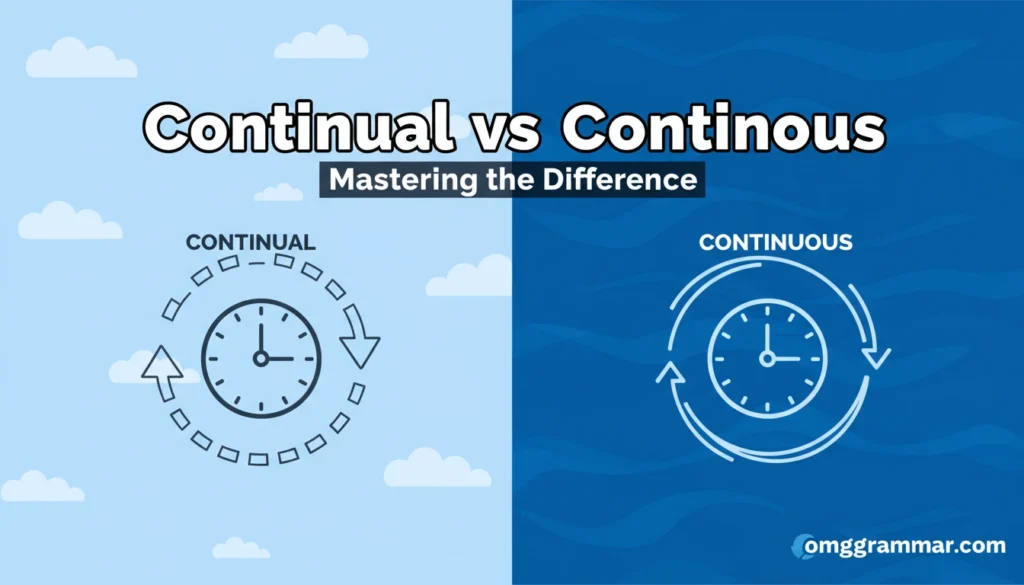
Continual vs continuous describe different patterns of time and repetition. “Continual” means happening repeatedly or frequently with breaks in between, like continual rain showers that stop and start. “Continuous” means happening without any interruption or pause, like continuous rainfall that never stops. Both words describe ongoing situations, but continual allows for breaks while continuous demands unbroken flow.
Why Do Writers Struggle With Continual vs Continuous?
Your brain gets confused by continual vs continuous because of temporal pattern processing working in complex ways. When you try to describe something that keeps happening, your brain must first decide: am I counting separate events (continual) or measuring unbroken duration (continuous)? That mental sorting process doesn’t happen consciously, so you often pick the wrong word.
Truth is, both words sound similar and relate to things that keep going. The similarity tricks your brain into thinking they’re interchangeable. You hear “continued” and think both continual and continuous must mean the same thing since they share the same root word.
The confusion deepens because these words overlap in casual speech. People say “continual problems” and “continuous problems” to mean roughly the same thing—ongoing difficulties. In everyday conversation, nobody stops you to ask whether the problems have breaks between them or happen non-stop.
But in formal writing, especially technical or scientific contexts, the distinction matters. Medical equipment provides “continuous monitoring”—it never stops watching. Therapy sessions offer “continual support”—regular help with breaks between appointments. Using the wrong word in these contexts changes your meaning completely.
Where Did Continual and Continuous Come From?
Both words trace back to Latin roots about holding together and continuing, but they entered English through different paths at different times. Understanding this history shows why the modern distinction developed and why it sometimes feels artificial.
The Earlier Word: Continual
“Continual” arrived first, entering Middle English around 1340 from Old French “continuel.” The French word came from Latin “continuus,” meaning “uninterrupted” or “joining together.” Early English writers used “continual” for both meanings—things that happened repeatedly AND things that happened without stopping.
For several hundred years, “continual” did all the work. Writers described “continual rain” whether it stopped between showers or poured non-stop for days. The word carried no specific distinction about interruptions. Context told readers which meaning fit.
Medieval and Renaissance texts show this flexible usage. A chronicler might write about “continual wars” meaning both frequent battles with peace in between and also unending conflict. Readers understood from surrounding details which sense the writer intended.
This broad meaning worked fine until English speakers wanted more precision. As scientific and technical writing developed in the 1600s-1700s, people needed clearer vocabulary to describe exact observations. That need created pressure for word specialization.
The Newcomer: Continuous
“Continuous” appeared around 1640, borrowed directly from Latin “continuus.” Early users treated it as a synonym for “continual”—just another way to say the same thing. But gradually, writers started using “continuous” specifically for unbroken duration.
By the 1700s-1800s, the split was happening. “Continual” started specializing toward repeated events with breaks. “Continuous” claimed the territory of uninterrupted flow. Grammar books and dictionaries began noting the difference, though not everyone followed the distinction strictly.
The specialization made sense linguistically. English often creates fine distinctions by keeping both a French-derived word and a Latin-derived word, assigning each to slightly different meanings. “Continual” (from French) handles frequency. “Continuous” (from Latin) handles duration.
Modern usage continues this split in formal writing. Academic papers, technical manuals, and scientific reports maintain the distinction carefully. But casual speech still treats them as rough synonyms, creating the confusion that persists today.
The Rule: Use “continual” for repeated events with breaks between them. Use “continuous” for ongoing action without any interruption.
Both words modify time, but they describe different time patterns. “Continual” emphasizes regularity and frequency—how often something happens. “Continuous” emphasizes duration and persistence—how long something goes without stopping.
How Do You Use Continual vs Continuous in Different Situations?
Context and precision determine which word you need. Technical writing, science, and medicine demand strict accuracy. Casual writing allows more flexibility but benefits from knowing the distinction.
Formal and Technical Writing
Scientific papers use “continuous” for unbroken measurements and processes. “The monitor provided continuous readings of heart rate and blood oxygen levels.” The equipment never stopped measuring—truly uninterrupted data collection.
Medical writing distinguishes carefully. “Continuous positive airway pressure (CPAP)” describes air flow that never stops during sleep. “Continual checkups” describes regular appointments with gaps between them. Mixing these terms confuses meaning in medical contexts.
Engineering documents use “continuous” for unbroken operation. “The factory runs on continuous production schedules” means machines operate 24/7 without shutting down. “Continual maintenance” means regular repairs happen frequently but with breaks between them.
Mathematics uses “continuous” with precise technical meaning. A continuous function has no breaks or jumps in its graph. “Continual” doesn’t appear in mathematical definitions because math requires the unbroken sense.
Academic and Professional Writing
Business reports use “continual improvement” to describe ongoing efforts with distinct phases. Companies review processes regularly, make changes, and measure results—repeated cycles, not unbroken activity. “Continuous improvement” would technically mean never-ending optimization without pauses.
Academic research papers maintain the distinction. “Continual revisions of the hypothesis occurred throughout the study” indicates multiple separate changes. “Continuous monitoring of participants” means observation never stopped during certain periods.
Professional journalism sometimes blurs the line but benefits from precision. “Continual updates throughout the day” suggests news comes in batches. “Continuous coverage” implies unbroken broadcasting without commercial breaks or interruptions.
Casual and Everyday Writing
Informal writing relaxes the rules. People write “continual headaches” and “continuous headaches” somewhat interchangeably to mean frequent or persistent pain. Readers generally understand from context without noticing the technical distinction.
Social media and texting ignore the difference entirely. “My phone is continuously dying” and “My phone continually dies” both communicate frequent battery problems. Nobody marks these as errors in casual digital communication.
However, even casual writing improves with precise word choice. “The baby cried continually during the flight” suggests crying happened repeatedly with brief quiet moments. “The baby cried continuously for two hours” emphasizes unbroken wailing. The distinction adds clarity.
Where Have Writers Used These Words in Classic and Modern Texts?
Literature shows how continual vs continuous function across different eras and writing styles. Classic authors used these words before the modern distinction fully solidified, while contemporary writers maintain clearer separation.
Classic Literature
Charles Dickens used “continual” frequently in his novels. In “Bleak House” (1853), he described “continual fog” in London. The fog lifted and returned repeatedly—accurate use of “continual” for intermittent conditions.
Victorian literature generally preferred “continual” because “continuous” was still relatively new and less common. Authors wrote about “continual noise,” “continual interruptions,” and “continual anxiety” to describe recurring rather than necessarily unbroken experiences.
Early scientific writing from the 1800s shows the distinction emerging. Scientists began using “continuous” specifically for unbroken processes they observed—continuous motion, continuous chemical reactions, continuous electrical currents.
Modern Technical and Scientific Writing
Contemporary medical journals use both words precisely. “Continuous glucose monitoring systems” never stop measuring blood sugar levels. “Continual dose adjustments” happen regularly but as separate decision points.
Engineering manuals distinguish clearly. “Continuous operation mode” means equipment runs 24/7. “Continual system checks” means periodic monitoring at regular intervals.
Academic textbooks teach the distinction explicitly. Physics discusses “continuous forces” that never stop acting. Psychology describes “continual reinforcement” that happens repeatedly as discrete events.
Environmental science reports use both appropriately. “Continuous emission monitoring” measures pollution output non-stop. “Continual sampling” collects data at regular intervals with gaps between samples.
What Words Mean the Same as Continual vs Continuous?
Understanding synonyms and related terms helps clarify when to use continual versus continuous. Each word has its own family of similar terms that share the same time-pattern distinctions.
Words Similar to Continual
“Frequent” captures the recurring nature of continual. “Frequent phone calls” and “continual phone calls” both mean calls that happen often with time between them.
“Repeated” works similarly. “Repeated attempts” and “continual attempts” both describe multiple tries with breaks between each one.
“Intermittent” specifically highlights the breaks between events. “Intermittent rain” explicitly means rain that stops and starts—the same pattern “continual rain” describes.
“Recurring” emphasizes the pattern of coming back. “Recurring problems” return regularly, just like “continual problems.”
Words Similar to Continuous
“Constant” suggests unbroken presence or action. “Constant noise” and “continuous noise” both mean noise that never stops.
“Uninterrupted” explicitly states no breaks occur. “Uninterrupted service” and “continuous service” mean the same thing—service that never stops.
“Non-stop” says the same thing more informally. “Non-stop flight” and “continuous flight” both describe flying without landing for refueling.
“Perpetual” suggests endless continuation. “Perpetual motion” and “continuous motion” both mean movement that doesn’t cease.
Visualizing the Pattern
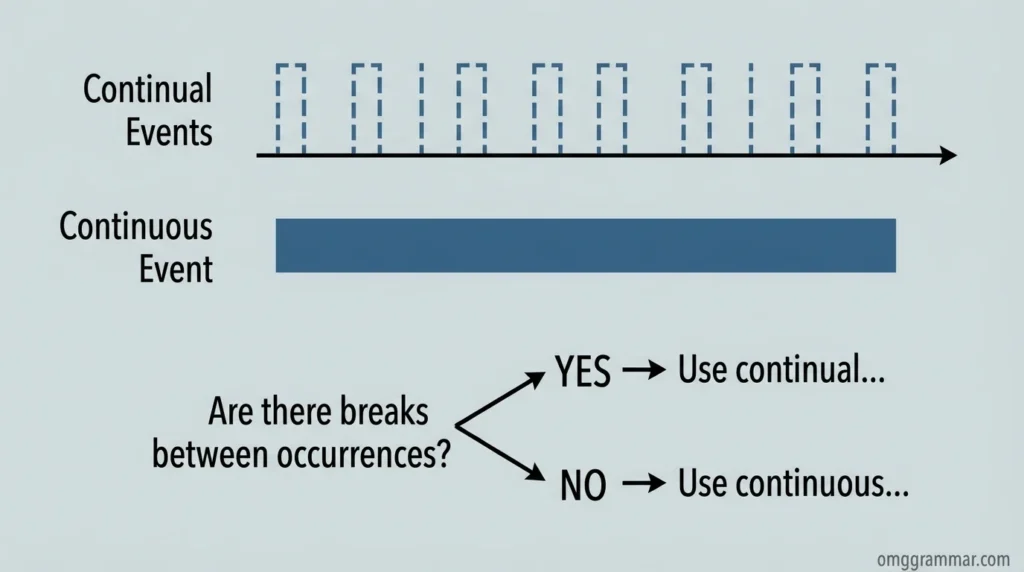
This visualization makes the core distinction visible. Continual creates a pattern of repetition with spaces. Continuous flows without interruption. When you’re unsure which word fits, ask yourself: can I count separate occurrences, or is it one unbroken thing?
No Regional Differences
American and British English use continual vs continuous identically. No spelling differences exist. The distinction operates the same way across all English-speaking regions.
Both formal and informal usage patterns match internationally. British technical writing maintains the same precision as American technical writing. Casual British speakers blur the distinction the same way American speakers do.
Common Mistakes When Using Continual vs Continuous
People make predictable errors with these words, usually by choosing based on which sounds more impressive rather than which meaning fits. Understanding these mistakes helps avoid them.
| Incorrect | Correct | The Fix |
| The machine provides continual monitoring of vital signs. | The machine provides continuous monitoring of vital signs. | Medical monitoring never stops—use “continuous” for uninterrupted data collection. |
| We need continuous meetings to address ongoing issues. | We need continual meetings to address ongoing issues. | Meetings happen repeatedly with breaks between them—use “continual” for regular events. |
| His continuous complaints made the trip unpleasant. | His continual complaints made the trip unpleasant. | Complaints happen repeatedly, not non-stop—even complainers pause to breathe. Use “continual.” |
| The factory operates on a continual production schedule. | The factory operates on a continuous production schedule. | 24/7 operation means no breaks—use “continuous” for non-stop manufacturing. |
| Continuous rainfall means showers stopping and starting. | Continual rainfall means showers stopping and starting. | Rain with breaks between showers is “continual,” not “continuous” which means no stopping. |
The main psychological trigger is formality bias. People think “continuous” sounds more sophisticated or official than “continual,” so they reach for it when writing formal documents. This often produces exactly the wrong word.
Another trigger is the assumption that both words mean the same thing. Writers who don’t know the distinction pick whichever sounds better in their sentence, creating technical errors they don’t recognize.
Speed and lack of proofreading cause problems too. When writing quickly, your brain defaults to whichever word you’ve used more often. If you’ve written “continuous” hundreds of times in technical contexts, it becomes your automatic choice even when “continual” fits better.
Tips for Using Continual vs Continuous Correctly
Mastering this distinction requires both knowing the rule and building mental associations that stick. Here’s how to get it right consistently.
Real-World Editing Experience
In 2015, while editing an environmental monitoring report for a government agency, I discovered the lead scientist had mixed continual and continuous throughout 80 pages. The deadline was crushing—we needed final submission in three days. The errors mattered because the report described both continuous monitoring equipment and continual sampling schedules.
I found “continuous sampling” (wrong—sampling happened at intervals) and “continual data streams” (wrong—the instruments never stopped collecting data). Each error potentially confused regulatory reviewers about the actual methodology.
We spent an entire afternoon reviewing every instance, asking “Does this ever stop?” for each occurrence. If the answer was “yes, during breaks,” we used “continual.” If “no, it runs non-stop,” we used “continuous.” That simple question fixed 67 errors.
The experience taught me that even scientists who understand the distinction intellectually make mistakes when writing quickly. The words look and sound so similar that fingers type the wrong one automatically. Systematic checking beats relying on expertise.
Memory Tricks That Work
The simplest trick: “Continual = recurring = interruptions.” All three words contain the letters “in” and “r.” Picture rain showers that happen intermittently.
For continuous: “Continuous = constant = no stops.” All three have “on” in them and share the “s” sound. Picture a river flowing without pausing.
Another method: think of “continual” as “continuing at intervals.” The word “interval” implies gaps. Think of “continuous” as “continuing straight through” with no breaks in the line.
A visual trick: the word “continual” has gaps between letters. The word “continuous” flows in an unbroken stream of letters. Let the appearance remind you of the meaning.
A practical shortcut: replace the word with “frequent” (for continual) or “constant” (for continuous). If “frequent” works, use “continual.” If “constant” works, use “continuous.” This substitution test catches most errors.
Conclusion
Continual vs continuous demonstrates how English creates fine distinctions by borrowing similar words from different language sources and then specializing their meanings over centuries. “Continual” (from French, 1300s) handles repeated events with breaks. “Continuous” (from Latin, 1640s) describes uninterrupted duration. The split wasn’t immediate—it developed gradually as writers needed more precision.
Use “continual” for things that happen frequently or regularly with pauses between occurrences—continual meetings, continual rain showers, continual problems. Use “continuous” for things that go on without any break—continuous monitoring, continuous rainfall, continuous operation. The core question is simple: are there breaks or not?
Understanding that formal writing demands precision while casual speech allows flexibility helps you make smart choices. Technical documents, scientific papers, and professional reports require strict accuracy. Casual emails and everyday conversation forgive blurring.
FAQs
Continual means repeated with breaks in between, while continuous means without any interruption. Continual describes frequent events that stop and start. Continuous describes unbroken flow or duration.
Not in formal or technical writing. Casual speech often treats them as synonyms, but professional, scientific, and medical writing demand precise usage. Using the wrong word can change your meaning significantly.
Both are correct but mean different things. Continual rain means frequent showers with breaks between them. Continuous rain means non-stop rainfall without any pause.
Doctors use both with specific meanings. “Continuous monitoring” means equipment that never stops watching. “Continual checkups” means regular appointments with gaps between them.
Continual improvement is more accurate. Improvement happens through repeated cycles of change with time between each cycle.
Same distinction as the adjectives. “Continuously” means without stopping. “Continually” means repeatedly with breaks. “The motor ran continuously for 24 hours” versus “She continually checked her phone throughout the day.”
Machines can run continuously (non-stop) or continually (frequently with breaks for maintenance). Use “continuous” for 24/7 operation. Use “continual” for regular operation with scheduled stops.
They sound similar, come from the same root word, and both describe ongoing situations. The difference is subtle—breaks versus no breaks—which brains sometimes miss.
“Continual” is older, appearing around 1340. “Continuous” arrived around 1640. For centuries, “continual” handled both meanings before “continuous” specialized for uninterrupted duration.