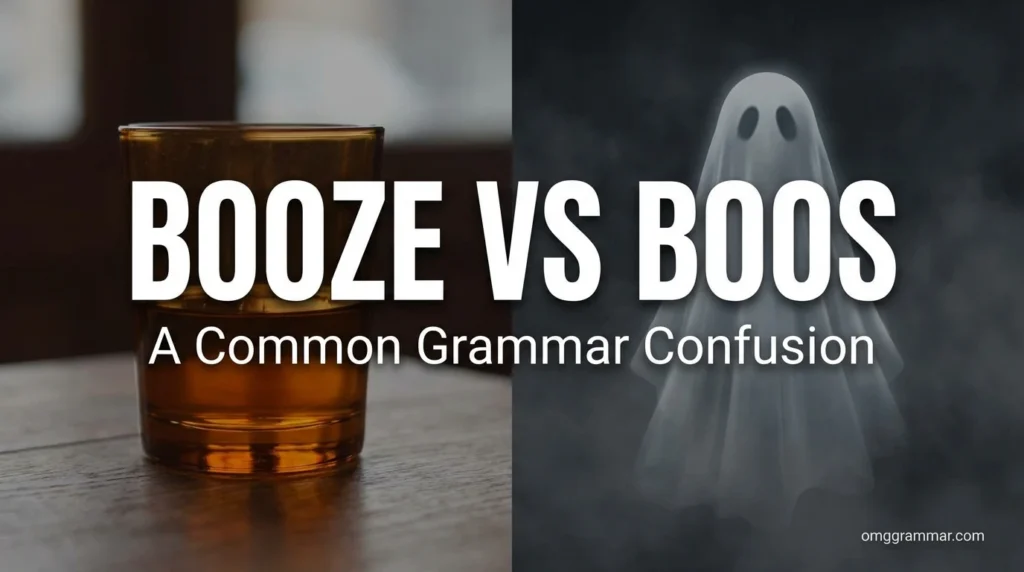
These two words sound exactly the same but mean completely different things. Booze (b-o-o-z-e) refers to alcoholic drinks, while boos (b-o-o-s) are sounds of disapproval. Both share identical pronunciation (/buːz/), making them homophones—words that sound the same but have different spellings and meanings. The difference lies in the final two letters: -ze for alcohol, -s for jeering sounds. For example, “The bar ran out of booze” versus “The crowd’s boos echoed through the stadium.” People confuse these because your ear can’t distinguish them when spoken. The trick is knowing which concept you’re expressing: beverages get -ze, sounds get -s.
How Do “Booze” and “Boos” Differ?
The distinction centers on meaning and endings. Booze (ending in -ze) relates to alcohol—as a noun (alcoholic drinks) or verb (drinking alcohol). Boos (ending in -s) connects to disapproval—as a noun (the sounds) or verb (making those sounds).
Both words sound identical. Your mouth shapes them the same way. The spelling difference exists only on paper.
When Should You Use “Booze”?
Use booze when discussing alcoholic beverages. This informal word works best in casual writing. Formal contexts prefer “alcohol” or “alcoholic beverages.”
As a noun, booze names drinks containing alcohol. As a verb, it means to drink alcohol, often implying excess. In my editing work, booze appears most in lifestyle pieces and restaurant reviews. Legal documents avoid it, using formal terminology instead.
When Should You Use “Boos”?
Use boos when writing about disapproval expressions. This word works across all writing styles because it simply describes a sound and action.
As a noun, boos is the plural of “boo”—multiple disapproval sounds. As a verb, it describes someone expressing disapproval: “She boos the umpire.” Sports journalism uses this constantly for audience reactions.
Real-World Usage Examples
Using “Booze” Correctly
The party hosts forgot to buy booze for the reception.
This uses booze as a noun meaning alcoholic drinks.
She tends to booze when celebrating work victories.
Here booze functions as a verb meaning to drink alcohol.
The liquor store stocks expensive imported booze.
The -ze ending works as a noun, describing merchandise.
They booze together every Friday after work.
Verb form showing habitual drinking behavior.
Using “Boos” Correctly
The audience’s boos drowned out the speaker’s voice.
This uses boos as a plural noun—multiple disapproval sounds.
Every time the villain appears, the crowd boos loudly.
Here boos works as a third-person verb describing the crowd’s action.
The comedian heard more boos than laughs tonight.
Comparing sounds, using boos as a plural noun.
She always boos the opposing team from her seat.
Verb form with -s ending showing present tense.
Wrong Ways People Mix Them Up
❌ “The wedding served boos to all the guests.”
✅ “The wedding served booze to all the guests.”
You serve drinks (-ze), not sounds (-s).
❌ “Fans showered the ref with booze from the stands.”
✅ “Fans showered the ref with boos from the stands.”
Fans make sounds (-s), not throw drinks.
❌ “He brought expensive boos for the dinner party.”
✅ “He brought expensive booze for the dinner party.”
You bring beverages (-ze) to parties.
❌ “The terrible performance earned loud booze.”
✅ “The terrible performance earned loud boos.”
Performances earn reactions (-s).
How Context Changes Usage
Bar writing uses booze frequently: “The menu features premium booze from local distilleries.” The informal tone fits casual dining.
Sports journalism employs boos regularly: “Boos cascaded from the upper deck.” The word objectively describes fan behavior.
Formal academic writing about alcohol avoids booze, preferring “alcoholic beverages.” However, boos maintains its form across formal and informal contexts.
Common Mistakes Writers Make
| Mistake | Example | Why It’s Wrong | Correction |
| Alcohol with -s ending | “They bought boos for the party.” | Boos means sounds, not drinks | “They bought booze for the party.” |
| Sounds with -ze ending | “The fans gave him booze.” | Booze means alcohol, not sounds | “The fans gave him boos.” |
| Wrong verb form | “She boozes the performer.” | Booze as verb means drinking, not jeering | “She boos the performer.” |
| Spelling as “boose” | “The bar sold premium boose.” | Missing the -z, incorrect ending | “The bar sold premium booze.” |
| Apostrophe in plural | “The crowd’s boo’s filled the arena.” | Unnecessary apostrophe | “The crowd’s boos filled the arena.” |
| Confusing meanings | “The concert had great booze and boos.” | This actually works if describing drinks AND jeers! | Sometimes both appear correctly in one sentence |
These errors stem from identical pronunciation. When you’re writing quickly, your brain retrieves the sound (/buːz/) but might grab the wrong spelling. In email communications about events, I catch this error most frequently in recaps mentioning both beverages and audience reactions. The writer hears both words the same way mentally, types rapidly, and selects the wrong ending. The -ze versus -s distinction requires visual checking, not phonetic awareness.
Memory Techniques That Work
BooZe has a “Z” like “liZquor”—the Z connects to alcohol. BooS has an “S” like “sounds”—the S marks plural sounds.
This links the letter to the concept. When writing about drinks, look for that Z. For disapproval sounds, use S.
Another technique: Picture “BOOZE” with a zigzag Z (like a drunk walk). Picture “BOOS” with a straight S (simple noise).
When typing fast, pause at the ending. Ask: “Drinks or sounds?” Then add -ze or -s.
Wrapping Up
Booze and boos sound identical when spoken, but their written forms differ in those crucial final letters. The -ze ending signals alcoholic beverages. The -s ending indicates sounds of disapproval. Both share the same pronunciation, same “oo” spelling, same opening letters—but the endings define everything.
This distinction matters in professional writing. Mixing them creates sentences that confuse readers and suggest carelessness. Spell-checkers won’t catch the error because both spellings are correct words. Only you can ensure you’ve picked the right one based on meaning, not sound.
Frequently Asked Questions
Booze (ending in -ze) means alcoholic drinks or drinking alcohol. Boos (ending in -s) means sounds of disapproval. They sound identical but mean different things.
Yes, they’re homophones with identical pronunciation (/buːz/). Your ear can’t distinguish them.
Yes. Booze functions as both a noun (alcoholic drinks) and a verb (to drink alcohol). Example: “They booze every weekend.”
Generally yes. Formal writing uses “alcohol,” “alcoholic beverages,” or “spirits.” Booze fits casual contexts.
Identical pronunciation. Your brain retrieves the sound, not the spelling. You must consciously choose the correct ending.
Absolutely. “The bar served booze while the crowd gave boos.” Both are correct when describing different things.
BooZe has a Z like “liZquor.” BooS has an S like “sounds.” Match the ending to the meaning.