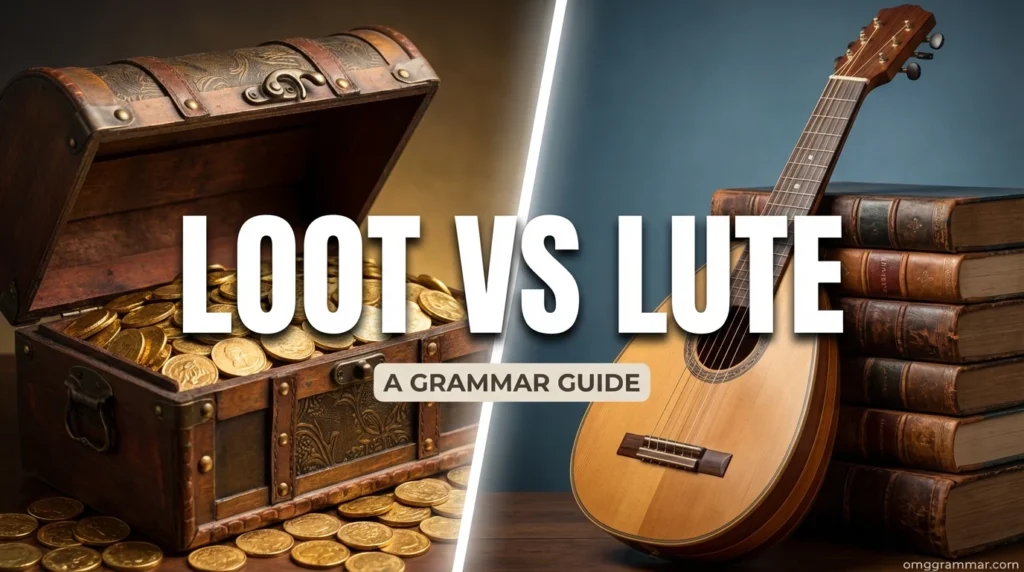
Loot vs Lute — What’s the Difference?
Loot vs lute are homophones that sound identical but mean completely different things. “Loot” means stolen goods or treasure, or […]
Loot vs Lute — What’s the Difference? Read More »

Loot vs lute are homophones that sound identical but mean completely different things. “Loot” means stolen goods or treasure, or […]
Loot vs Lute — What’s the Difference? Read More »

Die vs dice traditionally meant singular versus plural—one die, two dice—but modern English now accepts “dice” for both singular and
Die vs Dice — What’s the Difference? Read More »

“Tear” means to rip something apart or refers to the result of ripping, while “tare” means the weight of an
Tear vs Tare — When to Use Each Word Read More »

Yupper meaning is simply “yes,” but with a playful, cheerful twist. Yupper is informal slang that people use instead of
Yupper Meaning, Usage and Examples Read More »
Attain vs obtain both mean “to get something,” but attain emphasizes reaching a goal or achievement through sustained effort, typically
Attain vs Obtain — Definitions, Examples and Tips Read More »
When choosing between “who else” and “whom else,” use “who else” when the phrase acts as the subject performing an
Who Else vs Whom Else — Usage and Rules Read More »

Non-finite verbs are verb forms that don’t show tense, person, or number—they exist outside normal conjugation patterns. The three types
Non-Finite Verbs — What They Are and How to Use Them Read More »
Input vs imput might look like a minor spelling difference, but only one word exists in English. “Input” is the
Input vs Imput — Which Is Correct? Read More »
The difference between day off vs off day comes down to presence and performance. A day off means scheduled time
Day Off vs Off Day — Meaning, Usage & Examples Read More »
“Some of whom” is correct. “Some of who” is wrong. The word “of” is a preposition. Prepositions require objective case
Some of Whom vs Some of Who — Correct Usage & Examples Read More »