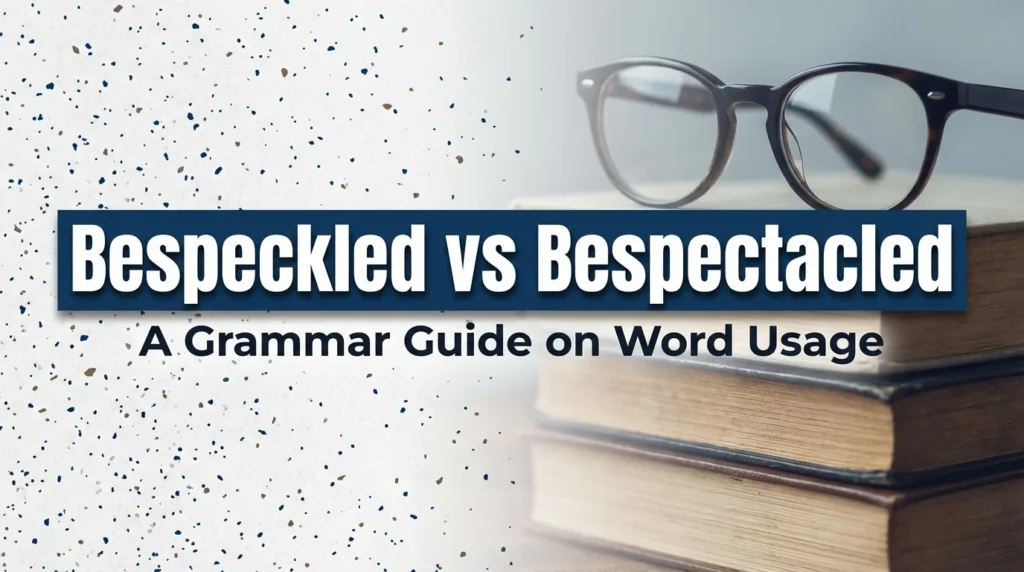
Bespeckled vs Bespectacled: bespeckled = covered with small spots or specks; bespectacled = wearing spectacles or glasses. Use bespeckled for surfaces and patterns—cloth, leaves, pottery—that show dots or flecks. Use bespectacled for people or characters who wear eyeglasses. You should label parts of speech when editing: check whether the word functions as an adjective modifying a noun or as part of a compound description. Read examples aloud to hear whether the meaning fits the context and to test modifier placement and subject–verb agreement. Quick tests and short edits below help you replace confusing phrasing with the correct word without changing tone or rhythm.
Contextual Examples
What Each Word Means
Bespeckled vs Bespectacled
Bespeckled = covered with little spots or flecks.
- Part of speech: adjective.
Bespectacled = wearing glasses (spectacles). - Part of speech: adjective.
Example 1 — Clear Surface Description
Sentence: The pillow was bespeckled with tiny dots.
Parts of speech and checks: The (article, modifies pillow) pillow (noun, subject) was (verb, past, singular — correct for singular subject) bespeckled (adjective, describes pillow) with (preposition) tiny (adjective, modifies dots) dots (noun, plural, object of preposition).
Comment: Use bespeckled for a spotted surface. Verb tense and agreement are correct.
Example 2 — Person Wearing Glasses
Sentence: A bespectacled woman entered the room.
Parts of speech and checks: A (article) bespectacled (adjective, describes woman) woman (noun, subject) entered (verb, past, singular — matches subject) the (article) room (noun, object).
Comment: Use bespectacled for someone who wears glasses.
Example 3 — Two Items in One Line
Sentence: A bespeckled mug sat beside a bespectacled portrait.
Parts of speech and checks: A (article) bespeckled (adjective) mug (noun) sat (verb, past, singular) beside (preposition) a (article) bespectacled (adjective) portrait (noun).
Comment: Adjectives attach to the noun that follows them. Check modifier position to avoid meaning slips.
Example 4 — Predicative Use
Sentence: The plate became bespeckled after the glaze dried.
Parts of speech and checks: The (article) plate (noun) became (verb, past, singular) bespeckled (adjective) after (subordinating conjunction) the (article) glaze (noun) dried (verb, past, singular).
Comment: Use linking verbs like became or was with these adjectives.
Example 5 — Appositive or Extra Note
Sentence: Mr. Cole, bespectacled and kind, answered slowly.
Parts of speech and checks: Mr. Cole (noun phrase, subject) , bespectacled (adjective) and (conjunction) kind (adjective) , answered (verb, past, singular) slowly (adverb).
Comment: Here bespectacled is part of an extra description. Keep commas to bracket the extra phrase.
Example 6 — Swap Error to Fix
Wrong: She is a bespeckled teacher who always wears glasses.
Parts of speech and problem: She (pronoun, subject) is (verb, present, singular) a (article) bespeckled (adjective) teacher (noun). Problem: bespeckled says “spotted,” not “wearing glasses.”
Fix: She is a bespectacled teacher who always wears glasses.
Check verbs and noun forms after edit.
Common Mistakes
Bespeckled vs Bespectacled
Mistake 1 — Mixing the Two Words
Problem: Using bespeckled when the writer means “wearing glasses.”
Why it happens: The words look similar.
How to fix: Ask whether the subject has spots or glasses. If glasses, use bespectacled.
Mistake 2 — Wrong Modifier Placement
Wrong: He gave her a bespectacled mug.
Parts of speech and problem: He (pronoun) gave (verb) her (pronoun, object) a (article) bespectacled (adjective) mug (noun). Problem: The mug cannot wear glasses.
Fix: Move adjective to the correct noun or rephrase: He gave the bespectacled woman a mug. or He gave her a mug; she, bespectacled, smiled.
Check that adjectives sit next to the nouns they describe.
Mistake 3 — Using the Word in the Wrong Register
Problem: Using bespeckled in a technical manual where plain words work better.
Fix: Use spotted or dotted for clear, simple writing. Use wearing glasses instead of bespectacled in plain help text.
Check audience and pick the simpler word if readers may be young or in a hurry.
Mistake 4 — Subject–Verb Agreement Errors
Wrong: The bespectacled students was late.
Parts of speech and problem: The (article) bespectacled (adjective) students (noun, plural) was (verb, singular) late. Mismatch: plural noun needs plural verb.
Fix: The bespectacled students were late.
Always match the verb number to the noun number.
Mistake 5 — Overuse That Causes Confusion
Problem: Repeating these adjectives too close together can clutter a sentence.
Fix: Use them only when the detail matters. Replace with plain words if needed.
American vs British English Differences
Core Meaning Is the Same
Both American and British English use bespeckled to mean “spotted” and bespectacled to mean “wearing glasses.” No big meaning change exists.
Small Style Notes
- American writers often use bespectacled in news and short profiles.
- British writers may prefer spectacled in casual speech.
Parts of speech: both words are adjectives in either variety. Tone and formality decide which to pick.
When to Use Simpler Words
In technical or clear instructions, both varieties prefer spotted, dotted, or wearing glasses.
Check the audience and pick words that readers know.
Idiomatic Expressions
Bespeckled vs Bespectacled
Common Collocations With Bespeckled
- Bespeckled with (use this to show what makes the speckled look)
Example: The field was bespeckled with white flowers.
Parts of speech: The (article) field (noun) was (verb) bespeckled (adjective) with (preposition) white (adjective) flowers (noun).
Common Collocations With Bespectacled
- Bespectacled figure or bespectacled face
Example: A bespectacled figure stepped forward.
Parts of speech: A (article) bespectacled (adjective) figure (noun) stepped (verb) forward (adverb).
Figurative Use
Both words can be used in a playful or figurative way.
- The town, bespeckled with lights, looked cozy. (figurative for spots of light)
- Her bespectacled look told the crowd she was ready to read. (figurative for wearing glasses as a sign of study)
Practical Tips
Bespeckled vs Bespectacled
Tip 1 — Quick Meaning Check
Ask: Does the subject have spots or glasses? If spots, use bespeckled. If glasses, use bespectacled.
Tip 2 — Put Adjective Next to Noun
Keep the adjective right before the noun it describes.
Example: The bespectacled lawyer (good). The lawyer bespectacled (awkward).
Tip 3 — Use Plain Words for Clarity
When writing for general readers or instructions, prefer spotted, dotted, or wearing glasses. These are easier to read.
Tip 4 — Check Verb Agreement
If the noun is singular, use singular verbs: The bespeckled bowl was old. If the noun is plural, use plural verbs: The bespectacled students were ready. Always check subject and verb match.
Tip 5 — Read the Sentence Aloud
Read the sentence out loud to hear if it makes sense. If a mug can’t wear glasses, something is wrong.
Tip 6 — Keep Sentences Short for Younger Readers
Use short sentences and clear words for grade 5–8 audiences. Break long ideas into short lines.
Tip 7 — Use Examples to Teach
Show a wrong version and then the right version. Example: Wrong: The bespeckled teacher put on glasses. Right: The bespectacled teacher put on glasses. Then explain the change.
Tip 8 — Check Collocations
If the phrase often appears as bespeckled with, keep that pattern. For bespectacled, use it directly before the person or as part of a phrase like a bespectacled man.
Tip 9 — Avoid Anthropomorphism Unless Fun
Giving human traits to objects can be playful but also confusing. If the effect is playful, mark it with strong context.
Tip 10 — Use a Simple Editing Checklist
- Check which noun the adjective should describe.
- Place the adjective next to that noun.
- Match verb number to noun number.
- Read aloud.
- Swap in a plain synonym if needed.
Revision Examples
Fixing a Bad Sentence
Wrong: She bought a bespectacled plate.
Problem: The plate cannot wear glasses.
Fix: She bought a bespeckled plate.
Parts of speech and fix: She (pronoun) bought (verb, past) a (article) bespeckled (adjective) plate (noun). Now the adjective fits the noun.
Fixing Agreement
Wrong: The bespectacled child were happy.
Problem: Child is singular; were is plural.
Fix: The bespectacled child was happy.
Parts of speech: The (article) bespectacled (adjective) child (noun, singular) was (verb, singular) happy (adjective).
Fixing Modifier Position
Wrong: A man walked in with a bespeckled hat and bespectacled.
Problem: Bespectacled hangs without a noun and feels odd.
Fix: A bespectacled man walked in wearing a bespeckled hat.
Parts of speech: A (article) bespectacled (adjective) man (noun) walked (verb) in (adverb) wearing (verb) a (article) bespeckled (adjective) hat (noun).
Conclusion
Choose bespeckled when you mean “spotted” and bespectacled when you mean “wearing glasses.” Keep the adjective next to the noun it describes, confirm verb agreement, and read the sentence aloud to ensure the image is clear. When clarity matters, prefer plain wording (spotted, wearing glasses) rather than obscure synonyms. Quick checklist: verify meaning, check modifier position, confirm agreement, and read aloud—those steps will catch nearly every mix-up.
FAQs
- Q: What does “bespeckled” mean?
A: Bespeckled means covered with small spots or flecks. Use it for surfaces like fabric, plates, or fields. - Q: What does “bespectacled” mean?
A: Bespectacled means wearing spectacles, or glasses. Use it for people or characters. - Q: Can a thing be bespectacled?
A: Not usually. Objects do not wear glasses unless the use is playful or personifying. Prefer bespeckled for objects. - Q: Which word is simpler for kids?
A: Use spotted or dotted instead of bespeckled, and wearing glasses instead of bespectacled for younger readers. - Q: How can an editor catch swaps between these words?
A: Ask if the noun has spots or glasses. If the answer is spots, it should be bespeckled; if glasses, bespectacled. - Q: Do American and British English use these words differently?
A: No big difference. Both varieties use the same meanings. Tone and formality guide the choice. - Q: Is “bespeckled with” correct?
A: Yes. Bespeckled with is a common way to show what causes the spots, as in bespeckled with paint. - Q: How should adjectives sit in a sentence?
A: Put the adjective right before the noun it describes. That keeps meaning clear.