
“Apposed” means placed side by side or adjacent (used mainly in anatomy and technical writing), while “opposed” means to resist, disagree with, or stand against something. The confusion between apposed vs opposed stems from their similar spelling, but using the wrong one changes your meaning entirely.
The Grammar Rule: Understanding Apposed and Opposed
These two words function as past participles and adjectives, but they come from entirely different verbs with distinct meanings.
Opposed derives from the verb “oppose,” meaning to resist, disagree with, or take a contrary position. When you’re opposed to something, you’re against it. This word appears constantly in everyday writing—from political discussions to personal preferences.
Apposed comes from the verb “appose,” meaning to place side by side or adjacent to something. In my editing work, I rarely encounter this word outside medical, anatomical, or highly technical contexts. It describes physical positioning, not disagreement.
Golden Rule: If you’re talking about disagreement or resistance, use “opposed.” If you’re describing something placed next to something else (especially in anatomy), use “apposed.”
Professional editors distinguish these by context. “Opposed” answers the question “Are you against this?” while “apposed” answers “Is this positioned next to that?”
How to Use Apposed vs Opposed Correctly
Correct Usage of “Opposed”
People use “opposed” far more frequently because disagreement and resistance appear in virtually every type of writing.
In political or opinion contexts:
- “The senator opposed the new healthcare legislation.”
- “I’m fundamentally opposed to censorship in any form.”
- “Most residents opposed the construction of the highway.”
In comparative contexts (as opposed to):
- “She preferred action as opposed to endless deliberation.”
- “This approach works through collaboration, as opposed to competition.”
- “I want practical advice, as opposed to theoretical frameworks.”
In professional documents, this construction appears constantly. Writers typically use “as opposed to” when contrasting two approaches or highlighting a preference.
In personal preference contexts:
- “He’s strongly opposed to working weekends.”
- “The committee members opposed every suggestion.”
- “They remain opposed to the merger.”
Correct Usage of “Apposed”
Across hundreds of manuscripts, I’ve noticed “apposed” appears almost exclusively in medical or technical writing.
In anatomical contexts:
- “The apposed surfaces of the joint showed signs of wear.”
- “The surgeon carefully apposed the wound edges before suturing.”
- “The apposed leaflets of the heart valve function properly.”
In technical contexts:
- “The apposed layers of tissue heal more effectively.”
- “Researchers examined the apposed cell membranes.”
Medical professionals use “apposed” to describe structures positioned directly against each other. General writers rarely need this term.
Context Variations
Formality matters with “opposed.” In casual conversation, people say “I’m against it,” but in business writing, “I’m opposed to it” maintains professionalism.
Regional differences barely affect these terms—both maintain consistent meanings in American, British, and other English variants.
Common Mistakes with Apposed vs Opposed
| Incorrect | Correct | The Fix |
| “I’m apposed to that idea.” | “I’m opposed to that idea.” | Use “opposed” for disagreement, not “apposed” |
| “The board members are apposed.” | “The board members are opposed.” | “Apposed” describes physical positioning, not opinions |
| “The opposed wound edges healed well.” | “The apposed wound edges healed well.” | Medical/anatomical contexts require “apposed” |
| “She’s strongly apposed to the changes.” | “She’s strongly opposed to the changes.” | Resistance = “opposed,” never “apposed” |
| “This method, as apposed to that one…” | “This method, as opposed to that one…” | The idiom is always “as opposed to” |
Why This Confusion Happens
The apposed vs opposed confusion emerges during rapid writing. Writers recognize “apposed” as a legitimate word but misunderstand its specialized meaning. They assume it’s a variant of “opposed”—it’s not.
The “as opposed to” construction causes particular trouble. Some writers spell this as “as apposed to,” perhaps thinking it relates to placing ideas side by side. However, this phrase always uses “opposed” because it contrasts one option against another.
How to Remember the Difference
The Mnemonic Device
Think of the double “p” in “apposed” as two things Placed (or Positioned) side by side.
The two “p”s stand next to each other, just like apposed surfaces. Meanwhile, “opposed” has only one “p”—it stands alone in Opposition.
Another memory technique I recommend to writers: “Opposed” contains “pose” (as in “im-POSE your will”)—when you oppose something, you’re imposing resistance against it.
Quick Verification Test
Ask yourself: “Am I talking about disagreement or physical positioning?”
- Disagreement/resistance → opposed
- Physical positioning (especially medical) → apposed
If you’re writing general content and not discussing anatomy or technical positioning, you almost certainly need “opposed.”
Visualizing the Decision Process
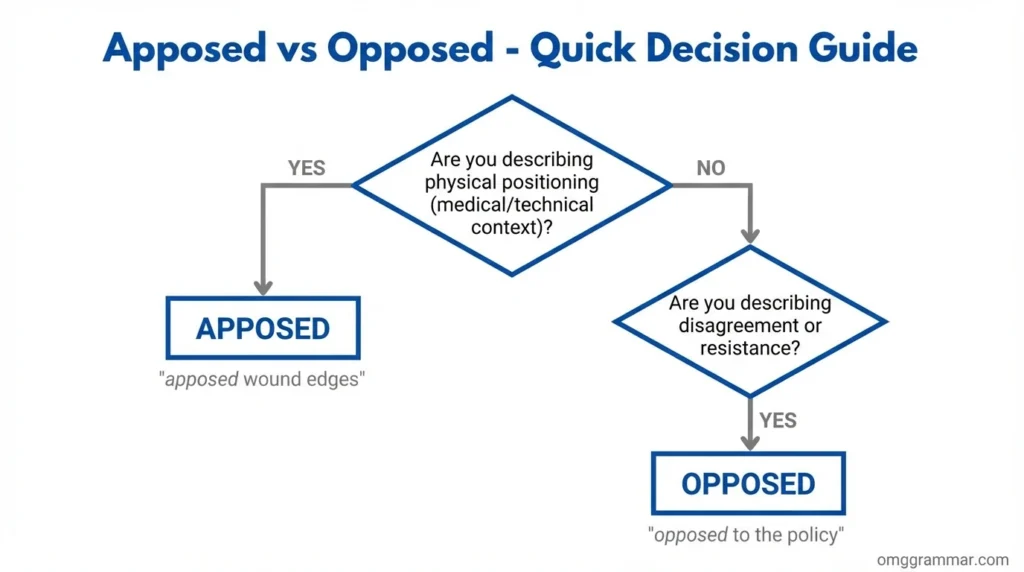
The flowchart demonstrates the decision process. In medical or technical writing about physical positioning, “apposed” might be correct. In virtually every other situation—disagreement, comparisons, or resistance—”opposed” is right.
The distinction centers on spatial relationships versus conceptual resistance.
Word Origins: Where These Terms Come From
Both words trace back to Latin roots that explain their different meanings.
Opposed comes from Latin “opponere” (ob- “against” + ponere “to place”), literally “to place against.” Apposed derives from “apponere” (ad- “to” + ponere “to place”), meaning “to place next to.”
This explains why one means “against” while the other means “adjacent to”—their Latin origins point in different directions.
Synonyms and Alternatives
Alternatives for “Opposed”
When expressing disagreement, consider these options:
- Against (casual, everyday use)
- Resistant to (emphasizes unwillingness)
- Contrary to (formal contexts)
- Averse to (personal dislike)
Each carries different weight. “Against” works for casual writing, while “contrary to” suits formal documents.
Alternatives for “Apposed”
In medical or technical contexts:
- Adjacent (next to)
- Juxtaposed (side by side)
- Contiguous (sharing a boundary)
However, “apposed” has specific medical meaning these alternatives don’t fully capture. Medical professionals should stick with “apposed” for anatomical structures.
When to Use Each Term
Use “Opposed” for:
- Expressing disagreement with policies or ideas
- Making comparisons (“Method A, as opposed to Method B”)
- Stating positions or objections
- Personal preferences (“I’m opposed to working weekends”)
This word appears in professional documents, academic writing, and everyday conversation whenever you’re expressing resistance or contrast.
Use “Apposed” for:
- Medical/anatomical contexts (wound edges, joint surfaces)
- Technical descriptions of physical positioning
- Scientific documentation of spatial relationships
Students in medical programs encounter this regularly, while general writers rarely need it. If you’re not writing about medicine or technical positioning, use “opposed.”
Conclusion
The distinction between apposed vs opposed is clear: “opposed” means against or in disagreement, while “apposed” means positioned side by side in medical contexts. In my editing work, writers frequently use the word “opposed” to show resistance or to draw a contrast.
Mastering this becomes intuitive when you ask yourself whether you’re discussing disagreement or physical positioning. For most writing, “opposed” is your answer. Reserve “apposed” for medical or technical contexts describing spatial relationships.
The next time you’re writing about being against something or contrasting approaches, you’ll confidently choose “opposed.” And if you ever describe wound edges or anatomical surfaces, you’ll know “apposed” fits.
FAQs
“Opposed” means against or in disagreement with something, while “apposed” means placed side by side or adjacent (used mainly in medical/technical contexts).
It’s always “as opposed to.” This phrase uses “opposed” because it contrasts one thing against another, not “apposed” which describes physical positioning.
No. “Apposed” only describes physical positioning, especially in medical contexts. Use “opposed” when expressing disagreement or resistance.
You’d use “apposed” primarily in medical, anatomical, or technical writing when describing structures or surfaces positioned directly against each other, such as “apposed wound edges” or “apposed joint surfaces.”
No. “Opposed” means to resist or disagree with something, while “opposite” refers to something completely contrary or facing in the reverse direction.
This phrase means completely against something—at opposite extremes.
No. “Apposed” appears almost exclusively in medical and technical writing.
No. The correct phrase is “opposed to” something. “Apposed” describes positioning, not opinion or resistance.