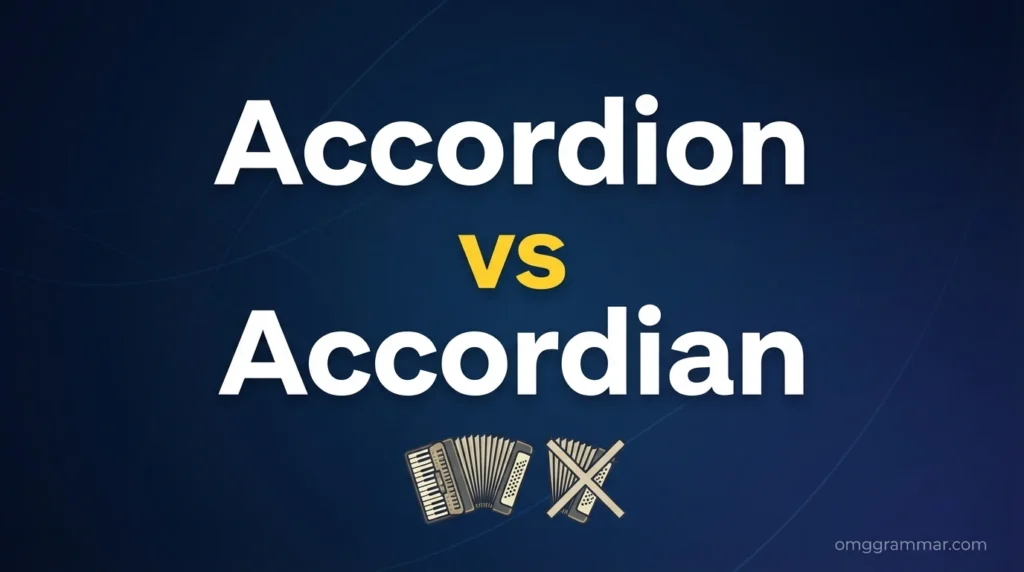
“Accordion” is the only correct spelling in English. “Accordian” is a common misspelling that appears frequently but has no legitimate place in standard dictionaries. The correct spelling uses a double “c” followed by “or”—accordion—and this pattern comes from the instrument’s German origins. Whether you’re writing about music, describing the instrument, or using the term metaphorically, always use “accordion.”
The Correct Spelling: Why “Accordion” Wins
The accordion vs accordian debate has a clear winner in standard English spelling.
The word “accordion” follows a specific orthographic pattern. It contains a double “c” (acc-) followed by “ordion.” This spelling reflects the word’s passage through German and French before entering English. Professional editors catch the “accordian” misspelling immediately because it violates this established pattern.
Golden Rule: The correct spelling is always “accordion” with double-c. “Accordian” is never correct in formal or informal writing.
In my editing work, this spelling error appears with surprising frequency, particularly in music-related manuscripts and product descriptions. Writers often default to “accordian” because the /di/ sound in the middle of the word suggests an “i” should come before the final syllable.
The double-c pattern actually makes linguistic sense. English borrowed this word from German “Akkordeon,” where the double consonant appears. When the word entered English through French influence (accordéon), it retained the double-c structure. That middle “or” comes from the French spelling convention.
Think of related words: “accord,” “according,” “accordance.” They all use double-c. The musical instrument simply extends this root with “-ion” at the end.
How to Use “Accordion” Correctly
Correct Usage
The word appears in various contexts beyond just naming the instrument.
“She played the accordion at the wedding reception.” This is the standard musical context where the spelling matters most.
“The accordion folder keeps all my documents organized.” Here, “accordion” describes the expandable pleated design that resembles the instrument’s bellows.
“His accordion-style resume includes expandable sections for each job.” Client documents frequently show metaphorical uses referencing the instrument’s expanding nature.
“The accordion menu on the website improves navigation.” Web design borrowed this term for collapsible interface elements.
“Traditional Irish music often features accordion accompaniment.” Musical genre descriptions regularly mention the instrument.
Incorrect Usage
The misspelling appears in predictable patterns.
~~”She’s an expert accordian player.”~~ Wrong—this is the most common error. Always use “accordion.”
~~”I bought an accordian at the music store.”~~ Incorrect—even in casual writing, the spelling doesn’t change.
~~”The website uses accordian navigation.”~~ Wrong—professional web developers should use the correct spelling.
~~”Accordian doors separate the rooms.”~~ Incorrect—architectural terms require proper spelling.
Context Variations
The spelling remains constant across all contexts and formality levels.
In music journalism, “accordion” appears in reviews and historical pieces without variation. Technical writing uses “accordion components” and “accordion widgets” in web development. Business writing includes “accordion files” in office catalogs.
In my editing work, the misspelling clusters in first drafts from writers unfamiliar with the word’s etymology. Once corrected, most writers remember the double-c pattern.
Common Mistakes with Accordion vs Accordian
| Incorrect | correct | The Fix |
| Accordian | Accordion | Always use double-c, never end with “ian” |
| Accordeon | Accordion | English uses “ion” ending, not French “eon” |
| Acording | Accordion | Never drop the double-c or the final “on” |
| Acordion | Accordion | Must include both c’s—single-c is wrong |
| Accordian-style | Accordion-style | When hyphenated, spelling rules still apply |
Why This Misspelling Happens
The “accordion vs accordian” confusion emerges from phonological processing. When you say “accordion,” the middle sounds like “dee-an” (/diən/), making writers spell it “accordian”—matching what they hear.
Your brain chunks the sounds into “ac-COR-dee-an,” suggesting an “i” before “an.” This phonological interference occurs when pronunciation misleads spelling.
Motor memory compounds the issue. If you’ve typed “accordian” multiple times, your fingers develop muscle memory for that pattern. Writers make this error when writing quickly or when the word is outside their regular vocabulary. In my experience, this appears frequently in casual writing where spell-checkers might not flag it.
How to Remember “Accordion”
The “Accord” Connection
Remember that “accordion” starts with “accord”—the musical term for chord harmony. Add “-ion” to the end. This trick works because “accord” is a familiar word most people spell correctly.
The accordion creates musical accords (harmonies). The spelling reflects this etymological connection. If you can spell “accord,” you’re already 75% of the way there.
The Double-C Rule
Think of the accordion’s distinctive feature—it has two rows of buttons (on many models) and two sets of reeds. Two of each = double-c. This visual mnemonic helps lock in the double consonant.
A technique I recommend to students: spell it out loud as “ACC-ORD-ION” with emphasis on the double-c and the “ord” sound. This breaks the phonological interference that creates the “ian” mistake.
The “Never -IAN” Rule
Words ending in “-ian” typically describe people or things from places: “Italian,” “Canadian,” “Martian.” “Accordion” isn’t describing origin or nationality—it’s an object. Objects take “-ion” endings, not “-ian” endings.
Visualizing the Spelling
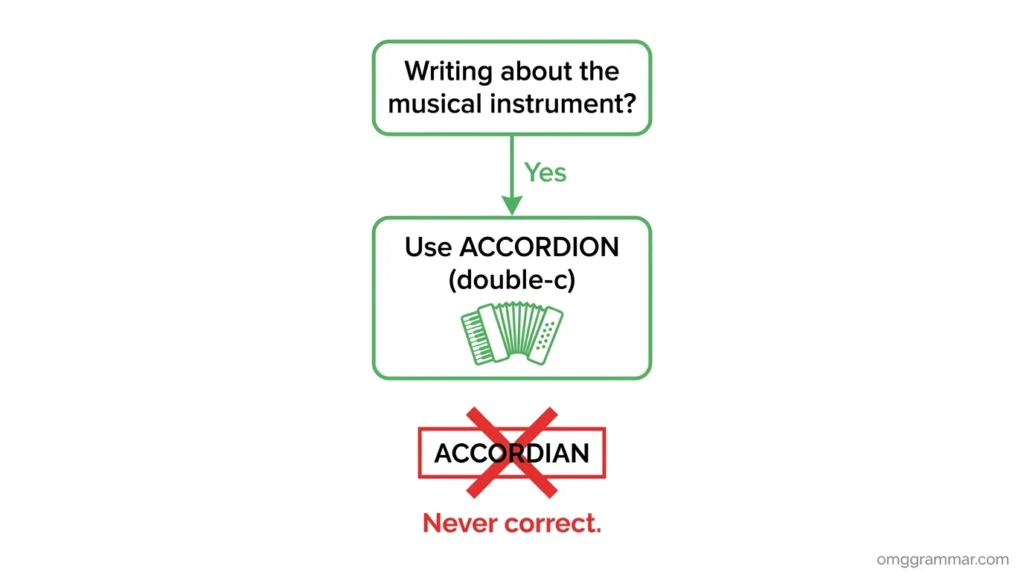
The flowchart illustrates the key decision point. When writing about the instrument or any accordion-related term, only one spelling works. The visual shows “accordion” with a checkmark and “accordian” crossed out, reinforcing the correct pattern.
Word Origins: Why the Double-C Exists
The spelling “accordion” preserves the instrument’s linguistic journey through Europe. German inventor Friedrich Buschmann created an early version around 1822, calling it “Akkordeon”—from “Akkord” (chord). When French adopted it as “accordéon,” the double consonant remained as double-c. English borrowed this pattern, keeping the double-c and adding the standard “-ion” ending. The spelling crystallized in the mid-1800s and hasn’t changed since.
Synonyms and Related Terms
Concertina describes a similar free-reed instrument with different bellows action. Squeeze box is casual slang for accordion. Melodeon refers to a small button accordion. Button accordion and piano accordion specify types while keeping the correct spelling.
Conclusion
The accordion vs accordian spelling question has a definitive answer: “accordion” is always correct. The double-c spelling preserves the word’s German and French origins while following English orthographic patterns.
Mastering this spelling becomes intuitive once you connect “accordion” to its root “accord” and recognize that “-ion” endings mark objects, not “-ian” endings. Professional writers develop pattern recognition that flags “accordian” immediately.
The key is remembering the double consonant and resisting the phonological pull toward “ian.” Once this spelling clicks, you’ll notice the error everywhere and help others avoid it.
FAQs
“Accordion” is the correct spelling. “Accordian” is a common misspelling with no legitimate usage in English dictionaries.
No, “accordian” is never correct in English. The only proper spelling is “accordion” with double-c and “-ion” ending.
People spell it “accordian” because the word sounds like “ac-COR-dee-an” when spoken. The /di/ sound makes writers add an “i,” but this is a spelling error.
Accordion uses two C’s (double-c). The pattern is “acc-ordion.” Single-c spellings like “acordion” are incorrect.
No, “accordeon” is the French spelling. In English, the correct spelling is “accordion” with “-ion” rather than “-eon.”
The double-c comes from the word’s German origin “Akkordeon” and French form “accordéon.” English preserved this double consonant pattern.