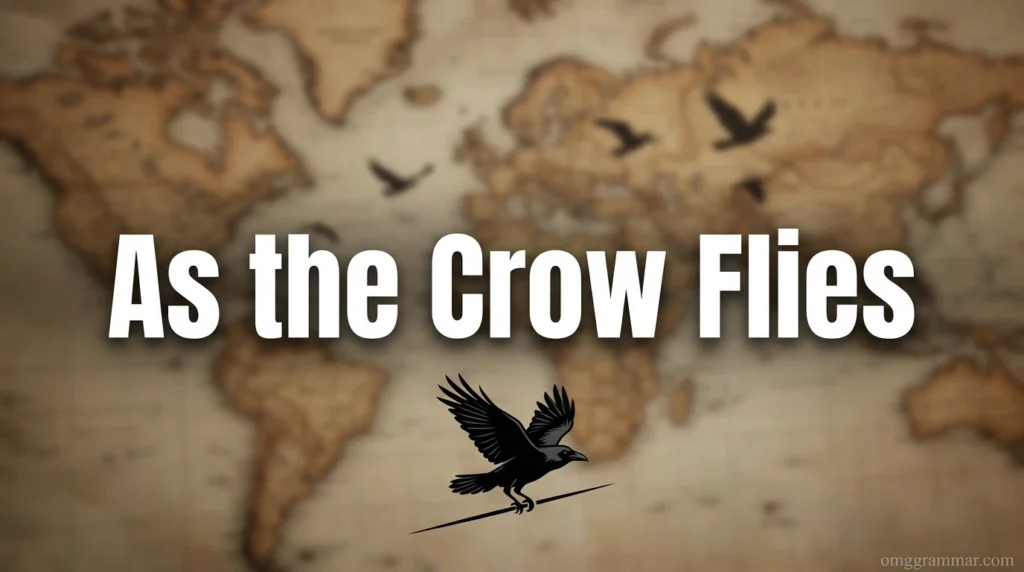
The phrase as the crow flies means the straight-line distance between two places, without considering roads, buildings, or obstacles. It describes the shortest possible path from one point to another, like a bird flying directly across land. In everyday English, it is used to explain distance in a simple, approximate way rather than an exact travel route. For example, saying “It’s five miles as the crow flies” means the distance is measured in a straight line, not by the roads you must take. The meaning stays consistent, but the context decides whether it sounds casual, descriptive, or slightly technical.
What does “as the crow flies” mean?
The direct meaning is simple: it refers to the shortest distance between two points in a straight line.
In real life, people cannot usually travel this way because of roads, rivers, or buildings. So the phrase is used to describe distance in a simplified, conceptual way.
I often see this in travel blogs and school geography assignments. Writers use it to compare real travel distance with straight-line distance.
TL;DR: “As the crow flies” means the straight-line distance between two places, ignoring roads or obstacles.
When should you use this phrase?
Use “as the crow flies” when you want to describe distance in a simple, visual way. It works well when the exact route does not matter.
It is common in casual writing, storytelling, and descriptive explanations. In technical writing, people may prefer terms like “linear distance” or “direct distance.”
In map-based reports, I usually replace it with “straight-line distance” to avoid confusion. The idiom is clear, but not always precise enough for formal data.
Is it always accurate?
No, it is not always accurate for real travel. The phrase describes the shortest possible path, but actual routes are shaped by roads, terrain, and access points.
For example, a location may be five miles away as the crow flies, but the driving distance could be ten miles or more. Rivers, hills, and city layouts often force longer routes.
This difference matters in writing that mixes distance types. If you state both values, label them clearly so readers do not confuse straight-line distance with travel distance.
In editing travel guides, I often see writers place both numbers in the same sentence without clarification. That creates a small but real misunderstanding, especially for readers planning routes.
Another issue appears in map descriptions. Some writers assume map scale equals travel distance, but scale usually reflects straight-line measurement, not roads.
TL;DR: “As the crow flies” gives the shortest distance, but real travel is usually longer.
Examples of “as the crow flies”
Examples make the meaning clearer and easier to apply. Strong examples often show a contrast between straight-line distance and real movement.
Examples make the meaning clearer and easier to apply.
Correct usage
- “The village is only two miles away as the crow flies.” — shows straight-line distance.
- “The airport looks close as the crow flies, but the drive takes much longer.” — compares two types of distance.
- “Their house is ten kilometers away as the crow flies.” — neutral descriptive use.
- “On the map, the two cities seem close as the crow flies.” — visual explanation.
Incorrect usage
- Incorrect: It is five miles as crow flies.
Correct: It is five miles as the crow flies.
Why: the phrase needs the full fixed form. - Incorrect: He walked as the crow flies to the store.
Correct: He walked straight to the store.
Why: the idiom describes distance, not the action of walking. - Incorrect: This route is as the crow flies.
Correct: This distance is measured as the crow flies.
Why: the phrase modifies distance, not the route itself.
Context variations
In casual speech, the phrase adds a visual image and makes distance easier to understand.
In academic or technical contexts, it may be replaced with more precise terms like “straight-line distance.”
While in storytelling, it helps create a sense of space without giving exact directions.
Common mistakes with “as the crow flies”
The main mistake is using the phrase for actual travel instead of distance. It does not describe movement; it describes measurement.
TL;DR: Use “as the crow flies” only for distance, not for how someone travels.
| Error Pattern | Incorrect | Correct |
| Missing article | as crow flies | as the crow flies |
| Misused for action | walked as the crow flies | walked straight |
| Route confusion | this road is as the crow flies | this distance is as the crow flies |
| Mixed distances | five miles by road as the crow flies | five miles as the crow flies |
These errors often appear in travel writing drafts. Writers mix figurative distance with real routes, which can confuse readers.
How do you remember this phrase?
Picture a crow flying in a straight line from one place to another. It does not follow roads, paths, or borders.
This simple image makes the meaning clear. The crow represents direct movement, even if people cannot follow that path.
Another way to remember it is to focus on the word “flies.” Flying suggests freedom from ground limits, which explains why the path is straight.
In classroom exercises, I ask students to draw two points and connect them with a straight line. Then I ask them to draw a road between the same points. The difference between the two lines explains the phrase better than a long definition.
If you connect the idea to maps, it becomes even easier. A straight line on a map is “as the crow flies,” while any curved or indirect line shows a real route.
Conclusion
“As the crow flies” means the straight-line distance between two places. It ignores roads, turns, and obstacles, focusing only on the shortest path.
The phrase is simple and visual, but it should be used carefully. It works best in descriptive or informal contexts, not precise technical writing.
Frequently Asked Questions
It means the shortest distance between two places in a straight line, ignoring roads or obstacles.
No, it describes straight-line distance, not the actual route you travel.
It is better suited to informal or descriptive writing. Formal texts often use “straight-line distance.”
It creates a simple visual way to explain distance without complex directions.
It comes from the idea of a bird flying directly between two points without following roads.