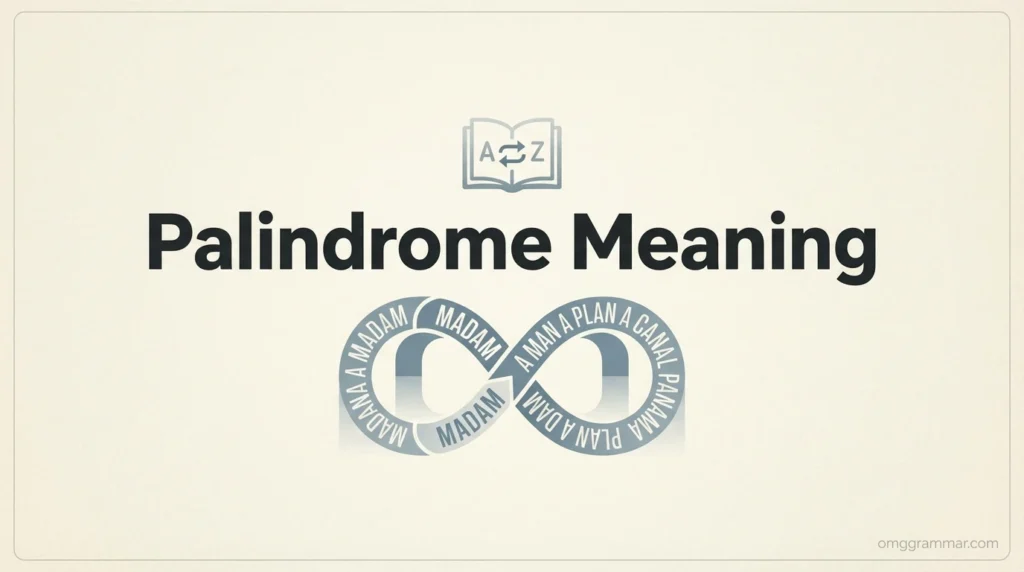
A palindrome is a word, phrase, number, or sequence that reads the same forward and backward. The order of letters or digits stays identical when reversed, which creates a mirror-like pattern in language. For example, words like “level” and “madam” are simple palindromes because they look the same from both directions. This idea may seem basic at first, but it appears in language, puzzles, and even coding exercises. Writers and learners often use palindromes to explore patterns and test attention to detail. The concept is easy to understand, yet it opens the door to more complex language play.
What Is a Palindrome?
TL;DR: A palindrome reads the same forward and backward.
A palindrome is a sequence that stays the same when reversed. It can be a single word, a full sentence, or even a number.
The key idea is symmetry. Each letter or number mirrors its position from the opposite end, creating a balanced structure. In a worksheet I once edited for middle school students, palindromes were used to teach pattern recognition, not just spelling. That small shift helped students see language as something they could analyze, not just memorize.
How Does a Palindrome Work?
A palindrome works by maintaining the same order in reverse. If you flip the sequence, nothing changes.
Take the word “racecar.” Reading from left to right or right to left gives you the same result. The first and last letters match, the second and second-to-last match, and so on until the center.
This pattern applies to longer phrases too. Spaces, punctuation, and capitalization are often ignored when checking if something is a palindrome. In editing exercises I have reviewed, students often missed correct answers because they focused on spacing instead of letter order. Once they ignored those extras, the pattern became clear.
Common Palindrome Examples
- Simple palindrome words include level, madam, radar, and civic. These are easy to spot because they are short and balanced.
- Longer palindromes can be phrases. A well-known example is “A man, a plan, a canal: Panama.” When you remove spaces and punctuation, the sequence reads the same in both directions.
- Numbers can also be palindromes. For example, 121 and 1331 remain the same when reversed. These patterns often appear in math puzzles and coding problems.
In a content draft I once reviewed, a writer used palindromes in a sidebar to engage readers. The list added variety and gave readers something interactive to notice.
Why Do People Use Palindromes?
People use palindromes to explore patterns, improve attention, and make language more playful. They are common in puzzles, word games, and educational material.
In classrooms, teachers use them to build pattern recognition skills. In writing, they can add creativity or humor without changing the meaning of the text.
While in programming tasks, palindromes are often used as beginner exercises. I have seen coding tutorials include palindrome checks to teach loops and string logic, which shows how the concept crosses into different fields.
Common Mistakes
- One common mistake is thinking a word is a palindrome when it is only similar at the start and end. The entire sequence must match when reversed, not just parts of it.
- Another mistake is counting spaces and punctuation as part of the sequence. In most cases, these are ignored, especially in longer phrases.
I often see this in early drafts of student work, where the idea is correct but the checking method is off. Once the writer focuses only on letters or numbers, the error becomes easy to fix.
Memory Tricks
Think of a palindrome as a mirror. If you place a mirror at the center, both sides look the same.
Another way to check is to reverse the word in your mind or write it backward. If both versions match, you have a palindrome.
In workshops I have helped review, this simple reversal method works faster than memorizing examples. It builds a habit of checking structure instead of guessing.
Context and Usage Guide
Palindromes appear in many contexts beyond simple word lists. In literature, they can be used as stylistic devices to add rhythm or symmetry.
In puzzles and games, they challenge players to think carefully about order and structure. This makes them useful for brain-training activities and logic exercises.
In technical fields, especially programming, palindromes are used to test algorithms. A simple palindrome check can show whether a system correctly processes strings or numbers.
Conclusion
A palindrome is a simple idea with wide use. It reads the same forward and backward, creating a clear and balanced pattern.
Once you understand the structure, it becomes easy to spot and create your own examples. That small skill can improve both language awareness and attention to detail.
Frequently Asked Questions
A palindrome is a word, phrase, or number that reads the same forward and backward.
Examples include level, radar, madam, and civic.
Yes. Longer phrases can also be palindromes if the sequence matches when reversed.
Usually no. Spaces and punctuation are ignored when checking.
Yes. Numbers like 121 or 1331 are palindromes.
They help develop pattern recognition and are used in learning, puzzles, and programming.
Reverse the sequence and compare it with the original.