
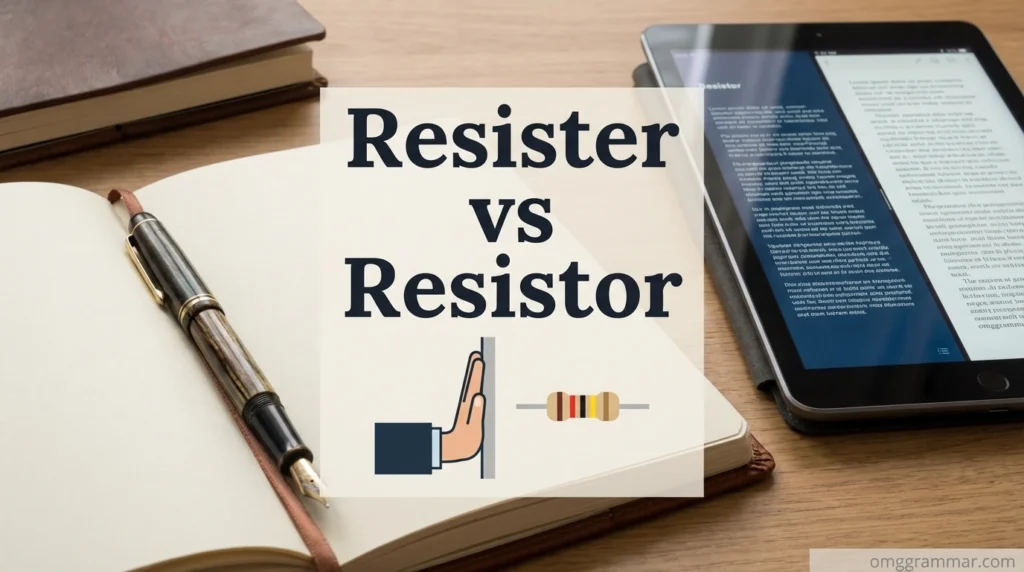
Resister vs resistor is a meaning-and-spelling contrast: resister is a person or thing that resists, while resistor is an electrical component that limits current. Resister comes from resist and usually names a person, group, or force that pushes back; resistor belongs to electronics, circuit diagrams, and engineering text. For example, a protest leader can be called a resister, but a circuit board needs a resistor.
Writers confuse them because the words look almost the same, and the wrong ending can still look plausible at a glance. The difference matters in technical copy, history writing, and any sentence where one letter changes the whole meaning.
In practice, the fastest check is simple: ask whether the sentence describes a person or an electronic part. That one question usually resolves the choice before the next draft. Once you link each word to its usual field, the spelling becomes quick and reliable.
What the Two Words Mean
TL;DR: Resister names someone or something that resists. Resistor names the electrical part that resists the flow of current. The words are not interchangeable, even though they share the same root.
Resister means a person or thing that resists. It points to opposition, refusal, or pushback. Resistor means a component in an electrical circuit that slows or controls current.
That split is the whole rule. In history and politics, resister can fit a person who opposes an authority or occupation; in electronics, resistor is the standard noun for the part on the board. In my editing work, this mix-up shows up most often in product specs, lab notes, and short captions — places where the writer trusts memory instead of checking the field.
A quick context check usually solves it: people resist; components resist current. If the sentence talks about a person, resister may fit. If it talks about ohms, current, or a circuit, resistor is the safe choice. The same idea also works in museum labels, where the subject is human and the spelling must match the role.
Correct Usage in Real Sentences
Correct Usage Examples
- A wartime resister refused to cooperate with the regime. That fits because it names a person who resists, not a machine part.
- The engineer replaced the burnt resistor on the board. That is right because resistor is the technical name for the component.
- She wrote about a resister in the memoir chapter. That fits the human sense of the word.
- The circuit needs a 220-ohm resistor. This is the electronics form you will see in manuals and parts lists.
- The museum label described him as a political resister. The label points to a person, so resister is the better choice.
- When the solder cooled, the resistor held steady. In technical writing, the noun points to the part, not the person.
- A short training note might say, “The resistor keeps the current from rising too fast.” That sentence works because it names the component and its job in clear, everyday language.
- The caption read, “Local resisters blocked the road.” That works because the sentence is clearly about people, not hardware.
Incorrect Usage Examples
- Incorrect: The circuit needs a resister.
Correct: The circuit needs a resistor.
Why: A circuit uses a resistor, the electrical component. - Incorrect: He bought a resistor for the protest.
Correct: He bought a resister for the protest.
Why: A protest figure is a person, so resister fits better. - Incorrect: The resister value was 100 ohms.
Correct: The resistor value was 100 ohms.
Why: Ohms belong to the electronic component. - Incorrect: The museum described the resistor.
Correct: The museum described the resister.
Why: The sentence refers to a human subject. - Incorrect: Replace the resister on the board.
Correct: Replace the resistor on the board.
Why: Boards use resistors, not resisters. - Incorrect: Add a resister to the schematic.
Correct: Add a resistor to the schematic.
Why: Schematics use the circuit part, not the person noun.
Context Variations
In formal engineering writing, resistor is the only safe choice. But in a history essay, resister may be correct if the subject is a person or group.
In casual speech, people often hear the word before they see it. That is why the spelling error survives in emails, drafts, and classroom notes.
In a museum label, “resister” can describe a wartime activist. In a circuit manual, the same spelling would be wrong, because the reader expects the component name. A social post about a protest can also use resister, while a product listing should never do that.
Common Mistakes
TL;DR: The confusion comes from sound, not meaning. Both words share resist, but one belongs to people and the other belongs to electronics.
The two words share a root, so a quick glance can mislead. The endings are the real clue, but under time pressure people often choose the form that looks more natural on the page. In editing, I see this error most often when a draft moves from a human topic into a technical one without a fresh check.
| Error Pattern | Incorrect | Correct |
| Same root, wrong field | The board needs a resister | The board needs a resistor |
| Human role in history | The resistor led the protest | The resister led the protest |
| Memory-based guessing | Check the resister value | Check the resistor value |
| Spellcheck blind spot | Install one resister there | Install one resistor there |
| Caption or label swap | The museum named a resistor | The museum named a resister |
The error clusters in product specs, school lab sheets, and short captions, where a fast draft can hide the wrong ending. It also appears when someone knows the verb resist but has not seen resistor in an electronics setting.
The pattern is simple: the wrong word usually comes from guessing by sound, not from misunderstanding the sentence. A quick look at the subject noun usually gives the answer.
How to Remember the Difference
Think of the ending first. Resistor ends in -or, and it names an object you use in a circuit; resister ends in -er, and it names a person who resists.
In training junior editors, I use that split to catch most errors in one pass. I also remind them that electronics language is fixed, so if the sentence mentions ohms, current, or a board, resistor is almost always the right word.
The person-or-part split is easier to remember than the spelling alone. If you can picture a person on one side and a component on the other, the choice usually takes only a second. It is a small rule, but it prevents a lot of avoidable edits.
A Simple Rule for Everyday Writing
Use resister for a person or force that resists, and use resistor for the electronic component. That rule covers almost every real case a writer meets, from history captions to circuit notes.
When the topic is human resistance, check the noun carefully. When the topic is electronics, trust the component name and keep the spelling exact. Small spelling shifts matter here because they change the field — not just the look of the word. Once you sort person from part, the right choice is easy.
Conclusion
The cleanest way to separate resister and resistor is to match the noun to the field. People resist; components resist current. That simple split handles most real writing without extra theory.
I look first at the sentence’s subject and then at the surrounding context. That habit saves a surprising number of fixes in captions, lab notes, and draft copy. Once the field is clear, the spelling usually follows without hesitation.
Frequently Asked Questions
Both can be correct, but they mean different things. Use resister for a person or thing that resists; use resistor for the electrical component. The surrounding topic usually gives it away.
Resister means a person or thing that resists. It often appears in history, politics, or any context where someone pushes back against control. In everyday writing, it usually points to a human subject.
Resistor means an electrical component that limits current in a circuit. You will see it in electronics manuals, diagrams, and parts lists. When a sentence mentions ohms or a schematic, this is the word to use.
No. They are not interchangeable because they belong to different fields and refer to different things. Swapping them changes meaning, not just spelling.
Use resistor. That is the standard term for the component that controls current and appears in circuit designs. A parts list, repair note, or schematic should use this form.
Use resister when you mean a person or group resisting power, pressure, or occupation. The word fits human opposition, not hardware. A caption or essay about resistance can use it naturally.
Because the words sound similar and share the same root. The easiest check is to ask whether the sentence is about a person or a circuit.