
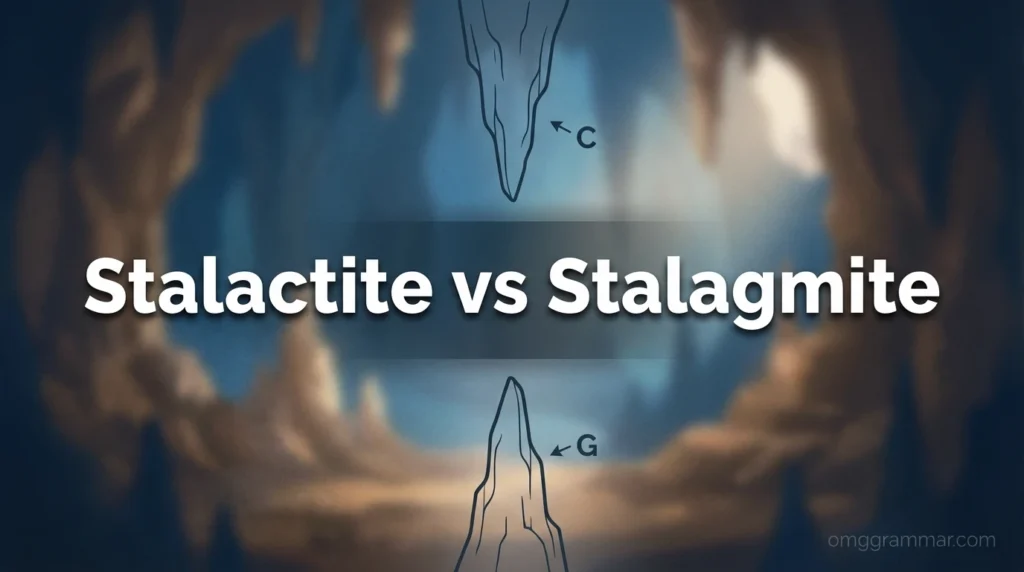
Stalactites and stalagmites are both mineral formations found in caves, but they grow in opposite directions. A stalactite hangs from the ceiling, while a stalagmite rises from the ground. For example, when water drips from a cave roof, it forms a stalactite above and may create a stalagmite below over time.
Many people confuse these terms because they look and sound similar. However, the key difference is simple: stalactites hang down, and stalagmites grow up. This distinction matters in science writing, school exams, and even casual descriptions of caves. Once you understand the direction of growth, the confusion becomes much easier to avoid.
Stalactite vs Stalagmite: What’s the Difference?
A stalactite hangs from the ceiling, while a stalagmite grows from the ground.
TL;DR: Stalactites hang tight from the top. Stalagmites might reach up from the ground.
This is the simplest and most reliable way to tell them apart. Still, many learners mix them up because the words look almost the same.
In school materials I’ve edited, this confusion often appears when diagrams are unclear or labels are placed too close together. So clarity in both words and visuals matters.
What Do Stalactite and Stalagmite Mean?
A stalactite is a mineral formation that hangs down from the ceiling of a cave. It forms as water drips from above and leaves behind tiny amounts of minerals.
A stalagmite is a mineral formation that grows upward from the ground. It forms when those same mineral-rich drops hit the floor and build up over time.
So the meaning difference is based on position:
- Stalactite → ceiling
- Stalagmite → ground
This is not just a small detail. In science writing, using the wrong term can change the meaning of a description.
How Do Stalactites and Stalagmites Form?
Both formations come from dripping water that carries dissolved minerals.
When water drips from the ceiling, it leaves a small deposit behind. Over time, these deposits build downward and form a stalactite.
At the same time, some of that water falls to the ground. As a result, it leaves minerals on the cave floor. These deposits build upward and form a stalagmite.
So both formations are connected. In some caves, they even meet and form a column.
In educational content, I often simplify this process for younger readers. Instead of focusing on chemistry, I describe it as “drip, drop, build.” That makes the idea easier to remember.
How Can You Tell a Stalactite from a Stalagmite?
You can tell them apart by looking at their direction.
If it hangs from above, it is a stalactite. If it rises from below, it is a stalagmite.
Another useful clue is position:
- Look up → stalactite
- Look down → stalagmite
In exam answers, students often lose marks by mixing these up. Yet once they focus on direction, the error almost disappears.
Examples of Stalactite and Stalagmite in Sentences
Correct Usage Examples
- The cave ceiling was covered with sharp stalactites.
(Correct because they hang from above.) - Water dripped slowly from the stalactite.
(Correct use of ceiling formation.) - A tall stalagmite stood in the center of the cave floor.
(Correct because it grows upward.) - The guide pointed to a stalagmite forming below the drip.
(Correct use of ground formation.) - Over time, the stalactite and stalagmite joined to form a column.
(Correct description of both together.)
In science articles I’ve reviewed, clear examples like these help readers connect the terms to real images.
Incorrect Usage Examples
- Incorrect: The stalagmite hung from the cave roof.
Correct: The stalactite hung from the cave roof.
Why: Hanging formations are stalactites. - Incorrect: A stalactite grew from the ground.
Correct: A stalagmite grew from the ground.
Why: Ground formations are stalagmites. - Incorrect: The stalagmite dripped from above.
Correct: The stalactite dripped from above.
Why: Dripping from above forms stalactites. - Incorrect: The stalactite rose from the cave floor.
Correct: The stalagmite rose from the cave floor.
Why: Upward growth from the floor is a stalagmite.
Context Variations
- In textbooks: clear labels are used to show ceiling vs ground
- In tours: guides explain the difference with simple memory tricks
- In exams: correct usage depends on direction
- In casual speech: people often mix them without realizing
Because the words sound alike, context alone is not enough. Direction is the key.
Common Stalactite vs Stalagmite Mistakes
| Error Pattern | Incorrect | Correct |
| Direction confusion | stalagmite on ceiling | stalactite on ceiling |
| Direction confusion | stalactite on ground | stalagmite on ground |
| Mixed usage | stalactite and stalagmite used randomly | match each to position |
| Guessing by sound | picking based on word feel | use direction rule |
| Diagram confusion | unclear labels | clear ceiling vs ground labels |
These mistakes often happen when learners rely on memory alone instead of visualizing the cave.
Memory Tricks to Remember the Difference
Here are simple and verified ways to remember:
- Stalactite = “tight to the ceiling”
The “c” in stalactite can remind you of “ceiling.” - Stalagmite = “might grow up”
The word “might” helps you remember upward growth. - Look direction trick
Look up → stalactite
Look down → stalagmite
When teaching this, I always suggest pairing the word with a mental image. That way, the memory sticks longer.
Why Do People Confuse Stalactite and Stalagmite?
People confuse these words because they look and sound very similar. Both start with “stala-” and differ only in the middle.
Also, both exist in the same place — caves — which adds to the confusion.
However, the real issue is lack of visual framing. When learners do not picture the cave, the words become abstract.
In educational editing, I’ve seen that once a simple diagram is added, confusion drops quickly. So linking the word to a clear image is the most effective fix.
Context and Usage Guide
Use these terms carefully in:
- Science writing
- School exams
- Educational content
In casual conversation, small mistakes may not matter. Still, in formal contexts, using the correct term shows accuracy.
When writing about caves, always check direction first. That one step prevents most errors.
Conclusion
The difference between stalactite and stalagmite is simple once you focus on direction. Stalactites hang from the ceiling, while stalagmites grow from the ground.
Although the words look alike, their meanings are clear when you connect them to position. With a simple memory trick and a mental image, you can avoid confusion completely.
So next time you read or write about caves, just remember: top or bottom — that is the key.
Frequently Asked Questions
A stalactite hangs from the ceiling, while a stalagmite grows from the ground.
Yes. Water dripping from a stalactite can form a stalagmite below.
A stalagmite grows upward from the ground.
A stalactite hangs down from the ceiling.
Yes. Over time, they can join and form a column.
They look and sound similar, and both are found in caves.
Both are common in caves where mineral-rich water drips regularly.