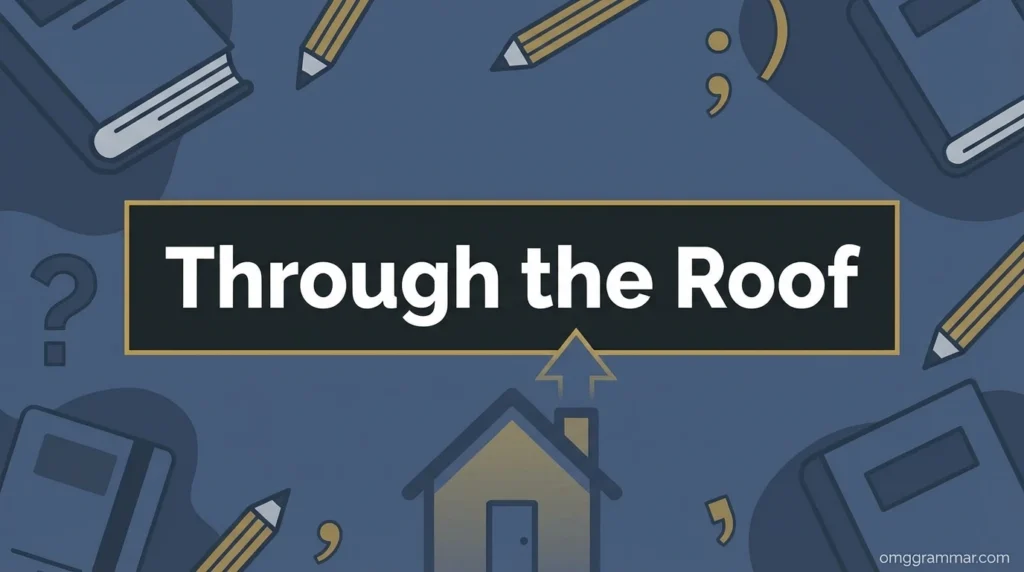
Through the roof means something has gone way up or gotten extremely high. When you say prices, costs, or numbers went through the roof, you mean they increased a lot and very quickly. For example, if gas prices went through the roof, they shot up fast. If someone’s anger went through the roof, they got really mad. This phrase always shows a big, sudden increase. You use it to describe numbers, feelings, or anything that rises sharply. The image comes from something breaking through a ceiling and going even higher. This phrase works in casual talk and professional writing, making it useful for many situations.
What Does Through the Roof Mean?
This phrase describes a dramatic increase. When something goes through the roof, it rises way higher than normal or expected. Think of it like a ball shooting up so high it breaks through the ceiling.
You can use it for many things. Prices can go through the roof. Sales numbers can go through the roof. Someone’s stress level can go through the roof. The key idea is always the same – a big, fast increase.
Most people use this phrase for negative things like costs or problems getting worse. But you can also use it for good things like sales or profits going way up. The tone depends on what you’re talking about.
How Do You Use “Through the Roof” Phrase?
The phrase works as a verb phrase in your sentence. You say something “went through the roof,” “is going through the roof,” or “has gone through the roof.”
Basic Pattern: Subject + went/is going/has gone + through the roof
The subject is whatever increased. It could be prices, costs, temperature, anger, sales, or any measurement that can go up.
Example sentences:
- “Gas prices went through the roof last month.”
- “Her anxiety is going through the roof before the test.”
- “Hotel rates have gone through the roof this summer.”
You don’t change the phrase itself. It stays as “through the roof” in every sentence. Don’t say “over the roof” or “past the roof” – those aren’t correct.
Examples in Different Contexts
Business and Finance
In business writing, this phrase shows up all the time when talking about costs, sales, or profits.
- “Our marketing costs went through the roof after the new campaign.”
- “Sales have gone through the roof since we added online ordering.”
- “Interest rates are going through the roof across the banking sector.”
- “Production expenses went through the roof due to supply chain issues.”
- “The stock price went through the roof after the merger announcement.”
When I edit business reports, writers use this phrase to grab attention. It shows a change is serious and needs action. Numbers alone might not feel urgent, but saying they went through the roof makes readers pay attention.
Sports and Entertainment
Sports writers and fans love this phrase for describing records, scores, or crowd reactions.
- “The crowd’s excitement went through the roof when she scored.”
- “Ticket demand went through the roof after they won the championship.”
- “His popularity went through the roof after that movie.”
- “The team’s confidence went through the roof with the new coach.”
Everyday Conversation
People use this phrase casually to talk about feelings, reactions, or daily situations.
- “My stress level went through the roof during finals week.”
- “Her blood pressure goes through the roof when traffic is bad.”
- “The kids’ energy went through the roof after eating all that candy.”
- “My phone bill went through the roof when I went over my data.”
When editing marketing copy, I notice this phrase works well because everyone understands it right away. You don’t need to explain that something increased a lot – the phrase says it all.
News and Media
News articles use this phrase to describe sudden changes in society or the economy.
- “Crime rates went through the roof in that neighborhood.”
- “Unemployment claims are going through the roof this quarter.”
- “Housing prices have gone through the roof in major cities.”
Common Mistakes to Avoid
| Mistake | Example | Why It’s Wrong | Correction |
| Wrong preposition | “Costs went over the roof” | The phrase uses “through” not “over” | “Costs went through the roof” |
| Using it for decreases | “Sales went through the roof and dropped” | This phrase only means increases | “Sales skyrocketed then dropped” |
| Adding extra words | “Went up through the roof” | Don’t add “up” – it’s already in the phrase | “Went through the roof” |
| Wrong verb form | “Go through the roofs” | Never make “roof” plural | “Go through the roof” |
| Mixing metaphors | “Hit the roof through the ceiling” | Don’t combine different ceiling phrases | Pick one: “hit the roof” OR “through the roof” |
The biggest mistake is using this phrase for things going down. Through the roof only works for increases. If prices drop, you can’t say they went through the roof. Say they “hit rock bottom” or “plummeted” instead.
Across news articles I’ve edited, writers sometimes mix this phrase with “hit the ceiling” or “hit the roof.” Those are different expressions. Hit the roof means getting angry. Through the roof means increasing dramatically. Keep them separate.
Where Did This Expression Come From?
This phrase uses the roof as a natural limit or boundary. In most buildings, the roof is the top – nothing goes higher. When something breaks through that limit, it goes beyond normal boundaries.
The expression became popular in American English in the mid-1900s. People used it to describe prices that rose so high they seemed to break through all normal limits, like breaking through a ceiling or roof. The image is powerful because everyone knows roofs keep things in and below. Something going through the roof is breaking free of normal constraints.
The phrase caught on because it creates a strong mental picture. You can imagine something shooting up so fast and high that it crashes through the roof and keeps going.
When Should You Use This Phrase?
Use through the roof when:
- You want to emphasize how big or fast an increase was
- Talking about numbers, costs, prices, or measurements
- Writing business reports, news articles, or casual messages
- The increase surprised people or caused concern
- You need a phrase everyone will understand quickly
Don’t use it when:
- Describing something that decreased or went down
- Writing very formal academic papers (use “increased significantly”)
- The change was small or gradual
- You already used it in the same paragraph (sounds repetitive)
In business writing, this phrase works well because it’s clear and punchy. Readers immediately know you’re talking about a major increase. Professional writers choose this phrase when plain words like “increased” don’t capture how dramatic the change was.
Quick Memory Tips
Remember the direction: Through the roof means going UP and beyond. If something went down, you can’t use this phrase.
Picture it: Imagine a rocket shooting through your roof. That’s the energy and speed this phrase suggests. It’s not a slow climb – it’s a fast breakthrough.
Context matters: Use this phrase for things that can be measured or felt going higher – prices, anger, temperature, sales. Don’t use it for things that can’t increase, like “his laziness went through the roof.” Say “his laziness got really bad” instead.
Keep it simple: The phrase never changes. Always say “through the roof” – never “over the roof,” “past the roof,” or “through the roofs.”
Conclusion
Through the roof describes dramatic increases in prices, numbers, feelings, or anything that can rise sharply. It’s a clear, powerful phrase that works in both casual and professional writing. Use it when you want to show something didn’t just increase – it shot up way higher than expected. Just remember it only works for increases, never decreases.
Frequently Asked Questions
Through the roof means something increased dramatically and quickly. It shows a big, sudden rise in prices, numbers, or intensity.
No. This phrase only describes increases. If something decreases, use phrases like “hit rock bottom” or “plummeted” instead.
It works in both settings. You can use it in business reports and casual conversation. For very formal academic writing, use “increased significantly.”
Through the roof means something increased a lot. Hit the roof means someone got really angry. They’re different phrases with different meanings.
No. The correct phrase is “through the roof” with the word “through.” Don’t say “over the roof” – that’s not the idiom.
Not always. It usually describes costs or problems getting worse, but you can use it for good things too, like “our profits went through the roof.”
It came from the image of something breaking through a roof or ceiling – going beyond normal limits. The phrase became popular in mid-1900s American English.
Yes. You can say someone’s anger, stress, or excitement went through the roof. It works for any feeling that can get more intense.