Appal vs appall are two spellings of the same word meaning to shock, horrify, or deeply dismay someone. “Appal” is the standard British English spelling, while “appall” is the standard American English spelling. Both words carry identical meanings and pronunciation, but using the wrong spelling for your audience can make your writing look unprofessional or full of errors to readers expecting the regional standard.
Why Do Writers Mix Up Appal and Appall?
Your brain gets confused by appal vs appall because of regional orthographic priming working against you. If you learned British English, your brain stored “appal” as correct through thousands of exposures in textbooks, newspapers, and books. If you learned American English, your brain did the same thing with “appall.”
Truth is, both groups feel equally certain their spelling is right. An American sees “appal” and thinks “typo.” A British reader sees “appall” and thinks “spelling error.” Neither is wrong—they’ve just been trained by different regional standards.
This creates real problems when writing for international audiences. You might write a paper for a British journal using American spelling, and editors mark every instance of “appall” as incorrect. Or you submit work to an American publisher with British spelling, and they “fix” all your “appals” to “appalls.”
The confusion deepens because most spell-checkers default to one region. If your software is set to US English, it flags “appal” as wrong. Set it to UK English, and “appall” gets the red squiggly line. You’re forced to actively choose your regional setting before you can spell confidently.
Where Did Appal and Appall Come From?
Both spellings trace back to the same origin but split apart through deliberate spelling reforms in the early 1800s. Understanding this historical divergence shows why neither spelling is more correct—they’re just different regional standards that developed from conscious language policy.
The Latin and French Roots
The word started in Latin as “pallēre,” meaning “to be pale” or “to grow pale.” Romans used this verb to describe the color draining from someone’s face during shock or fear. The image is vivid: something so horrifying it makes you turn pale.
Old French adopted this Latin root as “apalir,” combining “a-” (to) with “pale.” The French verb meant “to make pale” or “to cause to grow pale from fear.” Medieval French speakers used it to describe terrifying events that literally drained color from faces.
Middle English borrowed “apalir” from French around the 1300s. Early English spellings varied wildly—writers used apall, apalle, appale, and other versions interchangeably. No standardized spelling existed because English spelling hadn’t been fixed yet. Regional dialects and individual scribes spelled words however seemed logical to them.
For several centuries, English speakers on both sides of the Atlantic used multiple spellings without clear preference. “Appal” and “appall” both appeared in texts from England and early America. Writers chose based on personal preference or printing house style, not national identity.
Webster’s American Spelling Reforms
The split became official through Noah Webster’s dictionary work in the early 1800s. Webster wanted American English to be distinct from British English as part of American cultural independence. He deliberately simplified some spellings while standardizing others using different rules than British lexicographers.
Webster’s approach to doubled consonants followed specific logic. After short vowels in stressed syllables, he kept double consonants. Since the “a” in “appall” is short and the stress falls on that syllable, Webster’s rules demanded two L’s. His 1828 American Dictionary of the English Language listed “appall” as standard.
British spelling took a different path. British lexicographers in the 1800s often simplified doubled consonants in the base form while keeping them in inflected forms. They settled on “appal” as standard, matching patterns in other British verbs. The Oxford English Dictionary adopted “appal” as the primary spelling for British English.
By 1900, the split was complete. American textbooks, newspapers, and books used “appall” exclusively. British publications used “appal” just as consistently. This regional standardization has held steady for over a century, creating the current situation where both spellings are correct but regionally locked.
The Rule: Use “appal” for British, Australian, and most Commonwealth English. Use “appall” for American and Canadian English. Both spellings share the same pronunciation and meaning.
The inflected forms work identically in both regions. Everyone writes “appalled” (past tense) and “appalling” (adjective/present participle) with two L’s. Only the base verb differs—”appal” versus “appall.” This shared inflection shows the words are truly the same verb with regional spelling variation, not different words.
How Do You Use Appal vs Appall in Different Contexts?
Context determines which spelling you need based on your audience’s regional expectations. Academic writing, journalism, and professional communication all follow regional spelling standards strictly. Casual writing allows more flexibility but still benefits from consistency.
British English Writing
British newspapers, magazines, and websites use “appal” as standard. The Guardian, BBC News, and other UK publications consistently spell it with one L. Reading British journalism shows this pattern clearly.
Academic writing in the UK demands “appal” in formal papers. Universities teach British spelling standards, and professors expect students to follow them. Writing “appall” in a British university essay would get marked as a spelling error.
British book publishing follows the same standard. Novels, non-fiction, and textbooks published in the UK use “appal.” Publishers have house style guides that specify British spelling throughout.
Professional communication in British companies uses “appal” in emails, reports, and presentations. Business writing matches the regional standard to maintain credibility and professionalism.
American English Writing
American newspapers and media outlets use “appall” exclusively. The New York Times, CNN, and other US publications double the L consistently. American journalism has used this spelling for over a century.
US academic writing requires “appall” in research papers and essays. American universities teach US spelling standards, and using British spellings gets flagged as incorrect. Students learn to write “appall” from elementary school through graduate programs.
American publishers demand “appall” in all books released in the US market. Fiction, non-fiction, and academic texts follow American spelling conventions. Editors change “appal” to “appall” during the editing process.
Business writing in American companies uses “appall” in all professional documents. Consistency with American spelling standards maintains professional appearance and credibility with US audiences.
International and Global Contexts
Global companies face challenges with regional spelling. If a British employee writes “appal” and an American colleague writes “appall” in the same report, the document looks inconsistent. Many international companies choose one English variant as their corporate standard.
Academic journals specify their preferred English variant in author guidelines. Some journals use British English, others use American English. Authors must match the journal’s chosen variant exactly or face rejection during editing.
International news organizations like Reuters establish house styles that pick either British or American spelling. All writers follow that standard regardless of their personal background to maintain consistency.
Where Have Writers Used These Words Throughout History?
Classic and modern literature show the regional split clearly. British authors consistently use “appal” while American writers use “appall.” The different spellings have existed side by side for nearly 200 years.
Classic British Literature
Charles Dickens used “appal” in his novels when describing shocking social conditions. “Oliver Twist” (1838) and other works show British spelling standards from the mid-1800s. Dickens wrote for British audiences and followed British publishing conventions.
Victorian literature generally uses “appal” when the word appears. British authors writing in the 1800s and early 1900s followed the emerging British spelling standard that Oxford dictionaries were establishing.
British newspapers from the 1800s and 1900s used “appal” consistently once spelling standardized. Historical newspaper archives show this regional pattern solidifying over decades.
American Literature and Journalism
American authors from the 1800s onward used “appall” following Webster’s dictionary. Mark Twain and other American writers adopted American spelling standards in their published works.
American newspapers and magazines standardized on “appall” by the mid-1800s. Historical newspaper databases show American publications using the double-L spelling consistently once Webster’s influence spread.
Modern American fiction and non-fiction continue using “appall” exclusively. Contemporary American authors follow established US spelling conventions without question.
Contemporary Global Writing
International news coverage shows clear regional patterns. British outlets report events using “appal” while American outlets use “appall” when describing the same shocking incidents.
Academic papers published globally match the journal’s preferred variant. British journals contain “appal” while American journals use “appall,” even when authors come from different regions.
Online content creators must choose their target audience’s spelling. Bloggers and website owners writing for British audiences use “appal,” while those targeting American readers use “appall.”
What Words Are Similar to Appal and Appall?
Understanding synonyms and related terms helps clarify when regional spelling matters. Several words carry similar meanings but don’t have the same regional split.
Synonyms That Don’t Vary by Region
“Horrify” means roughly the same thing—to shock or frighten someone severely. Unlike appal/appall, “horrify” is spelled identically in British and American English.
“Shock” describes sudden disturbance or dismay. The word carries less intensity than appal/appall but fills similar roles in sentences. British and American English spell it the same way.
“Dismay” captures the sense of deep distress or disappointment. This synonym works in both regions without spelling variation.
“Disgust” emphasizes revulsion rather than shock but often substitutes for appal/appall in some contexts. Spelling stays consistent across regions.
Related Words with Regional Splits
Some other English words show similar British-American spelling differences. Understanding the pattern helps you remember which region uses which spelling approach.
“Cancel” becomes “cancelled” (British) or “canceled” (American) in past tense. The same doubling pattern appears—British adds the L, American doesn’t.
“Travel” becomes “travelled” (British) or “traveled” (American). Again, British doubles the consonant, American keeps it single.
“Fulfill” appears as “fulfil” in British English but “fulfill” in American English. The pattern reverses here, but it shows how regional preferences create different standards.
Visualizing Regional Spelling Patterns
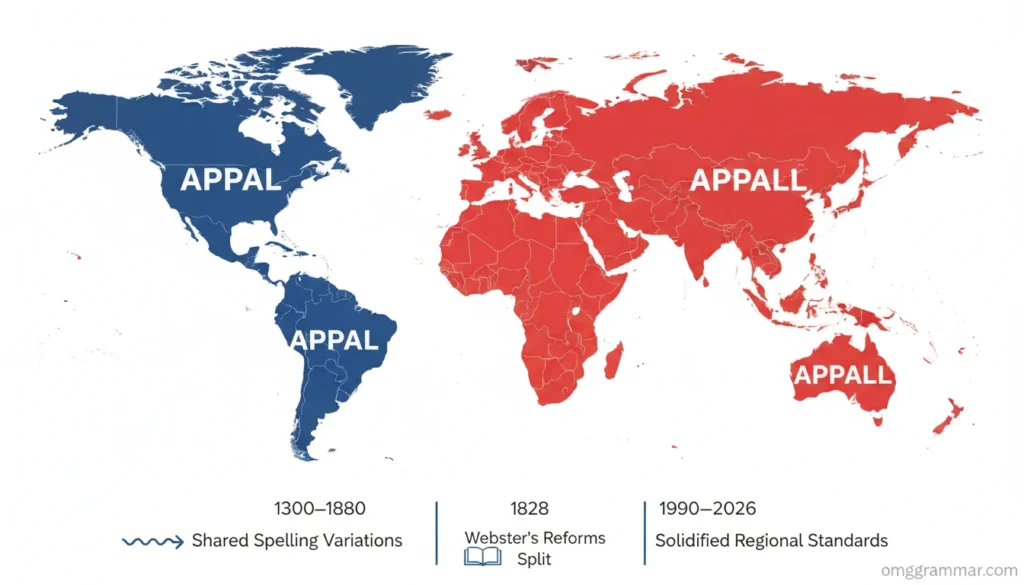
This visualization shows the geographic split clearly. British spelling zones use “appal” while American spelling zones use “appall.” The timeline reveals when the split happened and how it solidified over two centuries into today’s stable regional standards.
No Difference in Pronunciation
Both “appal” and “appall” sound identical. The pronunciation is /əˈpɔːl/ in both British and American English. You can’t tell which spelling someone uses just by hearing them speak the word.
This identical pronunciation matters because it means the spelling difference is purely visual. In spoken English, British and American speakers communicate perfectly without anyone noticing the spelling split.
Common Mistakes When Using Appal vs Appall
People make predictable errors with these regional spellings, mostly by not knowing which audience they’re writing for or by letting spell-checkers “correct” to the wrong regional standard. Understanding these mistakes helps avoid them.
| Incorrect | Correct | The Fix |
| Using “appall” in a British university essay | Using “appal” in a British university essay | Match spelling to your institution’s regional standard. British schools expect British spelling. |
| Mixing “appal” and “appall” in the same document | Using only “appal” or only “appall” consistently | Pick one regional standard and stick with it throughout your entire document. |
| Writing “apalled” (one L) for past tense | Writing “appalled” (two L’s) for past tense | Both regions use double L in inflected forms—”appalled” and “appalling” are universal. |
| Trusting spell-checker without checking regional setting | Setting spell-checker to match your target audience | Configure software to UK English or US English before writing to catch the right “errors.” |
| Using American spelling in British publication | Using British spelling in British publication | Research your publisher’s or journal’s preferred English variant before submitting work. |
The main psychological trigger is automation trust. People rely on spell-checkers to catch errors, but spell-checkers only know one regional standard at a time. If your settings don’t match your audience, the software actively makes your spelling wrong by “fixing” it.
Another trigger is ignorance of regional differences. Many writers don’t know that British and American English differ on this word. They assume one spelling is right and one is wrong globally, when actually both are right regionally.
Global education creates mixed training too. Someone might learn British English in school but consume mostly American media. Their brain gets conflicting signals about correct spelling, making them uncertain which version to trust.
Tips for Using Appal vs Appall Correctly
Mastering regional spelling requires both knowing the rule and building habits that match your audience. You need to consciously choose your regional standard and apply it consistently.
Real-World Editing Experience
In 2016, while editing a collection of international academic essays, I found a nightmare scenario. British authors had written “appal” throughout their submissions. American authors used “appall.” Two Australian contributors used “appal” (Commonwealth standard), but one Canadian used “appall” (North American standard).
The deadline pressure was intense—we had one week to produce final page proofs. The publisher demanded consistency but couldn’t decide which regional standard to adopt. They wanted both British and American audiences to accept the book.
We chose American spelling for the entire volume because the publisher was based in New York. That meant changing every British author’s “appal” to “appall”—over 300 instances across 400 pages. British authors protested. Some felt we were disrespecting their language by “Americanizing” their prose.
That experience taught me that regional spelling carries emotional weight. It’s not just about correctness—it’s about linguistic identity and cultural respect. The lesson? Make your regional choice early, communicate it clearly to all contributors, and stick with it consistently. Don’t surprise authors with changes after they’ve submitted work.
Memory Tricks That Work
The simplest trick: “Appal = UK = one L (shorter).” “Appall = USA = two L’s (longer).” This connects the shorter British spelling to the shorter UK abbreviation and the longer American spelling to the longer USA abbreviation.
Another approach: remember that British English often simplifies consonants—”travelled” becomes “traveled” in American English but stays “travelled” in British. Apply that same pattern to appal/appall.
For choosing which to use: think about your audience’s location. Writing for The Guardian? Use “appal.” Writing for The New York Times? Use “appall.” Let the publication’s home determine your spelling.
A practical shortcut: set your word processor’s language before you start writing. Choose “English (UK)” for British audiences or “English (US)” for American audiences. Let the software catch region-specific errors automatically.
Conclusion
Appal vs appall demonstrates how English splits into regional standards through deliberate language policy. Both spellings come from the same Latin root meaning “to grow pale,” but Noah Webster’s American spelling reforms in the 1820s created a lasting split. British English simplified to “appal” while American English kept “appall.”
Use “appal” when writing for British, Australian, or Commonwealth audiences. Use “appall” when writing for American or Canadian readers. Both spellings work identically in grammar and meaning—only the regional expectation differs.
Understanding that neither spelling is more correct helps you avoid feeling uncertain. They’re both right in their own regions. The key is matching your spelling to your audience’s expectations and staying consistent throughout your writing.
Master the distinction by always checking your target audience before you write. Set your spell-checker appropriately. When in doubt, research the publication or institution’s preferred English variant. That small step prevents embarrassing corrections later.
FAQs
The only difference is regional spelling preference. “Appal” is British English; “appall” is American English. Both words mean exactly the same thing—to shock, horrify, or deeply dismay someone.
Both are correct in their respective regions. Use “appal” for British audiences and “appall” for American audiences.
“Appalled” with two L’s in both British and American English. The past tense and the adjective “appalling” always use double L in all regions, even though the base verb differs.
British spelling reforms in the 1800s simplified doubled consonants in base forms. American English, influenced by Noah Webster’s different reform approach, kept the double L throughout.
Technically yes, readers will understand it. But it looks like a spelling error to British readers who expect “appal” as the standard form.
Canadians typically use “appall” with two L’s. Canadian English follows American spelling conventions for most words, though it occasionally accepts British variants in other contexts.
Yes, “appalling” uses two L’s in both British and American English. Only the base verb (appal/appall) differs regionally.
The split became official in the 1820s-1840s with Noah Webster’s American dictionary reforms and concurrent British standardization efforts.
To shock, horrify, or deeply dismay someone. The word describes causing intense negative emotion through something dreadful or disturbing.