
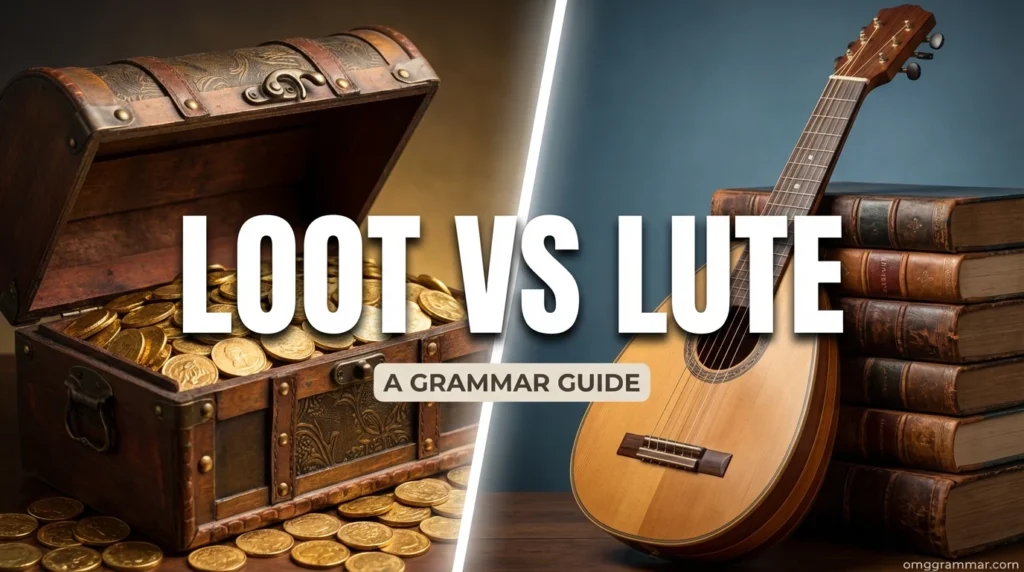
Loot vs lute are homophones that sound identical but mean completely different things. “Loot” means stolen goods or treasure, or to steal and plunder, while “lute” is a pear-shaped stringed musical instrument popular in medieval and Renaissance Europe. These words sound exactly alike when spoken but carry zero connection in meaning—one relates to theft and gaming rewards, the other to classical music and history.
Why Do These Same-Sounding Words Confuse People?
Your brain struggles with loot vs lute because of contextual priming working against you. When you hear someone say /luːt/ out loud, your brain immediately thinks “loot” because you’ve encountered that word thousands of times through video games, movies about pirates, and news about robberies. The musical instrument “lute” barely registers in modern conversation.
Truth is, most people under 40 have never seen or heard a real lute. They play video games where “loot” appears constantly—loot boxes, loot drops, legendary loot. Their brains store “loot” as the default meaning and forget “lute” exists at all.
This creates problems in writing. You’re typing about Renaissance music and autocorrect changes “lute” to “loot.” Or you’re discussing video game rewards and spell it “lute” accidentally. Spell-check won’t catch these errors because both words are spelled correctly—just used in wrong contexts.
The confusion gets worse because the words share no meaning bridge. With homophones like “their” and “there,” you can at least connect both to ideas about location or possession. But loot vs lute? A stolen treasure chest and a medieval guitar? Your brain finds no logical connection to help you remember which spelling fits which meaning.
Where Did Loot and Lute Come From?
Loot and lute traveled to English through completely different routes across thousands of miles and hundreds of years. Their stories show how words from different cultures and eras can accidentally end up sounding identical in modern English.
Loot: From Colonial India to Global Gaming
“Loot” started as the Hindi word “lūṭ,” meaning plunder or stolen property. Behind that lies the Sanskrit word “lotram,” meaning robbery or booty. Ancient Indian languages used these words to describe war spoils and theft long before English existed.
British colonizers encountered “lūṭ” during their rule in India starting in the late 1700s. British soldiers and officials heard Indians use this word and adopted it. The first written English record appears in 1788 in a glossary explaining Indian terms used during corruption trials.
Military history brought the word into wider use. British troops returning from India used “loot” to describe plundering enemy cities. The word spread through military culture, then into everyday English by the mid-1800s. Americans picked it up around the same time.
The colonial origin carries heavy historical weight. British forces literally looted India—taking treasures, art, and wealth. They borrowed the Hindi word while committing the act it described. That irony isn’t lost on historians who study colonial exploitation.
Modern usage exploded through video gaming. Starting in the 1980s-1990s, games used “loot” for items players collected from defeated enemies. Now every major game features loot systems. Millions of gamers say “loot” daily without knowing its Hindi origins.
Lute: From Arabic Music to Renaissance Courts
“Lute” took an entirely different path. It started as the Arabic word “al-ʕūd,” literally meaning “the wood.” This referred to a stringed instrument Arabs played across the Middle East and North Africa.
Medieval trade and cultural exchange brought the instrument to Europe around 1100-1200 CE. Spanish Muslims (Moors) introduced it through Spain. European musicians adopted it enthusiastically. The word traveled through languages, changing shape as it went.
Old French called it “leüt” or “lut.” From French, it entered English around 1300-1400 as “lute.” The instrument became wildly popular across Europe during the Renaissance (1400s-1600s). Kings, nobles, and common musicians all played lutes.
The lute’s golden age lasted roughly 1500-1700. Composers wrote thousands of pieces for it. Then guitars gradually replaced lutes around 1750-1800. By 1900, lutes were rare museum pieces or historical curiosities.
Today’s lute appears mainly in specialized classical music, Renaissance fairs, and historical performances. Some musicians revived interest in authentic period instruments starting in the 1960s. But compared to guitars or pianos, lutes remain extremely rare.
The Rule: Use “loot” for stolen goods, treasures, or rewards (especially in games). Use “lute” for the historical stringed musical instrument.
These words sound the same through pure coincidence. Hindi “lūṭ” and Arabic “al-ʕūd” had zero connection to each other. English pronunciation changes made them homophones by accident, not design.
How Do You Use Loot vs Lute in Different Contexts?
Context makes the choice obvious once you know which word means what. Gaming, crime, and treasure contexts need “loot.” Music and history contexts need “lute.” The words almost never overlap.
Gaming and Modern Pop Culture
Video games own “loot” now. Every major game—Fortnite, World of Warcraft, Call of Duty, Diablo—uses “loot” for items players collect. You kill an enemy and get “loot drops.” You open treasure chests for “epic loot.” Gamers discuss “loot tables” and “loot boxes” constantly.
Gaming journalism uses “loot” in headlines daily. “New update adds legendary loot to dungeon bosses.” “Players angry about loot box gambling mechanics.” The word appears thousands of times across gaming websites, streams, and forums.
RPG (role-playing game) culture especially embraces “loot.” Getting better loot motivates players to keep playing. They share screenshots of “rare loot” with friends. Gaming communities built entire vocabularies around loot concepts.
Pirate movies and adventure stories still use traditional “loot” meaning. Pirates divide their “loot” after raiding ships. Treasure hunters search for buried “loot.” The word carries excitement and adventure connotations.
Classical Music and Historical Writing
Music education texts mention “lute” when teaching about Renaissance and medieval music. “John Dowland composed beautiful pieces for the lute.” “The lute was the most popular instrument in 1600s Europe.” These references appear in music history courses and classical music programs.
Period dramas and historical fiction feature lutes when depicting pre-1800 settings. A character might play a lute at a Renaissance court. Authors describe “the gentle sound of the lute” to set historical atmosphere.
Music performance specialists use “lute” technically. They discuss “lute tablature” (special notation), “lute tuning,” and “historical lute technique.” This specialized vocabulary exists mainly in classical music communities.
Renaissance festivals and medieval reenactments showcase lutes. Performers play them for audiences interested in historical authenticity. But this represents a tiny niche compared to mainstream music.
Crime, News, and Real-World Theft
News reporting uses “loot” for stolen goods during riots or wars. “Looters ransacked stores during the unrest.” “Police recovered looted jewelry worth thousands.” The word appears in crime coverage regularly.
Archaeological discussions sometimes mention “looted” artifacts. Museums display items that colonial powers “looted” from conquered nations. This usage connects back to the word’s original meaning about war plunder.
Slang expressions use “loot” for money generally. “That car must have cost a lot of loot.” This informal meaning developed in American English around the 1920s-1950s.
Where Have Writers Used These Words in Literature?
Classic and modern writing show how loot vs lute function in different eras and genres. The words rarely appear together because they occupy completely separate contexts.
Classic Literature and Historical Texts
William Shakespeare never wrote “loot”—the word hadn’t entered English yet during his lifetime (1564-1616). But he wrote about lutes multiple times. In “The Merchant of Venice,” he mentions musicians with lutes. The instrument fit naturally into his depictions of entertainment and courtship.
Mark Twain’s adventure novels mention “loot” in pirate and treasure contexts. His stories about treasure hunting and frontier life used “loot” to describe stolen or found valuables. The word matched the rough, informal speech of his characters.
Historical accounts of British colonial India use “loot” frequently. Military memoirs from the 1800s describe soldiers “looting” enemy positions or cities. These texts document how the word spread through English-speaking military culture.
Modern Gaming and Music Writing
Contemporary gaming blogs use “loot” in every article about role-playing games or shooters. “The best loot comes from the final boss.” “This update nerfed legendary loot drop rates.” Gaming writing treats “loot” as fundamental vocabulary that needs no explanation.
Music textbooks discussing Renaissance composition mention lute regularly. “Composers wrote intricate polyphony for multiple lutes.” “Lute songs combined voice and instrumental accompaniment.” These academic texts preserve technical musical knowledge.
Historical fiction set in medieval or Renaissance periods often includes lute-playing characters. Authors write scenes like “She tuned her lute carefully before the evening’s performance.” This adds authentic period detail to storytelling.
Online gaming forums show the complete dominance of “loot” in modern usage. Searching gaming sites for “lute” versus “loot” reveals “loot” appearing thousands of times more frequently. The musical instrument barely registers in contemporary online conversation.
What Words Mean the Same as Loot vs Lute?
Understanding synonyms and related terms helps clarify when to use loot versus lute. Each word has its own family of similar terms and related concepts.
Words Related to Loot
“Plunder” works almost identically to “loot” as both noun and verb. “The pirates seized plunder from the merchant ship” means the same as “seized loot.” Both words emphasize violent or illegal taking.
“Booty” shares the same meaning, though it sounds slightly old-fashioned or playful now. Historical texts use “booty” more than modern writing. “The crew divided the booty” appears in classic pirate stories.
“Spoils” refers specifically to war loot. “Spoils of war” or “spoils of victory” describe goods taken from defeated enemies. This formal term appears in historical and military writing.
“Treasure” overlaps with loot but carries more neutral connotations. Treasure can be found legitimately or discovered legally. Loot implies theft or at least morally questionable acquisition.
Gaming uses “drops,” “rewards,” and “gear” alongside “loot.” All these terms describe items players receive. “Epic drops” and “rare loot” mean essentially the same thing in gaming contexts.
Words Related to Lute
“Instrument” serves as the generic term, but doesn’t specify the type. “She played a stringed instrument” could mean lute, guitar, violin, or dozens of others.
“Oud” refers to the Arabic instrument that became the European lute. Music historians use “oud” specifically for Middle Eastern versions and “lute” for European adaptations, though they’re closely related instruments.
Guitar-family terms like “cittern,” “mandolin,” and “theorbo” describe related stringed instruments from similar historical periods. Musicians familiar with lutes often know these related instruments.
No real synonyms exist for “lute” because it names a specific instrument type. You either mean lute specifically or you use the general term “instrument.”
Visualizing the Differences
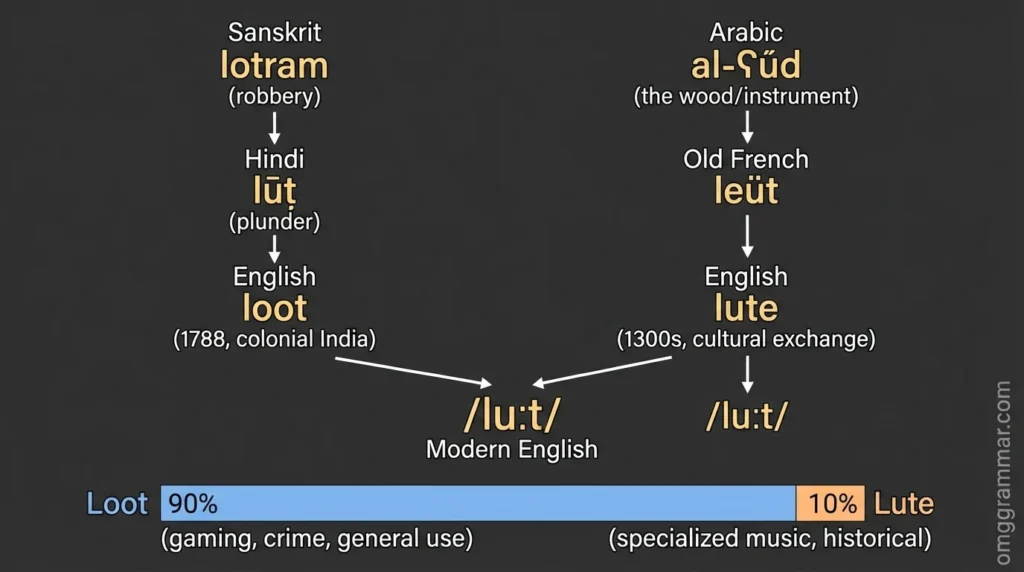
This visualization shows why loot vs lute confuse people. Two completely different historical journeys accidentally created identical sounds. The frequency gap explains why most people default to thinking “loot” when they hear the sound.
American and British English
Both American and British English use “loot” and “lute” identically. No regional spelling differences exist. Pronunciation stays consistent across all English-speaking countries—both words rhyme with “boot” or “suit” everywhere.
Gaming culture has globalized “loot” usage. British, American, Australian, and Canadian gamers all use “loot” the same way. The word crossed all regional boundaries through shared digital culture.
Classical music terminology keeps “lute” standardized worldwide too. Musicians in any English-speaking country use the same term for the same instrument. Historical and technical language doesn’t vary regionally.
Common Mistakes When Using Loot vs Lute
People make predictable errors with these homophones, usually by writing the more familiar word (loot) when they mean the rarer one (lute). Understanding these patterns helps avoid mistakes.
| Incorrect | Correct | The Fix |
| The musician played a beautiful melody on the loot. | The musician played a beautiful melody on the lute. | Use “lute” for the musical instrument. “Loot” never refers to instruments. |
| Renaissance composers wrote music for the loot and voice. | Renaissance composers wrote music for the lute and voice. | Historical musical contexts need “lute.” Check if you’re discussing music history. |
| Gamers search for legendary lute in dungeon raids. | Gamers search for legendary loot in dungeon raids. | Gaming contexts always use “loot” for rewards and items. |
| Pirates divided their lute equally among the crew. | Pirates divided their loot equally among the crew. | Stolen goods and treasure require “loot.” Pirates don’t divide musical instruments. |
| She studied loot performance in music school. | She studied lute performance in music school. | Academic music programs teach “lute” technique, not “loot.” |
The main psychological trigger is frequency bias. Your brain defaults to writing “loot” because you’ve seen it thousands of times more often than “lute.” This automatic response overrides careful thinking, especially when typing quickly.
Autocorrect causes problems too. Modern spell-checkers flag neither word as wrong because both are valid English words. They can’t detect context errors. You must catch these mistakes manually by proofreading carefully.
Voice recognition software struggles with loot vs lute too. When you dictate text about a musical instrument, the software often writes “loot” because that’s the more common word in its training data. You need to correct these errors after dictating.
Tips for Using Loot vs Lute Correctly
Mastering these homophones requires both knowing the definitions and building mental associations that stick. Here’s how to get them right every time.
Real-World Editing Experience
In 2019, while editing a museum catalog about Renaissance art, I found over 20 instances where the writer had typed “loot” instead of “lute” in descriptions of musical paintings. The deadline was brutal—we needed final proofs in 48 hours for the printer. The curator panicked when I showed her the errors.
Here’s what happened: the writer knew perfectly well what a lute was. She’d researched Renaissance instruments thoroughly. But her fingers automatically typed “loot” because that’s the word her brain stored as default. Every single error appeared in sentences like “The painting depicts a woman playing the loot.”
We spent three hours doing find-and-replace searches and manually checking every instance. The stress was intense—one missed error in a printed museum catalog would embarrass the institution permanently. That experience taught me that expertise doesn’t prevent homophone errors. Even specialists make these mistakes when typing quickly.
The curator implemented a new rule: any text mentioning musical instruments must go through specialized music fact-checking. Context-specific proofreading catches these errors better than general editing.
Memory Tricks That Work
The simplest trick: “Loot has two O’s like two eyes looking for treasure.” Picture a pirate with wide eyes spotting a treasure chest. Those two O’s in “loot” remind you it’s about treasure and theft.
For “lute,” remember: “Lute sounds like flute.” Both are musical instruments. Both end in “-ute.” This connection helps your brain link “lute” to music.
Another method: think “loot = loot boxes” (gaming). The repetition of the /luː/ sound makes it memorable. For “lute,” picture “lute = ancient flute’s relative.” The rhyme helps.
A visual trick: imagine a lute’s pear-shaped body. The u in “lute” looks rounded like the instrument’s body. The two O’s in “loot” look like treasure coins or loot boxes.
A practical shortcut: if you’re writing about anything except medieval/Renaissance music or classical instruments, use “loot.” In modern contexts, “loot” appears 95% of the time. Only specialized music writing needs “lute.”
Conclusion
Loot vs lute shows how English accidentally creates homophones from words with zero historical connection. “Loot” traveled from Hindi through colonial India, becoming a gaming and crime staple. “Lute” came from Arabic through medieval cultural exchange, remaining confined to classical music contexts. Sound changes made them identical in pronunciation despite their completely different journeys.
Use “loot” for stolen goods, gaming rewards, treasures, and plunder in any form. Use “lute” only for the pear-shaped stringed instrument from medieval and Renaissance Europe. Context makes the choice clear once you know the meanings—gaming and theft get “loot,” while classical music gets “lute.”
Understanding that these words share only sound, not meaning or history, helps prevent confusion. They occupy different worlds: loot lives in modern gaming culture and crime reporting, while lute exists in specialized music history. Their paths rarely cross except in spelling errors.
Master the distinction by building strong mental associations. Connect “loot” to treasure and games. Connect “lute” to music and history. These separate mental categories prevent mix-ups and make your writing clearer.
FAQs
“Loot” means stolen goods or treasure (or to steal), while “lute” is a medieval stringed musical instrument. These homophones sound exactly alike but mean completely different things. One relates to theft and gaming; the other to classical music.
Both words sound identical: /luːt/, rhyming with “boot” or “suit.” That identical pronunciation makes them perfect homophones, which is why people confuse them in writing.
“Loot” is correct for video games. Gaming uses “loot” for items, rewards, and treasures.
In gaming, “loot” means items, weapons, armor, or rewards players collect from defeating enemies, opening chests, or completing quests.
Yes, but rarely. Classical musicians who specialize in historical performance play lutes. Renaissance fairs feature them.
“Loot” comes from Hindi “lūṭ,” meaning plunder or stolen property. British colonizers adopted it from India in the late 1700s.
No, you play the lute. “Loot” is not a musical instrument—it’s treasure or stolen goods. Only “lute” refers to the instrument you can play.
Because “loot” is far more common in modern English, especially through gaming culture.
“Lute box” is likely a spelling error for “loot box.” Loot boxes are virtual containers in video games containing random rewards.
No, they have completely different origins and share nothing except identical pronunciation.