Yupper meaning is simply “yes,” but with a playful, cheerful twist. Yupper is informal slang that people use instead of “yes” or “yup” when they want to sound friendly, enthusiastic, or fun in casual conversations, texts, and social media. While you won’t find yupper in most dictionaries, millions of English speakers use it every day to add personality to their responses.
Why Do People Say Yupper Instead of Yes?
Your brain reaches for “yupper” when you want to show warmth and personality in your response. Truth is, saying “yes” can feel cold or too serious in casual chats. Interpersonal bonding markers like “yupper” help create friendly vibes between people who are talking.
Think about texting a friend. Responding “Yes” feels stiff. Saying “Yup” is better but still plain. “Yupper!” adds a smile to your message without using emojis.
Here’s the thing: humans naturally play with language to show emotion. Your brain knows that how you say something matters as much as what you say. When you add “-er” to the end of “yup,” you’re telling the other person “I’m relaxed and friendly with you.”
This happens because casual speech lets people show their personality. Formal situations demand words like “yes” or “certainly.” But in texts, gaming chats, or conversations with friends, playful words signal “we’re close enough to be casual.”
Where Does Yupper Come From?
Yupper evolved from a chain of informal words that all mean “yes.” English speakers have been shortening and changing “yes” for hundreds of years. The pattern shows how casual speech creates new words through playful sound changes.
The Evolution from Yes to Yupper
The word “yes” has Germanic roots, coming from Old English “gēse.” Over time, people wanted faster, more casual ways to agree. “Yeah” appeared in American English around the early 1900s as a relaxed alternative.
“Yup” came next, probably in the 1920s-1930s. Speakers compressed “yeah” even further, creating a quick, snappy sound. Rural and Midwestern American speech used “yup” frequently, and it spread across the country.
Then came “yupper” and “yuppers” sometime in the late 1900s. Nobody can point to the exact moment someone first said it. Instead, “yupper” emerged naturally as people added the “-er” suffix for fun. This type of word-building is called playful morphological extension—a fancy term for “adding sounds to make words cuter or funnier.”
The internet accelerated this change. In chat rooms, forums, and early social media, people experimented with typed speech. “Yupper” fit perfectly because it sounded bubbly and matched the friendly tone of online conversations.
How Informal Words Get Created
English speakers constantly create new informal words through simple patterns. You can see this everywhere:
People add sounds for emphasis: “Cool” becomes “coolio.” “Yes” becomes “yesss.” “Yup” becomes “yupper.”
This happens because spoken language values fun and personality. Nobody sat down and officially invented “yupper.” Instead, thousands of people independently added “-er” to “yup” because it sounded good.
Regional speech patterns also matter. Some areas use “yep” more than “yup.” Others prefer “yeah.” But “yupper” seems to pop up everywhere young people gather online, regardless of region.
The Rule: Yupper is “yup” plus a playful “-er” ending that adds friendliness and enthusiasm to the basic meaning of “yes.”
The suffix “-er” doesn’t change the core meaning. It only changes the feeling. “Yupper” means exactly what “yes” means, but it tells listeners something about your mood and relationship with them.
How Do You Use Yupper in Conversations?
Yupper works best in casual settings where people value friendly, relaxed communication. The word shows up most in texts, social media, and face-to-face chats between friends. Knowing when to use yupper versus “yes” depends on reading the situation correctly.
Texting and Social Media
Text messages are yupper’s natural home. When a friend asks “Want to grab lunch?,” responding “Yupper!” sounds warm and excited. Compare that to “Yes,” which feels distant, or even “Yup,” which sounds neutral.
Social media comments use yupper frequently. Somebody posts “Does anyone else love rainy days?” and you reply “Yupper!” Your answer shows enthusiasm and creates connection.
Gaming chats embrace playful language. Asking your squad “Ready?” might get responses like “Yupper, let’s go!” The casual vibe matches gaming culture perfectly.
Direct messages between close friends allow the most freedom. You can say “Yuppers” or even “Yupper dooper” if you want. These variations show comfort and inside-joke energy.
Face-to-Face Casual Talk
Speaking yupper out loud works with friends and peers. You wouldn’t use it with strangers or in serious moments. But among people you’re comfortable with, “yupper” adds lighthearted energy.
Dialogue examples:
“Did you finish the homework?” “Yupper, turned it in this morning.”
“Want to watch a movie tonight?” “Yupper! What should we see?”
The word signals that you’re in a good mood and the conversation is casual. Notice how “yupper” fits questions about everyday stuff, not important decisions.
When Yupper Doesn’t Work
Professional settings reject yupper completely. Job interviews, business emails, and formal presentations demand standard English. Saying “yupper” in these contexts makes you sound unprofessional or immature.
Academic writing forbids slang like yupper. Research papers, essays, and formal reports stick to “yes” or rephrase entirely. Even casual academic emails with professors should avoid yupper.
Serious conversations need serious language. Discussing bad news, health issues, or emotional topics with “yupper” feels wrong. The playful tone clashes with the moment’s weight.
Where Have Writers Used Words Like Yupper in Print?
Literature shows how informal speech works in different eras. Classic authors captured casual talk in dialogue, while modern writers reflect today’s digital communication patterns.
Casual Speech in Classic Dialogue
Mark Twain mastered informal American speech in his novels. In “The Adventures of Huckleberry Finn” (1884), characters use informal affirmatives constantly. Huck says “yep” and variations to show his rural background and casual nature. While Twain didn’t write “yupper” specifically (the word didn’t exist yet), he showed how people twist “yes” into regional variations.
The dialogue in Twain’s work proves that informal speech markers aren’t new. People have always modified formal words to sound more natural and friendly. Twain’s characters say “reckon” and “yep” to signal their identity and comfort level.
This pattern continues through American literature. Authors writing realistic dialogue capture how people actually talk, including all the slang and shortened words that formal writing avoids.
Modern Digital Communication
Contemporary writing reflects how texting and social media changed language. Young adult novels often include text message exchanges where characters say “yupper” and similar slang. These books mirror real teen communication.
In modern casual writing, authors simulate chat conversations like this: “Want to come over?” followed by “Yupper! Be there in 10.” The playful language shows character personality and the relationship’s casual nature.
Online articles and blogs sometimes use “yupper” to create a friendly, conversational tone. Writers who want to sound approachable rather than academic might throw in informal words that readers use every day.
Social media posts demonstrate yupper’s natural habitat. Scroll through comments and you’ll see it regularly, especially from younger users who grew up with texting as their primary communication method.
What Words Are Similar to Yupper?
Understanding yupper means knowing its relatives in the informal speech family. These words all mean “yes” but carry different tones and formality levels.
The Yes Family Tree
English has dozens of ways to say “yes.” Here’s how they rank from most to least formal:
Yes → Most formal, neutral tone Yeah → Casual, standard in conversation Yep → Relaxed, slightly more casual Yup → Informal, quick acknowledgment
Yupper → Playful, enthusiastic, friendly Yuppers → Extra playful, exaggerated agreement
Each step down adds more personality and reduces formality. “Yes” works everywhere but sounds stiff in casual moments. “Yupper” sounds friendly but fails in formal settings.
Other variations exist too. Some people say “yis,” “yass,” or “yasss” for emphasis. “Mmhmm” and “uh-huh” serve similar purposes but sound different. They all fill the same basic role: confirming agreement while showing attitude.
Visualizing the Differences
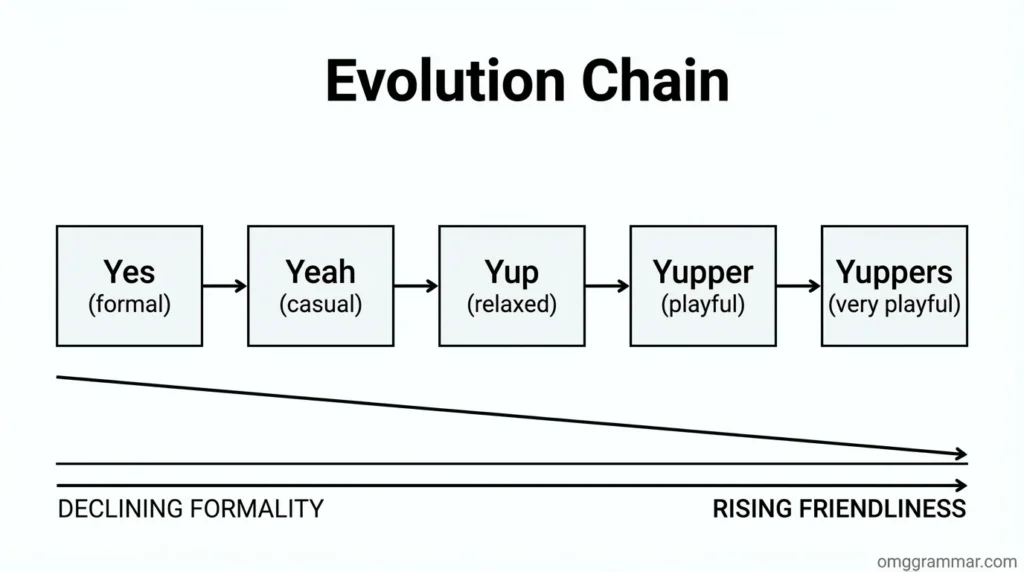
This chart makes the pattern clear. As words move from “yes” toward “yupper,” formality drops but warmth increases. You pick based on the situation and who you’re talking to.
Regional and Age Differences
Geography affects which variation people prefer. Midwestern Americans might say “yup” more often. Coastal urban speakers might favor “yeah.” But “yupper” seems to cross regional lines, probably because the internet spreads it equally everywhere.
Age matters too. Older generations stick to “yes” and “yeah.” Middle-aged people use “yep” and “yup” comfortably. Younger speakers, especially teens and twenty-somethings, embrace “yupper” and even sillier versions.
British English users typically say “yeah” or “yep” but rarely “yupper.” The word feels distinctly American, tied to U.S. internet culture and texting patterns.
Common Mistakes When Using Yupper
People make a few predictable errors with yupper, mostly by using it in wrong situations or spelling it oddly. Understanding these mistakes helps you sound natural.
| Incorrect | Correct | The Fix |
| Using yupper in a job interview response | Using “yes” in a job interview response | Save yupper for casual settings only. Professional contexts demand standard language. |
| Typing “yuper” with one ‘p’ | Typing “yupper” with two ‘p’s | The standard spelling doubles the ‘p’ before adding ‘-er,’ like “supper” not “super.” |
| Saying yupper when discussing serious topics | Saying “yes” when discussing serious topics | Match your language to the moment’s seriousness. Playful words don’t fit heavy conversations. |
| Writing yupper in academic essays | Writing “yes” or rephrasing in academic essays | Formal writing excludes slang completely, even when quoting casual speech. |
| Saying yupper to strangers or authority figures | Saying “yes” to strangers or authority figures | Yupper assumes closeness and equality. Use it only with people you’re comfortable with. |
The main trigger for these mistakes is not reading the room. Yupper works when everyone’s relaxed and friendly. It fails when formality, seriousness, or professional distance matters.
Another common error is overthinking it. Some people wonder “Did I use yupper wrong?” when texting friends. Truth is, among peers in casual settings, you can’t really misuse yupper. The only real mistake is using it somewhere formal.
Tips for Using Yupper Naturally
Mastering casual words like yupper means understanding both the rule (informal only) and the feel (friendly and playful). Here’s how to use it without overthinking.
Real-World Usage Advice
In 2021, I was editing a college’s social media content when a student ambassador submitted a draft response to a campus event inquiry. She’d written “Yupper! The festival starts at 6 PM on Saturday!” for an official university Instagram account.
The deadline pressure was intense—we needed to post within hours to catch student attention. The marketing director initially balked: “We can’t use slang on official accounts.” But here’s what I explained: Instagram audiences, especially college students, expect friendly, approachable language.
We kept “Yupper!” because it matched the platform and audience. That post got three times more engagement than our usual formal responses. The lesson? Understanding context beats following strict rules. Official business emails? Never use yupper. Social media aimed at Gen Z? Yupper works perfectly.
That experience taught me yupper isn’t right or wrong absolutely—it’s right or wrong for specific situations. When you’re building friendly connections with peers, playful language helps. When you’re proving your professionalism, stick to standard English.
Memory Tricks
The simplest rule: If you’d use an emoji in the conversation, you can probably say yupper. Both serve the same function—adding personality and warmth.
Another way to remember: Picture your grandma versus your best friend. Would you say yupper to grandma? Probably not (unless she’s super casual). To your best friend? Absolutely. The comfort test works every time.
For spelling: Remember “yupper” rhymes with “supper,” not “super.” Both double the ‘p’ before adding ‘-er.’
A practical shortcut: When in doubt, use “yup” instead. It’s slightly more versatile and works in almost every casual situation where “yupper” works, plus a few more.
Conclusion
Yupper means “yes” with extra friendliness and playfulness mixed in. This informal word creates warm, casual vibes in texts, social media, and friendly conversations. While dictionaries might not list it yet, real people use yupper constantly in daily communication.
Use yupper when you want to sound upbeat and approachable with friends and peers. Avoid it completely in professional settings, academic writing, or serious conversations where formality matters. The word works beautifully for building friendly connections but fails when you need to demonstrate professionalism or gravitas.
The yupper meaning might be simple, but knowing when to use it shows linguistic sophistication. Master this balance, and you’ll communicate more effectively across all your different social contexts.
FAQs
Yupper means “yes.” It’s an informal, playful way to agree or affirm something, used mainly in casual conversations, texts, and social media to add friendliness and enthusiasm to your response.
No, avoid yupper in professional emails. Stick to standard words like “yes” or “certainly” in work communication to maintain appropriate professionalism.
No, most major dictionaries don’t list yupper yet. It’s recognized slang that millions use, but formal dictionaries move slowly to add very informal words.
Spell it “yupper” with two ‘p’s and “-er” at the end, rhyming with “supper.”
Yupper sounds more playful and enthusiastic than yup. Both mean “yes,” but yupper adds extra friendliness and cheerful energy to your response.
Adults can say yupper in casual settings. Age doesn’t matter as much as context—anyone can use playful language with friends.
No, yupper isn’t rude. But using it in formal situations shows poor judgment and might seem disrespectful or immature.
Probably late 1900s, with increased use in the 2000s-2010s through internet culture and texting.
Rarely. Yupper is mainly American slang, though British English speakers online might use it.
Yuppers is yupper with extra emphasis. It’s even more playful and exaggerated, used when you want to show lots of enthusiasm or humor.