
Attain vs obtain both mean “to get something,” but attain emphasizes reaching a goal or achievement through sustained effort, typically for intangible things like skills or status, while obtain means acquiring something, usually a tangible object or permission, through a process or transaction. The distinction matters because using “attain” signals accomplishment and personal growth, whereas “obtain” focuses on possession and acquisition without necessarily implying difficulty or achievement.
Why Do These Two Words Confuse So Many People?
Your brain processes “attain vs obtain” through two competing mental pathways simultaneously. When you write either word, goal-oriented semantic processing activates different neural networks based on whether you’re thinking about achievements or acquisitions. This creates friction because both verbs end in “-tain” and share the meaning “to get,” making them feel interchangeable at first glance.
Truth is, the confusion runs deeper than similar spelling. English borrowed both words from Latin through different routes, and each carried distinct semantic baggage. “Attain” arrived loaded with connotations of reaching and touching, while “obtain” brought associations of holding and possessing. Your working memory can’t always distinguish these subtle shades when you’re focused on the broader sentence meaning.
The cognitive load increases because formal writing demands precision. In casual speech, nobody cares if you say “I obtained my degree” instead of “I attained my degree.” But on a résumé or in academic writing, that choice signals whether you view education as an achievement you worked toward or merely an object you acquired. Your brain knows this distinction exists but struggles to apply it consistently under time pressure.
Core Concepts and Historical Evolution
The distinction between attain and obtain emerged from two separate Latin verbs with fundamentally different meanings. Latin tangere meant “to touch or reach,” evolving through Old French ateindre into Middle English attainen around 1300. Latin tenēre meant “to hold or possess,” passing through Old French obtenir to become Middle English obteinen around the same period. These parallel etymological paths created two verbs that overlapped in function but diverged in nuance.
Etymology and Proto-Indo-European Root Divergence
The story begins thousands of years before Latin. Proto-Indo-European *teh₂g- carried the core meaning “to touch,” spawning Latin tangere and eventually our word “attain.” This root emphasized contact and reaching—the moment your hand first touches something previously out of reach.
Meanwhile, PIE *ten- meant “to stretch or draw,” producing Latin tenēre “to hold.” This root emphasized duration and possession—maintaining your grip once you’ve grasped something. Notice how the semantic difference was baked into the etymology from the beginning. One root described the achievement moment; the other described the state of having.
Latin added prefixes that sharpened these meanings further. Ad- (“toward”) combined with tangere to create attingere, literally “to touch toward,” which evolved into French ateindre. The prefix ob- (“toward, to”) joined tenēre to form obtinēre, “to hold toward oneself.” Both meant “to get,” but the first emphasized reaching a destination while the second emphasized securing possession.
English inherited both words during the Middle English period, roughly 1300-1400. Early usage showed considerable overlap, but formal writing gradually specialized them. By the 1600s, “attain” had claimed territory around achievements and goals, while “obtain” dominated contexts involving objects and permissions. This semantic drift continues today, driven by style guides and grammar checkers that flag awkward usage.
Grammatical Mechanics and Telicity
The mechanics hinge on aspectual verb classification, specifically telicity. A telic verb describes an action with a natural endpoint built into its meaning. “Attain” functions as inherently telic—when you attain something, you’ve reached a defined goal. The action concludes the moment achievement occurs.
“Obtain” operates differently. It can be telic (obtaining a specific document has a clear endpoint) or atelic (obtaining supplies can be ongoing). This flexibility makes “obtain” more versatile but also more ambiguous. Context must clarify whether you mean a single acquisition or repeated acquisitions.
The Golden Rule: Use “attain” for achievements requiring effort toward goals. Use “obtain” for acquisitions through processes or transactions, whether difficult or easy.
Both verbs take direct objects and can function transitively. You attain mastery; you obtain permission. But “attain” resists pairing with concrete physical objects unless the context emphasizes the achievement aspect. You wouldn’t naturally say “I attained a pencil,” but you could say “After years of searching, I attained the original manuscript”—the emphasis on prolonged effort makes “attain” acceptable.
The telicity difference affects sentence structure too. “Attain” works best in perfect tenses that emphasize completion: “She has attained fluency.” “Obtain” appears comfortably in continuous forms: “We are obtaining supplies.” That grammatical preference reflects the underlying semantic distinction—achievement versus acquisition.
How Do You Use Attain vs Obtain in Different Contexts?
Usage patterns split along the tangible-intangible axis, with “attain” claiming most intangible achievements and “obtain” covering tangible acquisitions plus certain intangible gains. The line blurs when effort becomes the primary focus, allowing “attain” to describe physical object acquisition if the achievement aspect dominates.
Formal and Academic Writing
Academic prose strongly prefers “attain” for degrees, qualifications, and scholarly achievements. “Dr. Martinez attained tenure after six years of research” sounds natural because tenure represents a goal requiring sustained effort. Substituting “obtained” wouldn’t be grammatically wrong but would strip away the achievement connotation.
Research reports use “obtain” for data, samples, and permissions: “We obtained ethical approval from the institutional review board.” The emphasis falls on securing necessary materials through proper channels, not on achieving a personal goal. Data collection involves acquisition, not accomplishment.
Thesis statements benefit from this distinction. “This study aims to attain a deeper understanding of neural pathways” emphasizes the research goal and intellectual achievement. “This study aims to obtain experimental results” focuses on data acquisition. Both work, but the first frames research as achievement-oriented, the second as process-oriented.
Professional and Business Communication
Business writing treats “attain” as the verb of choice for goals, objectives, and performance targets. “The sales team attained their quarterly target” emphasizes achievement and effort. “The company obtained new patents” focuses on acquisition through legal processes.
Email formality influences choice too. “I’ve obtained the necessary approvals” sounds appropriately neutral for routine business correspondence. “We’ve attained significant market share” adds weight to accomplishment announcements. The second version signals celebration; the first merely confirms completion.
Job applications showcase this difference powerfully. “Attained proficiency in Python through self-directed study” tells a story of personal growth and effort. “Obtained certification in project management” states a credential acquisition. Hiring managers read “attain” as active achievement and “obtain” as passive acquisition, even when both required equal work.
Casual and Everyday Usage
Conversational English rarely uses either word. People say “got” or “reached” instead. When “attain” or “obtain” do appear in speech, they signal formality or deliberate word choice.
Text messages would read: “I got my degree!” not “I attained/obtained my degree!” The formal verbs sound unnatural outside professional contexts. Even educated speakers default to simpler vocabulary in casual settings.
However, prepared speeches and presentations use both words strategically. “We must attain true equality” sounds more elevated than “We must get true equality.” The formality adds gravitas. Similarly, “The organization obtained significant funding” works better than “got funding” in public announcements.
The Nuance Trap: When Either Works
Certain contexts permit both verbs with minimal meaning shift. “She attained/obtained financial independence” works either way—the first emphasizes the achievement journey, the second the end state of independence. Native speakers choose based on which aspect they want to highlight.
Legal writing sometimes allows both: “The defendant obtained/attained majority status at age eighteen.” Lawyers might choose “attained” to emphasize the coming-of-age milestone or “obtained” to focus on the legal rights acquired. The choice becomes stylistic rather than grammatical.
This overlap zone causes the most confusion. When both verbs work, writers second-guess themselves, wondering if one choice is “more correct.” Usually, neither is wrong—they just shade the meaning differently. Understanding that shading requires sensitivity to the achievement-versus-acquisition distinction.
Where Have Writers Used Attain vs Obtain in Literature?
Classic and contemporary literature demonstrates how writers exploit the attain-obtain distinction to control emphasis and meaning. The usage patterns reveal evolving preferences and stylistic choices across literary periods.
Classic Literature
Mark Twain wrote in “The Adventures of Tom Sawyer” (1876): “Tom had struggled with his pride a few days, and tried to ‘whistle her down the wind,’ but failed. He finally attained to the comfortable conclusion that she was not worth it.” The choice of “attained” emphasizes Tom’s mental struggle and the achievement of reaching this psychological state.
Charles Dickens employed “obtain” for physical acquisitions in “Great Expectations” (1861). The text describes how Pip’s guardian “had obtained leave to bring me to spend a few hours with Estella.” Here, “obtain” perfectly captures the process of securing permission through request.
In “A Connecticut Yankee in King Arthur’s Court” (1889), Twain wrote about characters who “failed to obtain their desired reforms.” The verb choice focuses on unsuccessful acquisition rather than failed achievement, subtly shifting the reader’s perspective on political change.
Modern Professional Writing
Contemporary business authors favor “attain” for strategic objectives in ways that mirror classic usage but with sharper precision. Modern management books describe companies that “attain market leadership through innovation,” emphasizing competitive achievement.
Technical writing uses “obtain” extensively: “To obtain accurate measurements, calibrate instruments before each use.” The instruction focuses on the acquisition of data through proper procedure, not on achieving a goal.
Motivational literature deliberately chooses “attain” to inspire: “You can attain your dreams through consistent action.” The word selection emphasizes personal growth and achievement over mere acquisition, aligning with the genre’s purpose.
What Are the Synonyms and Variations of Attain vs Obtain?
Understanding semantic neighbors clarifies how “attain vs obtain” fits within the broader acquisition-achievement vocabulary. These related words illuminate the specific territory each verb occupies.
Semantic Neighbors and Functional Substitutes
“Achieve” functions as “attain’s” closest synonym, though “achieve” works more broadly. You achieve goals, and you attain goals, but “achieve” also describes accomplishing tasks that “attain” resists. “Achieve” has replaced “attain” in many casual contexts, relegating “attain” to formal writing.
“Acquire” and “gain” substitute for “obtain” in most contexts. “Acquire skills” and “gain experience” work where “obtain” might sound stilted. However, “obtain” remains preferred in formal or technical writing where precision matters.
“Reach” shares territory with both verbs. “Reach your goals” parallels “attain your goals,” while “reach an agreement” aligns with “obtain an agreement.” The versatility of “reach” explains its popularity in casual usage.
“Secure” sometimes replaces “obtain” when emphasizing the difficulty of acquisition: “secure funding” sounds more challenging than “obtain funding.” This substitution adds connotation beyond simple acquisition.
Visualizing the Difference
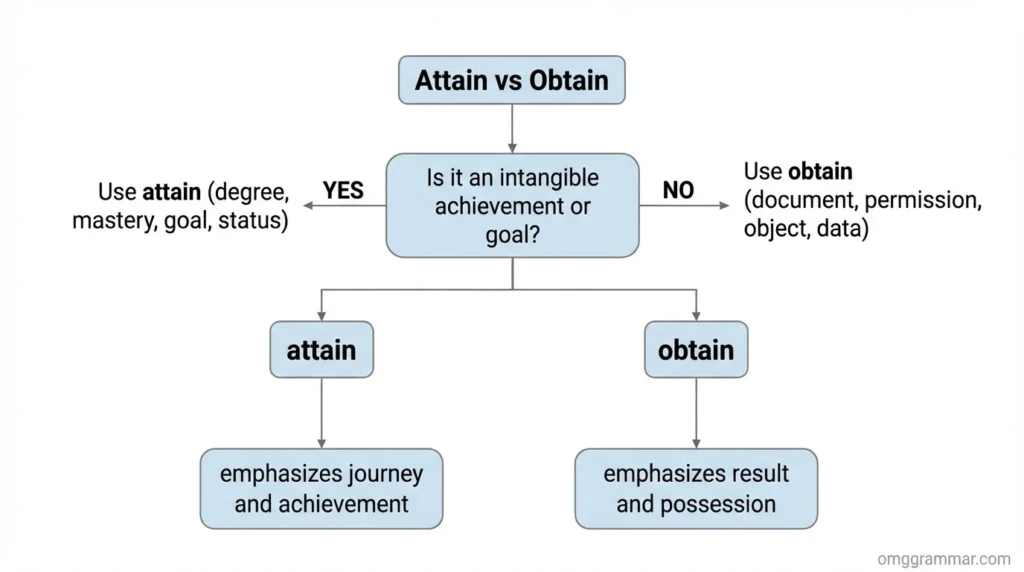
This visualization clarifies the decision process, but real usage involves gradients rather than sharp boundaries. Writers must consider not just the object’s tangibility but also the emphasis they want—achievement versus acquisition.
Regional Variations
American and British English show minimal variation in “attain vs obtain” usage. Both varieties follow the same basic pattern: “attain” for achievements, “obtain” for acquisitions. British formal writing might use both verbs slightly more frequently than American writing, which increasingly favors simpler alternatives like “achieve” and “get.”
Academic writing across English-speaking regions maintains consistent usage standards.
Common Mistakes When Using Attain vs Obtain
Errors cluster around three patterns: using “attain” with inappropriate concrete objects, using “obtain” where achievement emphasis is required, and inconsistent usage within a single document.
| Incorrect | Correct | The Fix |
| I need to attain a copy of the report. | I need to obtain a copy of the report. | Use “obtain” for routine document acquisition that involves no special achievement. |
| She obtained mastery of calculus through years of study. | She attained mastery of calculus through years of study. | Use “attain” for skills and mastery that represent personal achievement. |
| The company hopes to attain several new clients this quarter. | The company hopes to obtain several new clients this quarter. | Use “obtain” for acquiring clients as business assets, unless emphasizing competitive achievement. |
| After months of searching, he obtained his dream job. | After months of searching, he attained his dream job. | Use “attain” when the emphasis falls on the achievement aspect and sustained effort. |
| Students must obtain a deep understanding of the material. | Students must attain a deep understanding of the material. | Use “attain” for intellectual achievements and understanding that require effort. |
The psychological trigger behind these errors is vocabulary insecurity. Writers reach for “attain” because it sounds more sophisticated than “get,” but they overextend it to contexts where “obtain” fits better. This represents hypercorrection—the impulse to sound educated produces errors instead of preventing them.
Another trigger is inconsistent mental models. If you’re thinking about an object as a possession, you naturally gravitate toward “obtain.” If you’re thinking about the same thing as an achievement, “attain” feels right. The same writer might use different verbs for identical situations depending on their frame of mind.
Practical Tips and Field Notes for Attain vs Obtain
Mastering this distinction requires both understanding the rule and developing intuition through practice. Real-world application involves strategic choices based on audience and purpose.
The Editor’s Field Note
In 2017, while editing a university’s alumni magazine, I encountered a donor profile that read: “After obtaining her medical degree in 1985, Dr. Chen obtained board certification and obtained her current position as chief of surgery.” The repetition sounded awkward, but the verb choice bothered me more.
I marked up the paragraph in red during our editorial meeting with the development office. The deadline pressure was intense—we needed final copy for the printer within 48 hours. The development director pushed back: “What’s wrong with ‘obtained’? It’s grammatically correct.”
Truth is, it was correct but tone-deaf. I explained that “attain” would transform the first instance: “After attaining her medical degree” emphasizes Dr. Chen’s achievement and honors her effort. The emotional resonance matters when you’re profiling donors to inspire contributions. We kept “obtained” for the position because that reflected a hiring process rather than personal achievement.
That edit taught me that choosing between “attain vs obtain” isn’t just about correctness—it’s about respect and emphasis. When you’re writing about human accomplishments, “attain” acknowledges their effort. When you’re documenting transactions and acquisitions, “obtain” maintains appropriate neutrality.
Mnemonics and Memory Aids
The simplest trick: “Attain” contains “at” which sounds like “at last”—reaching a goal at last. “Obtain” contains “ob” which relates to “object”—getting an object or thing.
Another approach: think “Attain = Achievement” (both start with ‘A’). If you’re describing an achievement, use “attain.” If not, default to “obtain.”
For objects specifically: if you can drop it, lose it, or physically touch it, use “obtain.” If it’s abstract (knowledge, status, enlightenment), lean toward “attain.”
A pragmatic shortcut: after writing either verb, ask yourself “Could I replace this with ‘achieve’?” If yes, you probably want “attain.” If “acquire” works better, use “obtain.”
Conclusion
The “attain vs obtain” distinction rests on a fundamental semantic split: achievement versus acquisition. “Attain” signals reaching goals through sustained effort, typically for intangible achievements like skills, understanding, or status. “Obtain” covers broader territory—acquiring things through processes, transactions, or effort, whether tangible objects or intangible permissions.
Master the core principle: choose “attain” when emphasizing the journey and achievement aspect. Choose “obtain” when emphasizing the result and possession. This decision shapes how readers perceive your message—as a story of accomplishment or a statement of acquisition.
Remember that language serves communication first. If you’re uncertain, pick the verb that best captures what you want to emphasize. With practice, the distinction becomes intuitive, and you’ll naturally select the verb that conveys your precise meaning.
FAQs
Attain meansachieving a goal through effort, while obtain means acquiring something through a process.
No, they are not fully interchangeable despite overlap. “Attain” requires achievement context and sounds wrong with routine acquisitions. “Obtain” works more broadly but lacks the achievement emphasis that some contexts demand.
Use attain for goals, achievements, skills, understanding, or status that require sustained effort. Examples include attaining a degree, mastery, proficiency, or enlightenment.
Use obtain for acquiring objects, permissions, data, or information through processes or transactions. Examples include obtaining documents, approval, supplies, or results.
Both are equally formal. Neither belongs in casual conversation where “get” or “reach” would sound more natural.
Yes, if the emphasis falls on achievement rather than acquisition. “After decades of searching, she attained the lost manuscript” works because it stresses the achievement.
Technically yes, but it sounds awkward. “Obtained a degree” is grammatically correct but “attained a degree” better captures the achievement aspect.
No, both varieties follow the same pattern.
Think Attain = Achievement, Obtain = Object. If it’s an accomplishment, use “attain.” If it’s a thing you acquire, use “obtain.”
Yes. “Financial independence” can be attained (emphasizing the achievement) or obtained (emphasizing the state acquired). Choose based on which aspect you want to highlight.