

The choice between there has been and there have been depends entirely on what follows the verb, not on the word “there.” Use “has been” when the noun phrase after the verb is singular (there has been a problem), and “have been” when it’s plural (there have been problems). The word “there” functions as a grammatical placeholder, never as the subject that controls agreement.
Why Does Your Brain Stumble Over This Construction?
Your confusion about there has been versus there have been stems from a cognitive phenomenon called Agreement Attraction Error. This occurs when your brain latches onto the nearest noun instead of tracking the true grammatical subject. Linguists have documented this processing failure for decades.
Here’s the thing: when you say “there,” your mind registers it as the subject. After all, it sits in subject position. But “there” is merely an expletive—a grammatical ghost that occupies space without carrying meaning.
Your working memory juggles three elements simultaneously: the placeholder “there,” the verb, and the actual noun that determines agreement. Research shows this cognitive load triggers systematic errors even in fluent speakers. The brain wants efficiency. Matching the verb to the nearest noun feels natural, even when grammatically wrong.
Core Concepts and Historical Evolution
Existential constructions emerged from Old English spatial expressions where “þǣr” meant “in that place.” Over centuries, English speakers repurposed this locative adverb into a pure grammatical function. The transformation reflects how languages economize—using existing words for new structural purposes rather than inventing fresh vocabulary.
Etymology and Existential Construction
The word “there” descends from Old English “þǣr,” which Germanic languages inherited from Proto-Indo-European *to-. Originally a demonstrative pointing to physical locations, it migrated into abstract grammatical territory around the 13th century. Middle English texts show “there” beginning to introduce statements about existence rather than place.
This grammatical innovation solved a pragmatic problem. English word order demands a subject before the verb. When introducing new information, speakers needed a way to delay mentioning the important noun until after the verb, where it carries more emphasis. The existential construction filled this gap perfectly.
Truth is, most Indo-European languages developed similar structures. French uses “il y a,” German employs “es gibt,” and Spanish relies on “hay.” Each language found its own path to the same destination: a dummy subject that satisfies syntax while keeping focus where it belongs.
Grammatical Mechanics and Notional Subject
The mechanics hinge on distinguishing two types of subjects. The grammatical subject occupies the position before the verb—in this case, “there.” The notional subject, however, carries the actual meaning and controls verb agreement.
Golden Rule: The verb agrees with the notional subject (the noun phrase that follows), never with the expletive “there.”
When you write “there has been resistance,” the singular noun “resistance” determines the verb form. Switch to “there have been complaints,” and the plural “complaints” triggers “have been.” The grammatical subject “there” remains inert, contributing nothing to number agreement.
This split between grammatical and notional subjects appears in passive constructions too. Consider “it is believed that” or “it seems that.” These dummy pronouns occupy syntactic positions without participating in meaning.
How to Use There Has Been vs There Have Been in Context
The formal test requires identifying the notional subject first, then selecting the verb that matches its number. In “there has been a decline in sales,” the singular “decline” governs agreement. For “there have been multiple incidents,” the plural “incidents” controls the verb form.
Formal and Academic Usage
Academic writing demands precision with these constructions. Consider this complex example: “There has been significant debate among linguists regarding whether agreement attraction errors reflect encoding or retrieval failures.” The singular noun “debate” controls the verb despite the intervening prepositional phrases.
Active voice analysis reveals the structure clearly. If you invert the sentence—”Significant debate has been among linguists”—the singular verb remains with its singular subject. Consequently, the existential construction must preserve this agreement.
The passive construction in “there have been studies conducted on this phenomenon” shows plural agreement. Converting to active voice yields “researchers have conducted studies,” confirming the plural nature of the notional subject.
Casual and Conversational Examples
Dialogue shifts the terrain slightly. In rapid speech, native speakers often contract: “There’s been problems all week” technically violates standard agreement, yet occurs frequently in informal contexts. Linguists note this tendency toward singular default forms in casual speech.
Text messages reveal similar patterns: “There’s been so many complaints” appears despite prescriptive rules demanding “have been.” This reflects how spoken English prioritizes speed over formal accuracy. Your ear might not catch the mismatch in conversation.
The distinction matters more in writing than speech. Professional communications require standard forms, while casual exchanges tolerate deviation. Tone shifts accordingly—formal contexts demand “there have been developments,” while friends accept “there’s been a bunch of stuff happening.”
The Nuance Trap: Correct But Awkward Versus Native-Sounding
Some grammatically correct sentences sound stilted. “There have been occurring several incidents” follows agreement rules but jars the ear. Native speakers prefer “there have been several incidents” or “several incidents have been occurring.” Structure affects naturalness.
“There has been appearing a pattern” technically maintains singular agreement with “pattern,” yet English speakers avoid progressive forms with existential constructions. The cleaner version: “a pattern has been appearing” or simply “there has been a pattern.”
Mastery requires balancing correctness with idiomaticity. Choose constructions that feel natural while preserving grammatical standards. If a sentence sounds wrong despite following rules, restructure rather than force compliance.
Literary Evidence: There Has Been and There Have Been in Print
Classic literature preserves authentic examples showing how skilled writers deployed these constructions. The patterns reveal surprising consistency across centuries.
Classic Literature
Charles Dickens wrote in “Bleak House,” “There has been an unseasonable drought for many weeks.” This 1853 sentence demonstrates singular agreement with “drought.” Dickens knew his grammar cold. The sentence could have read “a drought has existed,” but the existential construction achieves greater emphasis.
Later in the same novel appears: “There have been mysterious transactions in the house.” Plural “transactions” governs the verb choice. Dickens recognized that the construction draws attention to the existence of something rather than to characteristics of the thing itself.
Mark Twain’s “The Adventures of Tom Sawyer” from 1876 includes: “There has been a great deal of talk about it.” The phrase “great deal” functions as singular despite implying quantity. This subtle distinction trips modern writers who might default to plural agreement.
Jane Austen deployed the construction frequently. “Sense and Sensibility” from 1811 offers: “There has been such a succession of them.” The singular “succession” controls agreement even when referring to multiple items. Austen understood that collective nouns maintain singular form.
Modern Stylistic Usage
Contemporary thriller writers use there has been to create urgency in sparse prose. The construction appears in terse scene-setting: “There has been movement in the warehouse” signals threat without elaborate description. The passive observation heightens tension.
Mystery novels employ there have been to establish patterns. “There have been three murders in two weeks” compresses exposition efficiently. Readers grasp the escalation without lengthy explanation. The construction serves plot mechanics.
Technical writing favors these constructions for impersonal reporting. “There have been advances in quantum computing” maintains neutral tone while conveying progress. Scientific papers use the pattern to shift focus from actors to actions or results.
Synonyms and Variations: Understanding Your Options
Alternative constructions exist, though each carries different implications. Understanding semantic neighbors helps writers choose precisely.
Semantic Neighbors and Illocutionary Force
“It has occurred” serves similar functions but emphasizes the event itself rather than its existence. Illocutionary force differs subtly. “There has been an explosion” foregrounds the fact of existence, while “an explosion has occurred” spotlights the event’s happening.
“We have seen” adds human perspective, shifting from objective observation to subjective experience. “There have been complaints” remains neutral, but “we have seen complaints” implies witness and potentially response.
“Exists” and “occurs” provide direct alternatives. “There has been resistance” becomes “resistance exists” or “resistance has occurred.” The simpler forms eliminate the expletive construction entirely, gaining directness while losing emphasis on the state of existence itself.
Visualizing the Agreement Pattern
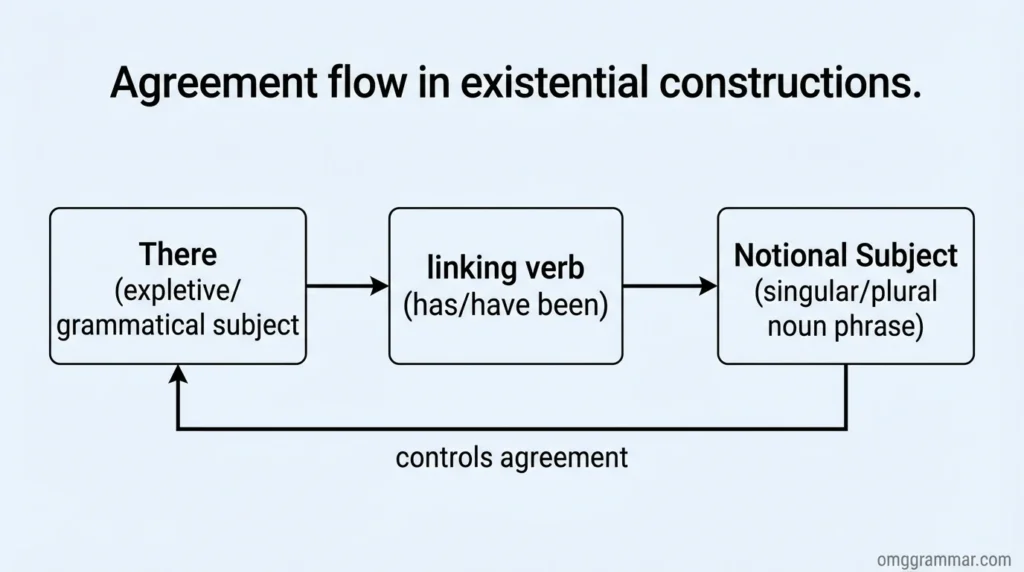
Flow diagram illustrating how the notional subject following the verb controls agreement in existential constructions, with “there” serving as a non-controlling grammatical placeholder.
Regional Variations
British and American English handle these constructions identically in formal writing. Both require agreement with the notional subject. Spoken varieties diverge more freely.
American casual speech shows higher tolerance for singular defaults: “there’s been issues” appears frequently despite plural subjects. British speakers demonstrate similar patterns, though regional variations exist. Cockney and Yorkshire dialects show particular flexibility.
Canadian English mirrors American patterns. Australian English aligns closely with British standards in formal contexts while adopting relaxed agreement in casual speech. The global trend favors informal singular defaults in conversation regardless of regional origin.
Common Mistakes
Even experienced writers stumble. Understanding error patterns helps avoid repetition.
| Incorrect | Correct | The Fix |
| There has been complaints | There have been complaints | Match verb to plural “complaints” |
| There have been a problem | There has been a problem | Match verb to singular “problem” |
| There’s been many incidents | There have been many incidents | Avoid singular contraction with plural subject |
| There has been issues arising | There have been issues arising | Plural “issues” requires “have been” |
| There have been a significant increase | There has been a significant increase | Singular “increase” needs “has been” |
The psychological trigger behind these errors connects to Agreement Attraction Error. Your brain processes “there” as the subject, then fails to track the actual controller. Proximity also matters—when adjectives or other words separate the verb from the notional subject, errors spike.
Hypercorrection contributes too. Writers who know the formal rule sometimes overcorrect, using “have been” with singular subjects because it sounds more proper or educated. The impulse backfires, creating new errors while attempting to avoid old ones.
Speed compounds the problem. Rapid writing or speech doesn’t allow time for careful analysis of number agreement. Your first instinct might generate the wrong form, and without revision, the error persists. Slow down during editing to catch these slips.
Practical Tips and Field Notes
Real-world application demands strategies beyond memorizing rules. Experience teaches shortcuts.
The Editor’s Field Note
In 2019, while editing a corporate legal brief for a securities fraud case, I caught a critical error in a key paragraph. The attorney had written: “There has been numerous violations of SEC regulations documented across three fiscal quarters.” The stakes ran high—this brief would reach federal court.
I flagged the error with red ink, noting that plural “violations” demanded “have been.” The attorney pushed back initially, insisting “there” as the subject took singular verbs. We spent twenty minutes at his desk, diagramming the sentence on a whiteboard. When I showed him how “violations” controlled agreement, not “there,” he finally conceded.
Here’s what made it memorable: the error appeared in the opening paragraph, where it would shape judicial perception of the firm’s attention to detail. Judges notice grammatical sloppiness. We revised it to “there have been numerous violations,” and the brief sailed through without objection. The case settled favorably six weeks later.
That deadline pressure—we had three hours until filing—meant no room for lengthy debate. I learned to explain the notional subject concept quickly, using visual demonstration rather than abstract grammatical terminology. The stress crystallized my teaching method: show, don’t theorize.
Memory Aids and Mnemonics
Try this trick: mentally delete “there” and “been” from the sentence. What remains? If you see “have problems,” use “have been.” If you see “has a problem,” use “has been.” This reveals the true subject-verb relationship.
Another approach: substitute a pronoun for the noun phrase. “There have been problems” becomes “they have been” (plural). “There has been a solution” becomes “it has been” (singular). The pronoun test clarifies number instantly.
Recite this rhyme: “There’s just a placeholder, a grammatical ghost / The noun that comes after controls agreement most.” Corny? Yes. Effective? Absolutely. Memory responds well to rhythm and rhyme.
Conclusion
Mastering there has been versus there have been requires understanding a simple but counterintuitive principle: “there” never governs verb agreement. The notional subject—the noun phrase following the verb—holds complete control. Identify that subject, determine its number, and select the matching verb form.
This construction exemplifies how English separates grammatical position from grammatical function. Your brain wants to process “there” as the subject because it occupies subject position. Resist that instinct. Train yourself to look past the placeholder to the true controller.
FAQs
The difference lies in the number of the following noun. Use “has been” with singular nouns (there has been a delay) and “have been” with plural nouns (there have been delays). The word “there” doesn’t control agreement—the noun after the verb does.
No, not in formal or professional contexts. While common in speech, “there’s been problems” violates standard agreement rules.
Identify the head noun, ignoring modifying phrases. In “there has been a series of problems,” the head noun is “series” (singular), not “problems.” The verb matches the head noun.
Yes, standard grammar requires “there have been” with plural countable nouns.
No, British and American English use identical agreement rules.
The head noun controls agreement. In “there has been a group of protesters,” “group” (singular) governs the verb despite “protesters” being plural.
Absolutely—the same principle applies to all tenses. Use “had been” with singular subjects (there had been a mistake) and plural subjects (there had been mistakes).
Agreement Attraction Error causes the brain to match the verb with the nearest noun rather than the grammatical controller.
Not at all—use it when appropriate with singular subjects. The construction serves legitimate purposes in formal prose.