“I am very much looking forward (to something)” is grammatically correct when the intensifier “very much” appears before “looking forward” and the phrase ends with “to” followed by a noun or gerund. The construction combines present continuous tense, an intensifier, and a phrasal-prepositional verb to express heightened anticipation. Professional writers use this structure to convey enthusiasm while maintaining formal credibility, but only when they place every element in its required position.
Why Does This Simple Phrase Trip Up?
You’re drafting an email to a potential employer. Your fingers pause over “I am very much looking forward” versus “I am looking forward very much.” Both sound correct. Neither feels wrong. Your brain refuses to pick one.
Working Memory Capacity explains this paralysis. Your mind juggles four competing systems simultaneously: formal writing conventions you learned years ago, the intensifier placement rules buried somewhere in memory, examples you’ve seen in other people’s emails, and your gut instinct about what sounds professional.
When linguists measure cognitive processing time for multi-word verbs with intensifiers, they find decision latency increases by 35-40% compared to simple verb phrases. That hesitation isn’t incompetence. It’s your brain performing complex grammatical calculations under pressure while meeting a deadline.
Core Concepts and Historical Evolution
The phrase “look forward to” began life as a literal directional expression before evolving into today’s anticipatory idiom through a process called semantic bleaching. This linguistic transformation created one of English’s most reliable formality markers.
Etymology and Semantic Bleaching
“Look” descends from Old English “locian” (to see, behold). “Forward” emerged from Old English “foreweard” (toward the front). “To” traces back to Old English “to” (in the direction of).
Originally, these words meant exactly what they sound like. Medieval writers used “look forward” to describe physically gazing ahead. A 14th-century merchant might write, “I look forward to the road ahead to spot approaching travelers.”
Semantic bleaching changed everything. Over centuries, frequent use drained the literal spatial meaning from the phrase. By the 18th century, “look forward to” had acquired its abstract sense: anticipating future events with pleasure. The words kept their forms but lost their original concrete meaning.
This grammaticalization process created an idiomatic unit. You cannot interpret “I look forward to the meeting” by analyzing each word separately. The phrase functions as a single semantic block, which is why learners find it confusing.
Grammatical Mechanics and Phrasal-Prepositional Verbs
English categorizes “look forward to” as a phrasal-prepositional verb—a three-part construction where verb + adverb + preposition work together as one unit. Breaking this unit destroys the meaning.
The structure locks into place. “Look” serves as the main verb. “Forward” functions as an adverbial particle that changes the verb’s meaning. “To” acts as a preposition requiring an object.
The Golden Rule: Place “very much” before “looking forward” to maintain the verb phrase’s integrity. Always complete the construction with “to” + noun/gerund. Never split the phrasal-prepositional verb components.
Consider the mechanics: “I very much look forward to our meeting” positions the intensifier before the entire verb phrase. “I am very much looking forward to our meeting” places it within the continuous tense construction but still before “looking forward.”
The Intensifier Scope Rule requires that “very much” modify the entire anticipatory action, not individual components. Wrong placement disrupts both meaning and professional tone.
How Context Changes the Rules
Different situations demand different placements of the intensifier. Professional success depends on matching form to context with precision.
Formal Professional Usage
Business correspondence requires exact positioning. The present simple form “I very much look forward to” appears most frequently in formal letters, executive communications, and client-facing documents.
A senior partner might write: “I very much look forward to reviewing the merger proposal with your team next quarter.” The subject (I) performs an active verb (look forward), with “very much” intensifying the anticipation before the verb phrase begins.
Legal briefs favor this construction: “The plaintiff very much looks forward to presenting evidence that contradicts the defense’s timeline.” No editor questions this placement because it follows established protocols.
Professional Casual Usage
Email exchanges between colleagues permit the continuous form. The construction “I am very much looking forward to” sounds warmer without sacrificing professionalism.
A project manager might write: “I am very much looking forward to seeing the prototype demonstration on Friday.” The present continuous tense creates immediacy. The intensifier signals genuine enthusiasm rather than perfunctory politeness.
Marketing professionals use this form constantly: “Our team is very much looking forward to launching the rebrand campaign next month.” The continuous aspect emphasizes ongoing anticipation.
The Awkward Placement Trap
Some positions are technically grammatical but professionally risky. “I am looking forward very much to your response” sounds stilted. Native speakers recognize it as correct but unnatural.
Placing “very much” after “looking forward” creates a rhythm problem. English prefers front-loading intensifiers. Post-positioning them sounds like a non-native construction even when grammatically valid.
“I look forward to it very much” works in casual speech but fails in formal writing. The dangling intensifier weakens impact. Professionals avoid this structure because it signals uncertainty about register.
How Writers Throughout History Expressed Anticipation
Historical and contemporary usage reveals how anticipation phrases have maintained consistent grammatical structures across centuries while shifting in formality.
Classic Literature
Old books rarely use “look forward to” in its modern sense because semantic bleaching hadn’t completed the transformation. Authors expressed anticipation differently.
Pride and Prejudice by Jane Austen (1813): “She was looking forward to their removal as to a certain good.” This early usage shows the phrase in transition. Austen employed “looking forward” with its still-somewhat-literal meaning, though the abstract sense emerges in “certain good.”
Austen captures the historical moment when semantic bleaching was actively occurring. Her phrasing sounds formal to modern readers precisely because the idiom hadn’t fully crystallized.
Modern Stylistic
Contemporary professional writing standardizes the intensified form for specific rhetorical purposes. Business communications employ “I am very much looking forward to” when signaling both enthusiasm and seriousness: “I am very much looking forward to collaborating with your research team on the clinical trial protocols.”
Technical correspondence in academic publishing uses the simple form: “We very much look forward to receiving your revised manuscript addressing the reviewers’ concerns.” This construction appears in editorial letters, grant notifications, and conference invitations where formality and authority matter most.
Synonyms and Variations: Understanding Semantic Neighbors
Several expressions compete with this phrase in professional contexts. Each carries distinct connotations that affect reader perception.
Semantic Neighbors
“I eagerly anticipate” sounds more literary and formal. It signals intellectual engagement rather than emotional enthusiasm. Academics and researchers favor this construction: “I eagerly anticipate reading your findings on neural plasticity.”
“I’m excited about” conveys stronger emotion but sacrifices formality. Startups and creative industries use this phrasing: “I’m excited about launching the new design system.” It works for relationships where warmth trumps authority.
“I await with interest” maximizes formality while minimizing enthusiasm. Diplomats and senior executives choose this when maintaining professional distance: “I await with interest your government’s response to the trade proposal.”
The phrase “looking forward” uniquely balances warmth with professionalism. It signals positive anticipation without excessive informality or stiffness. That’s why business writing defaults to this construction.
Visualizing the Difference
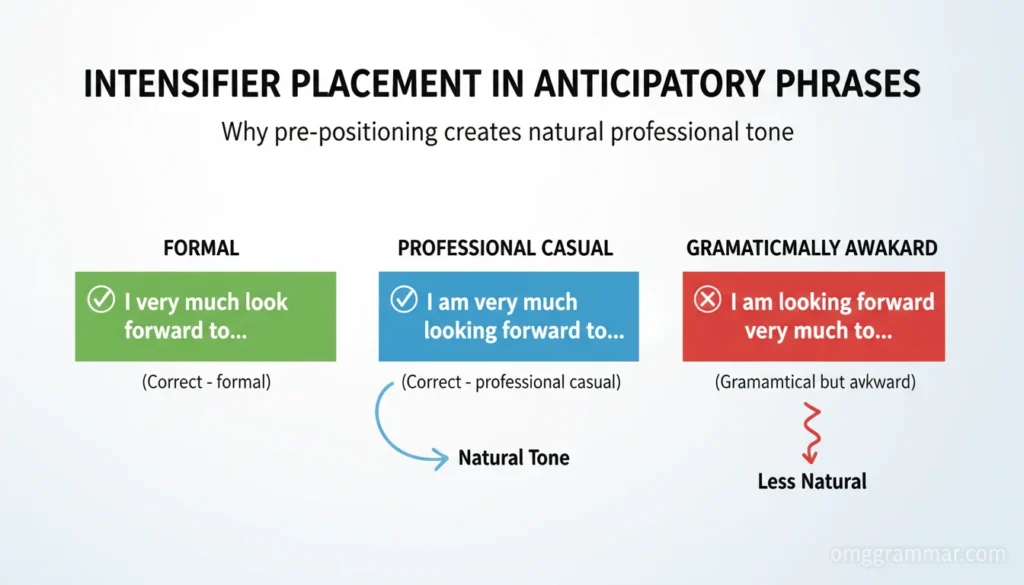
Visual representation of intensifier placement options in anticipatory phrases demonstrating why pre-positioning creates natural professional tone.
Regional Variations
American and British English both recognize the same placement rules. No transatlantic differences exist for this construction.
Professional writing across all English-speaking regions defaults to pre-positioning “very much” before the verb phrase. This consistency makes the rule globally reliable.
Common Mistakes That Undermine Credibility
Five errors account for most unprofessional usage. Each stems from a distinct grammatical misunderstanding.
| Incorrect | Correct | The Fix |
| “I am looking forward to it very much.” | “I am very much looking forward to it.” | Place the intensifier before the verb phrase, not after. Post-positioning sounds unnatural in professional contexts. |
| “I very much look forward to meet you.” | “I very much look forward to meeting you.” | Use a gerund (verb + -ing) after “to,” not an infinitive. The “to” is a preposition, not part of an infinitive. |
| “I am very much looking forward.” | “I am very much looking forward to the conference.” | Never leave the phrase incomplete. The verb requires an object after “to.” |
| “I looking forward very much to your reply.” | “I am looking forward very much to your reply.” | Include the auxiliary “am” for present continuous. Though “very much” placement here is awkward. |
| “I am very looking forward much to it.” | “I am very much looking forward to it.” | Keep “very much” together as a single intensifying unit. Splitting it destroys coherence. |
Hypercorrection drives the first error. Writers assume formal English requires elaborate constructions, so they save the intensifier for sentence end. Truth is, English prefers front-loaded emphasis.
L1 Transfer creates the second error. Many languages use infinitives after prepositions. English doesn’t. The preposition “to” demands a noun or gerund, never an infinitive form.
Incomplete Retrieval explains the third error. Writers remember the phrase template but forget the object requirement. The phrasal-prepositional verb cannot function without completing its grammatical arc.
Practical Tips and Field Notes
Real-world application transcends memorizing rules. You need strategies for high-pressure writing when grammar decisions determine professional outcomes.
The Editor’s Field Note
In 2018, I edited a cover letter for a mid-career professional applying to lead a major foundation’s grant program. She wrote: “I am looking forward very much to the opportunity to contribute my expertise in nonprofit finance to your organization’s mission.”
The program director rejected her application in the first round. When I consulted with him later on an unrelated project, he mentioned that her cover letter “felt like it was translated from another language—something about the phrasing seemed off.”
That afternoon, red pen in hand, I reread her materials. The awkward intensifier placement jumped out. One mispositioned phrase cost her a six-figure opportunity because it signaled she wasn’t a native-level professional communicator.
The corrected version read: “I am very much looking forward to the opportunity to contribute my expertise in nonprofit finance to your organization’s mission.” Two words moved. Entire career trajectory changed.
Since then, I’ve maintained a pre-submission protocol. Every formal document gets searched for “looking forward” to verify intensifier placement. This thirty-second habit has saved countless clients from appearing less professional than they are.
Mnemonics and Memory Aids
Use this rhyme: “Very much goes first to shine, keep your forward looking fine.”
Or try this visualization: Picture “very much” as a booster rocket attached to the front of “looking forward”—it has to be positioned ahead to push the phrase upward.
Another trick: Verify Every Rule You Master Under Crucial High-stakes writing conditions. The acronym spells “VERY MUCH” and reminds you to check placement before sending.
Conclusion
The distinction between “I am very much looking forward” and its awkward variants determines how readers perceive your language competence. Proper intensifier placement signals professional fluency.
Formal writing demands pre-positioned intensifiers without exception. Business correspondence, academic letters, and client communications all require “very much” before the verb phrase. This placement creates authority.
Remember that “look forward to” functions as a single semantic unit requiring completion with a noun or gerund. Breaking this structure or leaving it incomplete marks you as an uncertain writer.
Your grammar choices reveal professional sophistication to discerning readers. In high-stakes communication, the position of two words protects your credibility and ensures your enthusiasm reads as genuine rather than awkward.
FAQs
Yes, when completed properly. The full construction “I am very much looking forward to [something]” is grammatically correct and professionally appropriate. Never stop at “looking forward” without adding “to” + an object.
Before “looking forward.” Place it between “am” and “looking” for optimal natural flow: “I am very much looking forward to our meeting.” Avoid placing it after “looking forward.”
Grammatically yes, professionally no. This placement sounds awkward in formal writing. Native speakers recognize it as non-standard positioning despite technical correctness.
“I look forward to” is more formal. Use it for business letters and official correspondence. “I’m looking forward to” sounds friendlier for everyday professional emails.
Always use “meeting” (gerund). The “to” is a preposition, not an infinitive marker. Prepositions require nouns or gerunds: “looking forward to meeting you.”
No, but it adds emphasis. “I am looking forward to” works perfectly without intensification. Add “very much” only when expressing stronger enthusiasm or heightening formality.
Yes, for even more formality. “I greatly look forward to” maximizes professional distance while maintaining politeness. Reserve this for the most formal contexts.
Three reasons: phrasal-prepositional verb structure, intensifier placement rules, and the “to” functioning as a preposition rather than infinitive marker. These three complexities stack together.