

“For all the marbles” means competing for everything—the final prize, ultimate victory, or total stakes in a winner-take-all scenario. The phrase originated from children’s marble games in early 20th century America, where players gambled their entire marble collection on a single game.
Why Does This Phrase Sound Childish and Serious?
Your brain processes “for all the marbles” through conceptual metaphor mapping. Marbles represent childhood currency—small glass spheres that held genuine value in schoolyard economies. When you hear the phrase in adult contexts, your cognitive system simultaneously activates two schemas: the innocent memory of children’s games and the serious reality of high-stakes competition.
This dual activation creates the phrase’s rhetorical power. The childlike simplicity contrasts with adult consequences, making the stakes feel both relatable and momentous. Conceptual metaphor theory explains this phenomenon: your brain maps concrete source domains (physical marbles) onto abstract target domains (career success, championship victories, business deals).
The phrase works because marbles once functioned as real stakes. Kids didn’t just play for fun—they risked losing their entire collection. That authentic childhood pressure translates perfectly to adult scenarios where everything rides on one decision, one game, one negotiation.
Where Did “For All the Marbles” Come From?
The expression emerged from American children’s marble games during the 1910s and 1920s, when marbles served as playground currency and gambling stakes. Kids played “keepsies” or “for keeps,” where winners claimed all marbles in the ring. The phrase crystallized this winner-take-all dynamic into a metaphor that adults adopted for high-pressure competitions.
The Marble Game Economy and American Vernacular
Depression-era America saw marbles function as genuine childhood wealth. Working-class kids couldn’t afford toys, so marbles became both entertainment and tradeable assets. Boys carried marble bags to school the way modern kids carry trading cards, and playground hierarchies formed around marble-shooting skill.
Games operated on clear rules: draw a circle in the dirt, place marbles inside, shoot from outside the ring. Any marble you knocked out became yours. “Playing for all the marbles” meant risking your entire collection on a single game—the ultimate gamble. This practice created authentic stakes that made the phrase emotionally resonant when it migrated to adult usage.
The linguistic transition happened gradually. Sports reporters in the 1940s and 1950s adopted the phrase for championship games. Business writers used it for high-stakes negotiations. The metaphor stuck because Americans shared the cultural memory of marble games, making the reference immediately comprehensible across generations.
How the Phrase Functions as an Adverbial Idiom
“For all the marbles” operates as a prepositional phrase serving an adverbial function. It modifies verbs by specifying the conditions or stakes involved: “They’re playing for all the marbles” describes not what they’re playing, but what’s at risk.
Grammatically, the phrase demonstrates semantic opacity—you can’t decode its meaning from individual words. Someone unfamiliar with the idiom might imagine actual marbles as prizes. Native speakers recognize it as a frozen metaphor where the literal meaning has fossilized into figurative usage.
When competition reaches the point where everything depends on a single outcome, you’re playing for all the marbles.
The phrase resists modification. You can’t say “for most of the marbles” or “for several marbles” and maintain the idiom’s meaning. This rigidity marks it as a lexical chunk—a multi-word unit your brain stores and retrieves as a single piece of language.
How Do You Use “For All the Marbles” in Different Contexts?
The phrase fits competitive scenarios where outcomes determine ultimate success or total failure, with no middle ground. You use it to emphasize binary results: win everything or lose everything.
Sports Broadcasting and Championship Stakes
Announcers say “This is for all the marbles” during championship games, finals, or elimination matches. The phrase signals that this single game decides the season, not just advances a team. It works because sports operate on clear win/lose structures—no ties, no do-overs.
Example: “Game 7 of the World Series—they’re playing for all the marbles tonight.” The statement emphasizes totality. Everything both teams worked toward across 162 regular season games and multiple playoff series comes down to nine innings. One team leaves with a championship; the other goes home empty-handed.
The phrase appears most frequently in American football, basketball, and baseball coverage, where playoff structures create natural winner-take-all moments. Broadcasters use it to heighten drama and clarify stakes for casual viewers who might not follow the sport closely.
Business Negotiations and High-Stakes Deals
Corporate contexts employ the phrase when describing negotiations, pitches, or deals that determine company survival. “This presentation is for all the marbles” means the client meeting will either save the company or seal its fate. The phrase signals that moderate success isn’t an option—you either win the contract or lose the business.
Startup culture particularly favors this expression. When pitching to final-round venture capital investors, founders describe the moment as competing for all the marbles. That single pitch determines whether the company receives funding to continue or shuts down.
The phrase also appears in merger discussions, product launches, and competitive bidding scenarios. Any situation where binary outcomes eliminate middle ground becomes “for all the marbles” territory.
Personal Achievement and Life Decisions
People use the phrase for pivotal personal moments: final exams determining graduation, job interviews for dream positions, marriage proposals. The metaphor scales from childhood games to life-defining choices because the emotional structure remains identical—everything depends on this single moment.
Text message example: “Final round interview tomorrow. For all the marbles!” The casual tone contrasts with the stakes, using humor to acknowledge pressure. The phrase communicates seriousness while deflecting anxiety through the playful marble reference.
How Has “For All the Marbles” Appeared in American Culture?
The expression permeates American competitive contexts, from sports journalism to political campaigns, functioning as shorthand for ultimate stakes and winner-take-all scenarios.
Gambling and Stakes Language in Classic American Writing
Mark Twain frequently employed gambling metaphors in his work, though not this specific phrase. His characters “put all their chips on the table” and “bet the farm”—linguistic cousins of “for all the marbles.” In “The Celebrated Jumping Frog of Calaveras County,” Twain wrote about a character who “was willing to take a chance on any thing.” The vernacular captures the same American fascination with all-or-nothing wagering that later produced the marble metaphor.
The cultural foundation existed in 19th century America—stake-raising, bluffing, gambling as both vice and virtue. Frontier culture celebrated risk-taking, and language evolved to express these values. “For all the marbles” emerged from this tradition, adding childhood innocence to adult stakes-raising.
O. Henry’s short stories contain similar competitive frameworks. Characters scheme for total success or face complete ruin. His 1906 story “The Gift of the Magi” hinges on all-or-nothing sacrifice. While not using the marble phrase, these narratives established the winner-take-all story structure that made the metaphor culturally resonant.
Modern Media and Contemporary Usage
Sports documentaries title episodes “For All the Marbles” when depicting championship games. The 1981 comedy film of that name follows women’s professional wrestling, using the phrase to emphasize career-defining matches. The expression appears in political coverage during election nights—”voting for all the marbles”—and business podcasts discussing merger negotiations.
Contemporary thriller novels structure climactic scenes as “for all the marbles” moments. The protagonist faces the villain in a final confrontation where survival, justice, or salvation hangs in the balance. Authors don’t always use the exact phrase, but they build that narrative structure into plot resolution.
Tech journalism adopted the phrase for product launches and startup exits. Headlines declare “Apple vs Samsung: For All the Marbles” when major competitors release flagship products simultaneously. The phrase efficiently communicates that market dominance, not just temporary advantage, depends on the outcome.
What Other Phrases Mean the Same Thing?
English offers multiple expressions for ultimate stakes, each with distinct connotations and origins. “For all the marbles” belongs to a semantic family of winner-take-all metaphors drawn from games and gambling.
Stakes-Related Expressions and Their Nuances
“Winner take all” states the concept directly without metaphor. It functions more literally—tournament structures and political systems genuinely operate on this principle. The phrase lacks the playful childhood reference that makes “for all the marbles” memorable.
“All or nothing” emphasizes binary outcomes without gaming imagery. You use it for philosophical choices or personal commitments: “I’m all or nothing about this relationship.” The phrase applies broadly but lacks specificity about competition.
“Put it all on the line” comes from betting—specifically, placing your entire stake on a single outcome. It emphasizes risk more than competition. You “put it all on the line” when making vulnerable commitments, not just competing.
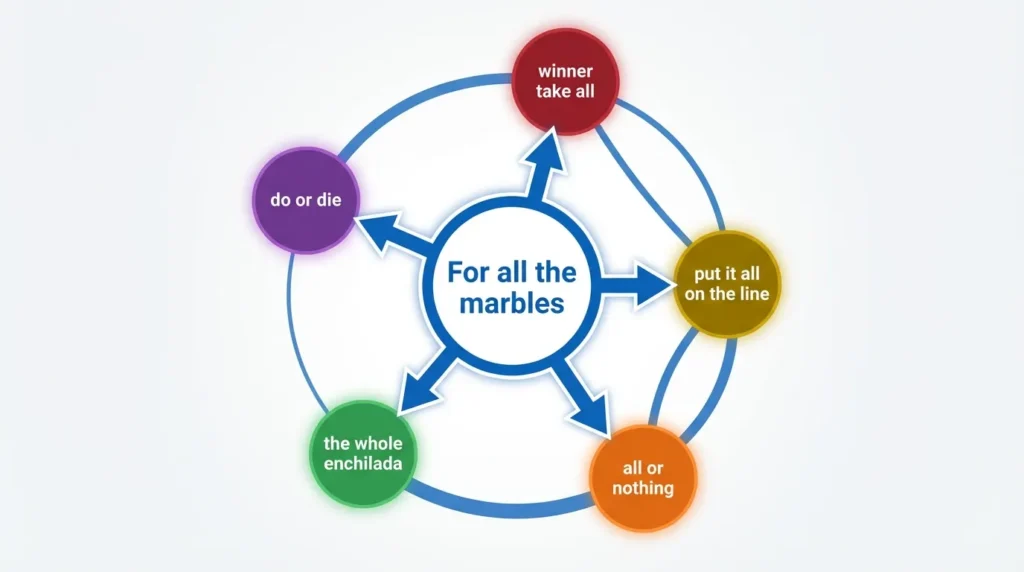
“The whole enchilada” emphasizes completeness—getting everything or nothing. Mexican food metaphor adds cultural flavor but doesn’t specifically indicate competition. You might inherit “the whole enchilada” or lose it without competing for it.
Regional and International Variations (US vs UK)
British English uses “for all the chips” more frequently, drawing from poker rather than marbles. The meaning stays identical, but the source domain shifts from childhood games to casino gambling. Australians say “for all the cookies” occasionally, though this sounds antiquated to modern ears.
American sports culture made “for all the marbles” the dominant expression within the U.S. International English speakers recognize it through American media exposure but might default to other metaphors in their own writing. Non-native speakers sometimes misunderstand it literally, imagining actual marble prizes.
What Mistakes Do People Make with This Phrase?
Writers often misuse “for all the marbles” by applying it to situations lacking clear binary outcomes or by altering the phrase in ways that destroy its idiomatic meaning.
| Incorrect | Correct | The Fix |
| “Playing for some of the marbles” | “Playing for all the marbles” | The idiom requires totality; partial stakes change the meaning |
| “For all the marble’s stakes” | “For all the marbles” | Don’t add possessives or extra words to frozen idioms |
| “This meeting is for most marbles” | “This meeting is for all the marbles” | Quantifiers like “most” break the metaphor |
| “Competing for the marbles” | “Competing for all the marbles” | The “all” is essential—without it, you’re just discussing actual marbles |
| “For all marbles in the game” | “For all the marbles” | Don’t expand or explain idioms; use them as-is |
The psychological trigger here is semantic decomposition—trying to make literal sense of figurative language. When you analyze “for all the marbles” word-by-word, your brain wants to clarify: which marbles? How many? This literal interpretation destroys idiomatic force. Frozen metaphors work precisely because they resist logical analysis.
Another error: using the phrase for low-stakes situations. Saying “this coffee run is for all the marbles” as a joke undermines the expression through hyperbole. Overuse weakens impact. Reserve it for genuinely high-stakes scenarios where everything truly depends on the outcome.
When Should You Actually Use “For All the Marbles”?
Professional writing demands judgment about when this colloquial phrase fits your tone and audience. The expression works beautifully in some contexts while sounding unprofessional in others.
Recognizing Appropriate Contexts
I edited a startup pitch deck in 2019 where the founder titled his final slide “For All the Marbles.” The presentation targeted venture capitalists for a Series B round—genuinely winner-take-all stakes. If they didn’t secure funding, the company would fold within three months. Eight employees’ livelihoods depended on this pitch.
The phrase worked. It acknowledged the pressure without begging for sympathy. It showed self-awareness—the founder understood he was asking investors to bet on a binary outcome. However, two board members initially objected. They felt the marble reference sounded unprofessional, like he wasn’t taking the situation seriously.
We debated for an hour. I argued that the phrase humanized the pitch. VCs see polished desperation daily. This acknowledged stakes honestly while using culturally resonant language. The founder kept it. They closed the round.
That experience taught me the phrase requires cultural fluency from your audience. American investors recognized the reference immediately. International investors might have puzzled over it. Context determines appropriateness.
Memory Techniques for Stakes Phrases
Remember: marbles = childhood total. If kids risked everything they owned, the situation truly represents ultimate stakes. Don’t use the phrase unless the outcome genuinely determines success or failure with no middle ground.
Alternative trick: Can you replace “for all the marbles” with “winner take all” and maintain the meaning? If yes, you’re using it correctly. If the situation involves partial success, compromise, or graduated outcomes, choose different language.
Think of marbles as a plural that demands “all.” You wouldn’t say “for a marble” and expect people to understand. The quantity matters—total collection versus single piece. This reminds you that the idiom applies only to complete stakes.
Why “For All the Marbles” Still Resonates
The phrase endures because it efficiently communicates ultimate stakes through culturally accessible imagery. Winner-take-all scenarios dominate modern competition—from championship sports to startup funding rounds—and language evolves to capture these moments memorably.
“For all the marbles” succeeds where more formal phrases fail. It acknowledges pressure while maintaining perspective. The childhood reference prevents excessive gravitas, reminding speakers that even high stakes remain, ultimately, games we choose to play. That balance of seriousness and playfulness makes it irreplaceable in American competitive vocabulary.
Use it wisely. Save it for genuine binary outcomes where everything rides on a single moment. When you deploy it correctly, the phrase crystallizes stakes instantly, preparing your audience to appreciate the drama ahead.
FAQs
For all the marbles means competing for everything in a winner-take-all scenario. The phrase indicates that success brings total victory while failure brings total loss, with no middle ground or consolation prizes.
The phrase comes from early 20th century American children’s marble games. Kids played “keepsies” where winners claimed all marbles in play, creating authentic winner-take-all stakes that adults later adopted as a metaphor.
Yes, it’s a colloquial idiom best suited for casual or dramatic contexts. Avoid it in formal academic writing or legal documents, but it works well in sports commentary, business pitches, and creative writing.
No, modifying the phrase destroys its idiomatic meaning. The expression is a frozen metaphor—you must use it exactly as-is or choose different language.
Both mean the same but carry different tones. “Winner take all” sounds more formal and direct, while “for all the marbles” adds playful cultural reference to childhood games.
Recognition varies—Americans immediately understand it, while international audiences might need context. British English speakers grasp it through media exposure but might use “for all the chips” instead.
Use it only for genuinely binary outcomes in competitive scenarios. Championship games, final negotiations, and career-defining moments fit; routine decisions or situations with compromise options don’t.
“For all the chips” appears in British English. Both communicate ultimate stakes, but chips reference poker while marbles reference children’s games.