Hastle vs Hassle: “Hassle” is the only correct spelling. “Hastle” is a misspelling that stems from phonological confusion—your brain mishears the double-s sound and tries to simplify it to a single consonant, creating a phantom spelling that doesn’t exist in any dictionary.
Why Does This Misspelling Feel So Natural?
Your brain isn’t failing you when it reaches for “hastle.” The confusion originates from phonological interference—the way your auditory processing system handles consonant clusters. When you hear someone say “hassle,” your brain registers a sibilant sound (/s/) followed by a liquid consonant (/l/). That sequence triggers pattern-matching with words like “castle,” “wrestle,” and “whistle,” where a single consonant precedes the “-le” ending.
Here’s the cognitive trap: your brain prioritizes speed over precision. It hears a sound pattern, matches it against stored phonetic templates, and selects the closest fit. Since English contains dozens of words spelled with “-stle” but relatively few with “-ssle,” your pattern-matching system defaults to the more common structure.
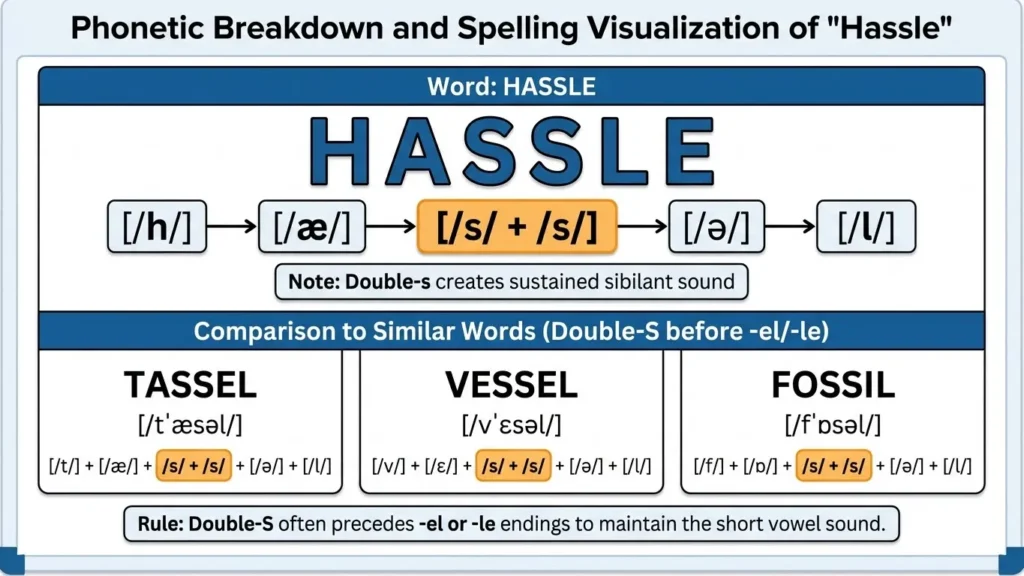
The spelling “hassle” violates your brain’s expectations because the double-s creates an unusual consonant cluster before the “-le” ending. Your cognitive processing system wants linguistic efficiency, so it attempts to regularize the spelling into a more familiar pattern. That’s why “hastle” feels intuitively correct even though dictionaries never acknowledged it.
Core Concepts and Historical Evolution
The word “hassle” entered American English around 1945, making it relatively young compared to most vocabulary. Its sudden appearance and informal origins explain why spelling confusion persists even 80 years later. Unlike words with centuries of printed history, “hassle” lacked the visual reinforcement that stabilizes orthography.
Etymology and Dialectal Borrowing
“Hassle” emerged from dialectal borrowing—the process where informal speech from specific regional or cultural groups becomes standard vocabulary. Linguists trace two possible origins: Southern US dialect and Yiddish-influenced American English from the 1930s-40s.
The Southern US theory connects “hassle” to dialectal “haggle” or “tussle,” suggesting it developed through phonetic blending. Speakers combined the aggressive connotation of “harass” with the physical implication of “tussle,” creating a hybrid term for persistent annoyance.
The Yiddish theory links it to “hatsle” (to worry or trouble), brought to American English by Jewish immigrants in urban centers like New York. This pathway explains the double-s spelling—Yiddish orthographic patterns influenced how early users wrote the word when it transitioned from purely oral to written form.
Regardless of origin, “hassle” entered print without a long establishment period. Most English words spend centuries in manuscripts and books before spelling standardizes. “Hassle” jumped from casual speech to newspapers and novels within a decade, giving the public limited exposure to the correct orthography before widespread use began.
Grammatical Mechanics and the Transitive Verb Function
“Hassle” operates as both a transitive verb and a concrete noun. As a verb, it requires a direct object: “The agent hassled the suspect for hours.” As a noun, it names a specific type of difficulty: “Filing taxes is such a hassle.”
The misspelling “hastle” appears most frequently in verb usage. When writers construct active sentences like “Don’t hastle me,” the error emerges because they’re focused on the action rather than the orthography. Noun usage sees fewer errors, possibly because nouns receive more visual attention when reading—your brain processes the word more carefully as a thing rather than an action.
Golden Rule: “Hassle” always uses double-s, never single-s. Think: “Harass” + “Hassle”—both use double-s to indicate persistence.
Contextual Examples in Different Registers
Understanding when and how “hassle” appears in various contexts clarifies why the misspelling persists across different communication settings.
Formal and Professional Writing
In professional contexts, “hassle” functions as a transitive verb describing persistent difficulty or as a noun identifying a problematic situation.
Business email: “The new system shouldn’t hassle employees with unnecessary verification steps.”
Subject: The new system | Verb: shouldn’t hassle | Object: employees
The active construction places the system as the agent causing difficulty. The double-s spelling maintains credibility in professional correspondence.
Technical documentation: “Users report login hassles when accessing the dashboard from mobile devices.”
The noun form identifies specific problems. Professional settings demand correct spelling because errors signal carelessness that undermines technical authority.
Casual Digital Communication
Casual contexts use “hassle” in abbreviated constructions where speed prioritizes communication over precision.
Text message: “Don’t hassle me about it, I’ll get there when I can”
The clipped rhythm of texting accelerates typing speed, increasing misspelling risk. Autocorrect typically catches “hastle,” but manual typing or voice-to-text transcription sometimes preserves the error.
Social media post: “Anyone else think airport security is a total hassle?”
The noun form solicits shared experience. Casual platforms tolerate spelling variation, but “hastle” still registers as incorrect to careful readers.
The Error Pattern
Misspellings cluster around high-speed writing where phonetic processing overrides visual memory.
Consider these contexts:
- Handwritten notes during meetings (highest error rate)
- First-draft typing when composing quickly
- Voice-to-text transcription when speech-to-text software mishears
- SMS messages typed on small keyboards
The pattern reveals that “hastle” emerges when writers bypass visual spelling verification. When you type slowly or review your writing, visual memory corrects the error. When you write at the speed of thought, phonological interference wins.
Historical Usage Patterns
Since “hassle” only entered common usage after 1945, examining its evolution requires different methods than analyzing centuries-old vocabulary.
Early Print Appearances
The word first appeared in American newspapers and magazines in the late 1940s, often in quotes or slang sections. Early usage shows inconsistent treatment—some publications italicized it as informal speech, others presented it as standard vocabulary.
Military correspondence from the Korean War era (1950-53) used “hassle” frequently to describe bureaucratic difficulties. Soldiers writing home complained about “the hassle of requisition forms” or “officers hassling us about uniform standards.” This military usage accelerated the word’s spread into civilian vocabulary.
Beat Generation writers of the 1950s adopted “hassle” enthusiastically. Jack Kerouac’s letters reference “hassling with editors” and “the hassle of finding publishers.” Though these are modern texts, the historical pattern matters—informal writers legitimized the word before formal authorities accepted it.
Modern Usage Patterns
Contemporary digital communication has made “hassle” ubiquitous. Customer service complaints dominate current usage: “The return process was a huge hassle” appears thousands of times daily across review platforms.
Business communications shifted from avoiding “hassle” as too informal to embracing it as customer-friendly language. Companies now advertise “hassle-free returns” and “no-hassle warranties,” making the word standard in commercial contexts where formality once ruled.
Synonyms and Semantic Distinctions
Examining related terms clarifies what makes “hassle” distinct and why substitutes don’t always work.
Semantic Neighbors
“Bother” carries less intensity: “Don’t bother me” suggests mild annoyance, while “Don’t hassle me” implies persistent, aggressive annoyance.
“Trouble” names a broader category: “Engine trouble” covers mechanical failure, while “Engine hassle” would sound odd because “hassle” specifically means difficulty involving persistence or bureaucracy.
“Annoyance” functions as a formal noun but lacks verb flexibility: You can “hassle” someone, but you can’t “annoyance” them.
“Inconvenience” sounds bureaucratic and passive: “We apologize for the inconvenience” appears in corporate apologies, while “We apologize for the hassle” sounds better and accountable.
Visualizing the Spelling
Regional and Cultural Variations
American English uses “hassle” more frequently than British English, where speakers might prefer “bother” or “aggravation.” The word maintains American associations because of its origins in US dialectal speech.
Australian English adopted “hassle” readily, fitting it into the characteristically direct Australian communication style. “Don’t hassle me” sounds natural in Australian speech patterns.
South African English uses “hassle” but often with intensifiers: “a real hassle” or “proper hassle,” adding emphasis through modifiers.
Common Spelling Errors and Cognitive Triggers
The misspelling follows predictable patterns driven by specific cognitive processes.
Incorrect Correct The Fix “Don’t hastle me” “Don’t hassle me” Double the s—think “harass” “What a hastle” “What a hassle” Visual memory: two s’s always “Hastle-free returns” “Hassle-free returns” Compound words keep base spelling “Stop hastling customers” “Stop hassling customers” Present participle maintains double-s “I got hastled by security” “I got hassled by security” Past tense preserves double-s
The psychological trigger behind these errors: phonological simplification. Your brain wants to reduce complex consonant clusters to simpler forms. The double-s followed by -le feels excessive, so your cognitive processing system drops one letter to create a pattern matching familiar words.
Another trigger: analogy interference. Words like “castle,” “hustle,” and “bustle” teach your brain that /s/ + /l/ combinations use single consonants. When “hassle” violates that pattern, your brain attempts to regularize it.
Time pressure amplifies errors. Rushing creates perfect conditions for phonological processing to override visual memory. You hear the word in your head, transcribe the sound, and move on without visual verification.
Practical Application and Memory Techniques
Real-world experience teaches lasting lessons about when spelling matters most and how to avoid errors under pressure.
Professional Experience
I spent 45 minutes in 2017 arguing with a freelance copywriter who insisted “hastle” appeared in older dictionaries and therefore counted as an acceptable variant. We were editing web copy for a legal software company with a tight launch deadline—less than 72 hours before the site went live. The client paid premium rates specifically for error-free content.
I pulled up five major dictionaries on my screen while we video-conferenced. Merriam-Webster, Oxford, Cambridge, Collins, Dictionary.com—every single authority showed only “hassle.” The writer insisted he’d seen “hastle” somewhere legitimate, possibly British spelling. That false memory happened because his brain had seen the misspelling so many times in unedited internet content that it seemed authoritative.
The deadline pressure made the situation worse. We had pages of copy to finalize, and this single word consumed nearly an hour. I finally recorded myself saying “harassment hassle” repeatedly, emphasizing the shared double-s, until the phonetic pattern clicked for him. That stress—the client checking in by email, the clock counting down, the writer’s defensiveness—taught me that spelling confidence often masks cognitive interference rather than actual knowledge.
Memory Techniques
Harassment leads to Hassle—both double the S to stress the mess.
The rhyme connects two related concepts while reinforcing the double-s pattern. When you remember “harass” uses double-s, “hassle” follows naturally.
Alternative mnemonic: Has + Sle = Hassle. Breaking the word into “has” (which you see constantly) plus “sle” isolates the unusual ending, making it memorable rather than confusing.
Physical technique: When writing by hand, deliberately slow down on the double-s. Make it a conscious moment—two distinct strokes—rather than a rushed blur that might produce one letter or three.
Mastery Through Understanding
You now control the knowledge that separates correct spelling from persistent error. “Hassle” uses double-s because its dialectal origins and rapid adoption into print never allowed spelling variation to develop. Unlike words with multiple historical spellings that eventually standardized, “hassle” entered written English with its current orthography intact.
Your brain creates “hastle” through normal phonological processing, not through ignorance or carelessness. Recognizing that cognitive interference drives the error helps you catch it before it reaches the page. Check any instance where you write “hassle” quickly—in emails, texts, or notes. That split-second verification prevents the error from becoming habitual.
The distinction matters because spelling errors in professional contexts undermine your credibility more than minor grammatical choices. A misused semicolon suggests stylistic preference; “hastle” suggests insufficient attention to detail. Master this spelling, and you eliminate one more opportunity for readers to question your expertise.
FAQs
No. No recognized dictionary in any English-speaking country lists “hastle” as correct. American, British, Australian, Canadian, and South African English all use “hassle” exclusively. The misspelling persists only in unedited writing.
Autocorrect dictionaries prioritize common misspellings, but “hastle” occurs frequently enough that some systems learned it as a variant through user behavior. When thousands of users type “hastle” and ignore correction suggestions, machine learning algorithms sometimes flag it as intentional rather than erroneous.
Yes, but sparingly. “Hassle” originated as informal speech but has achieved standard status. Academic contexts accept it when describing bureaucratic or procedural difficulties, though more formal alternatives like “difficulty” or “complication” often suit scholarly tone better.
Yes. Official Scrabble word lists include “hassle” as a valid play worth 9 points. The double-s and the -le ending make it strategically useful for high-scoring board positions.
“Hassled” maintains the double-s throughout all conjugations. Present: hassle/hassles. Past: hassled. Present participle: hassling. Past participle: hassled. The double-s never disappears regardless of grammatical form.
No. British English uses identical spelling despite generally favoring different orthographic patterns than American English. “Hassle” standardized before British/American spelling conventions could create variants.
Phonological interference creates false confidence. Your brain processes the sound /hasl/ and matches it to familiar patterns like “castle” and “wrestle,” producing “hastle” as the logical spelling. The correct form violates expected consonant patterns, making the error persistent and difficult to overcome through casual exposure alone.