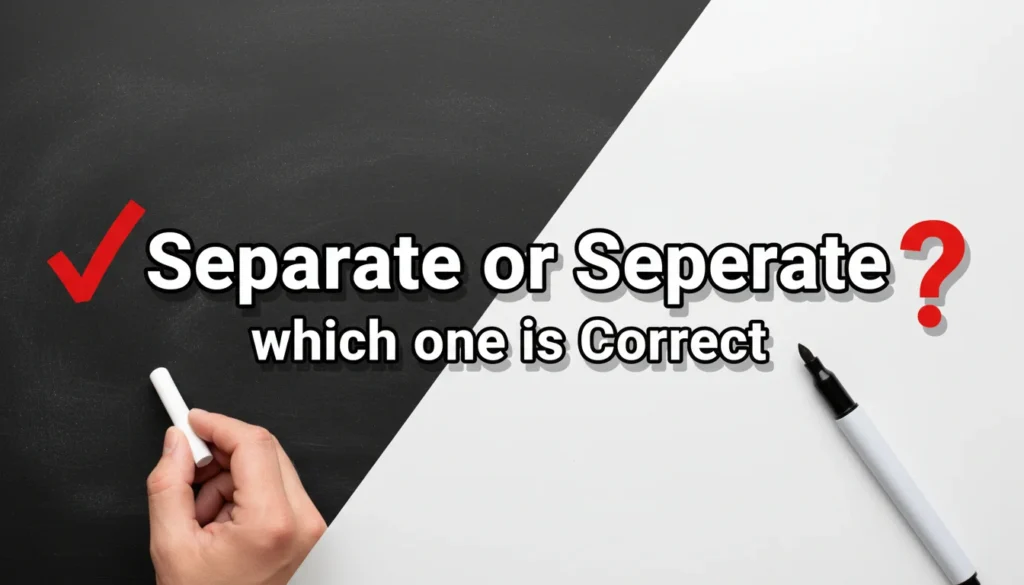
Separate or Seperate — which one is correct? The correct spelling is separate, not seperate, and knowing the right form helps you avoid a common writing error. Separate serves as a verb (to set apart) and as an adjective (distinct or not joined); watch related forms separating and separated for tense and agreement. When you edit, label the word’s part of speech so you choose the right form and verb ending, and read the sentence aloud to catch a wrong vowel sound. A quick memory trick: sep-a-rate contains an “a” sound in the middle (think “a rat”) to lock the correct pattern. Use the spoken test, a dictionary check, or the checklist below to fix the mistake fast and keep your writing clear and professional.
Contextual Examples
Definition and Quick Guide
Separate — correct spelling. Part of speech: verb (to set apart) and adjective (not joined, distinct). Root and pattern: Latin separatus, with -ate ending common in verbs and adjectives in English.
Seperate — incorrect spelling. Not listed in standard dictionaries as a correct variant. Avoid it.
Example 1 — Verb Use (Simple Present)
Sentence: They separate the recyclables from the trash.
Parts of speech and checks: They (pronoun, subject) separate (verb, present plural — correct for plural subject) the (article) recyclables (noun, plural) from (preposition) the (article) trash (noun).
Comment: Verb tense and subject–verb agreement are correct. Use separate as the action.
Example 2 — Verb Use (Simple Past)
Sentence: She separated the coins by year.
Parts of speech and checks: She (pronoun, subject) separated (verb, past tense) the (article) coins (noun, plural) by (preposition) year (noun).
Comment: Past tense separated follows regular -ed pattern. The root is separate.
Example 3 — Adjective Use (Attributive)
Sentence: Put the separate plates on the table.
Parts of speech and checks: Put (verb, imperative) the (article) separate (adjective, modifies plates) plates (noun, plural) on (preposition) the (article) table (noun).
Comment: As an adjective, separate means not joined or distinct.
Example 4 — Adjective Use (Predicative)
Sentence: Their rooms are separate.
Parts of speech and checks: Their (possessive pronoun, modifies rooms) rooms (noun, plural) are (verb, present plural — agrees with plural subject) separate (adjective, subject complement).
Comment: Subject–verb agreement is maintained.
Example 5 — Compound and Modifier Precision
Sentence: A separate envelope contains the invitation.
Parts of speech and checks: A (article) separate (adjective) envelope (noun) contains (verb, present singular — matches singular subject) the (article) invitation (noun).
Comment: Match verb number to noun. Keep modifier directly before its noun.
Example 6 — Wrong Spelling Example and Correction
Wrong: Please use a seperate folder for receipts.
Parts of speech and problem: Please (adverb, polite request) use (verb, imperative) a (article) seperate (adjective — misspelled) folder (noun) for (preposition) receipts (noun, plural).
Correction: Please use a separate folder for receipts.
Comment: The only change is seperate → separate. Pronunciation clues do not show the correct vowel order, so spelling must be learned.
Example 7 — Hyphenated/Derived Forms
Sentence: Set separate-minded goals if tasks differ.
Parts of speech and checks: Set (verb, imperative) separate-minded (compound adjective) goals (noun, plural) if (conjunction) tasks (noun) differ (verb, present plural).
Comment: Compound forms derive from the correct base separate.
Example 8 — Verb With Object and Preposition
Sentence: They separate fact from opinion during review.
Parts of speech and checks: They (pronoun) separate (verb) fact (noun, singular) from (preposition) opinion (noun).
Comment: Keep prepositions close to the object and confirm noun number as intended.
Common Mistakes
Mistake 1 — Spelling Mix-Up: Vowel Swap
Error: Writing seperate instead of separate.
Why it happens: Pronunciation and syllable stress can mislead writers. People often hear the unstressed vowel and swap e and a.
Fix: Memorize visual cues (see memory tips below) and run a quick spell check.
Mistake 2 — Wrong Verb Form or Agreement
Error: Using an incorrect verb form or wrong agreement after long modifiers.
Wrong: The list of tasks separate easily.
Problem: Subject is list (singular), not tasks.
Correct: The list of tasks separates easily. or The tasks separate easily.
Parts of speech: The (article) list (noun, singular) of (preposition) tasks (noun, plural) separates (verb, singular).
Mistake 3 — Confusing Adjective and Verb Roles
Error: Using adjective form where verb form is needed, or vice versa.
Wrong: We will keep them separateing the groups.
Problems: separateing is misspelled; correct gerund is separating. Also the structure is wrong.
Correct: We will keep them separate when sorting the groups. or We will separate the groups.
Check verb forms: base separate, present participle separating, past separated.
Mistake 4 — Double Determiners and Article Misplacement
Error: Adding unwarranted articles that produce awkward phrases.
Wrong: A separate the boxes were labeled.
Fix: The separate boxes were labeled. or A separate box was labeled.
Parts of speech: Remove extra article; check noun number.
Mistake 5 — Run-On and Fragment Problems
Error: Joining clauses without proper conjunctions or punctuation.
Wrong: Separate the colors put the reds here put the blues there. (run-on)
Fix: Separate the colors: put the reds here and the blues there. or Separate the colors. Put the reds here; put the blues there.
Parts of speech: Use conjunctions and punctuation to keep clauses clear; check verbs in each clause for tense and agreement.
American vs British English Differences
Core Spelling: Same Across Varieties
Both American and British English use separate as the correct spelling. Seperate is not recognized as standard in either variety.
Usage and Frequency
- American English: Uses separate in daily writing, textbooks, and legal texts. Verb and adjective forms mirror standard usage.
- British English: Uses separate in the same way. Phrase choices around separate may differ slightly by idiom (for example, British writers may use separate to in informal speech but standard preposition is from or from is more neutral). However, separate to is nonstandard in formal writing and better avoided.
Prepositional Collocations
Common collocations that are similar in both varieties: separate from, separate into, separate by, separate out. Choose the preposition that matches meaning: separate A from B (to divide), separate into parts (to split into pieces). Avoid regional-only preposition patterns in formal writing.
Formal vs Informal Tone
Both varieties prefer separate in formal texts. Informal speech may slip into constructions like separate out (phrasal verb), which is acceptable in conversation and many workplaces.
Idiomatic Expressions
Common Phrases With Separate
- Separate from — to be distinct: Keep raw meat separate from vegetables.
- Separate into — to divide: Separate the dough into six balls.
- Separate the wheat from the chaff — idiom meaning to distinguish valuable from worthless.
Parts of speech: Check verbs and prepositions: separate as verb, from/into as prepositions, objects as nouns.
Fixed Expressions Using Separate
- Separate but equal — historical/political phrase; adjective separate used predicatively.
- Separate account — adjective + noun phrase used in finance.
These collocations show separate as a standard modifier across contexts.
Wrong Idiom With Misspelling
Wrong: Keep them seperate but fair.
Fix: Keep them separate but fair.
Parts of speech: Keep (verb) them (pronoun) separate (adjective) but (conjunction) fair (adjective).
Phrasal Verbs and Variants
- Separate out — to sort or distinct: Separate out duplicates.
- Separate off — less common; means to remove a portion.
Use in speech and casual writing, but in formal prose prefer separate with clear prepositional phrase.
Practical Tips
Tip 1 — Memory Tricks for Correct Spelling
- A comes before R in the alphabet; think separAte has an a before the r that follows.
- Break the word: sep-a-rate — notice the a in the middle syllable.
- Visual mnemonic: Think of a rat inside sepARate — the letters a then r appear in that order. These tricks help recall separate instead of seperate.
Tip 2 — Use a Quick Search or Dictionary
If unsure, look up the word in a reliable dictionary or run a quick digital search. Most spell-checkers flag seperate as wrong.
Tip 3 — Check Verb Forms
Base: separate. Present participle: separating. Past: separated. Make sure to swap internal vowels correctly in derived forms.
Tip 4 — Read Aloud to Catch Agreement
Reading a sentence aloud often reveals agreement problems. If a sentence sounds off, check the subject and verb number.
Tip 5 — Keep Modifiers Close
Place separate directly before the noun it modifies or after a linking verb: separate rooms or rooms are separate. Avoid ambiguous placement.
Tip 6 — Prefer Plain Phrases in Manuals
In instructions or manuals for broad audiences, simple phrasing helps: keep items apart or put items in different boxes can replace separate when clarity is critical.
Tip 7 — Check Collocations
Use the right preposition: separate from, separate into, or separate by. Test each with a sample sentence to ensure it conveys the intended meaning.
Tip 8 — Avoid Run-Ons and Fix Fragments
When using separate in lists or multi-step instructions, separate the commands with punctuation and conjunctions: Separate the colors. Put reds in one pile; put blues in another. Each clause must have a clear verb.
Tip 9 — Use Spell-Checker but Verify
Spell-check flags will help but not always catch homophone mistakes or context. When a spell-check changes seperate to something else, verify manually.
Tip 10 — Teach the Rule With Examples
When editing others’ writing, show a wrong sentence and correct it, label parts of speech, and explain why the spelling matters. Example: Wrong: The group will seperate. Correct: The group will separate. Show verb tense and subject.
Revision Examples and Edits
Original: The files are seperate and needs fixing.
Problems: seperate misspelled; verb needs mismatches plural files.
Edited: The files are separate and need fixing.
Parts of speech: The (article) files (noun, plural) are (verb, plural) separate (adjective) and (conjunction) need (verb, plural) fixing (gerund).
Original: Please seperate the pages, tape them.
Problems: comma splice and misspelling.
Edited: Please separate the pages, and tape them. or Please separate the pages. Then tape them.
Fix moves: correct spelling and fix sentence join.
Original: Separateing items saves time.
Problems: misspelled present participle.
Edited: Separating items saves time.
Parts of speech: Separating (verb, gerund) items (noun) saves (verb, singular) time (noun).
Original: He was separate from them.
Problems: Grammatically fine but awkward passive voice. Could be clearer.
Edited: He was separated from them. if the meaning is that someone separated him (passive), or keep He kept himself separate from them. If the adjective meaning is intended, He stayed separate from them. Always pick the verb or adjective that matches intended meaning.
Conclusion
Separate is the correct spelling; seperate is a misspelling. Use separate as a verb (separate the items) and as an adjective (a separate room), and check forms like separating and separated for correct tense. Quick checklist: confirm the separate spelling, read aloud to hear the short “a” in the middle, verify subject–verb agreement, and keep modifiers next to the nouns they modify. Apply these checks and you will stop mixing up separate or seperate in your writing.
FAQs
- Q: Which spelling is correct: “separate” or “seperate”?
A: Separate is correct; seperate is a misspelling. - Q: Is “seperate” ever acceptable?
A: No; standard English does not accept seperate. Always use separate. - Q: How do I remember the right spelling?
A: Use a mnemonic: sepARate has a before r, or think sep-a-rate to see the a in the middle. - Q: What are the verb forms of separate?
A: Base: separate. Present participle: separating. Past: separated. - Q: Which prepositions pair with separate?
A: Common pairs: separate from, separate into, separate by, separate out. Choose the one that fits the meaning. - Q: How do I fix subject–verb agreement with long noun phrases?
A: Identify the head noun and match the verb to it. Example: The list of items separates easily. (head noun list) or The items separate easily. (head noun items). - Q: Is “separate to” correct?
A: Avoid separate to in formal writing; prefer separate from or separate into for clarity. - Q: Can “separate” be used in compound adjectives?
A: Yes — separate-minded or separate-step can appear, but prefer plain phrasing unless the compound aids clarity.